
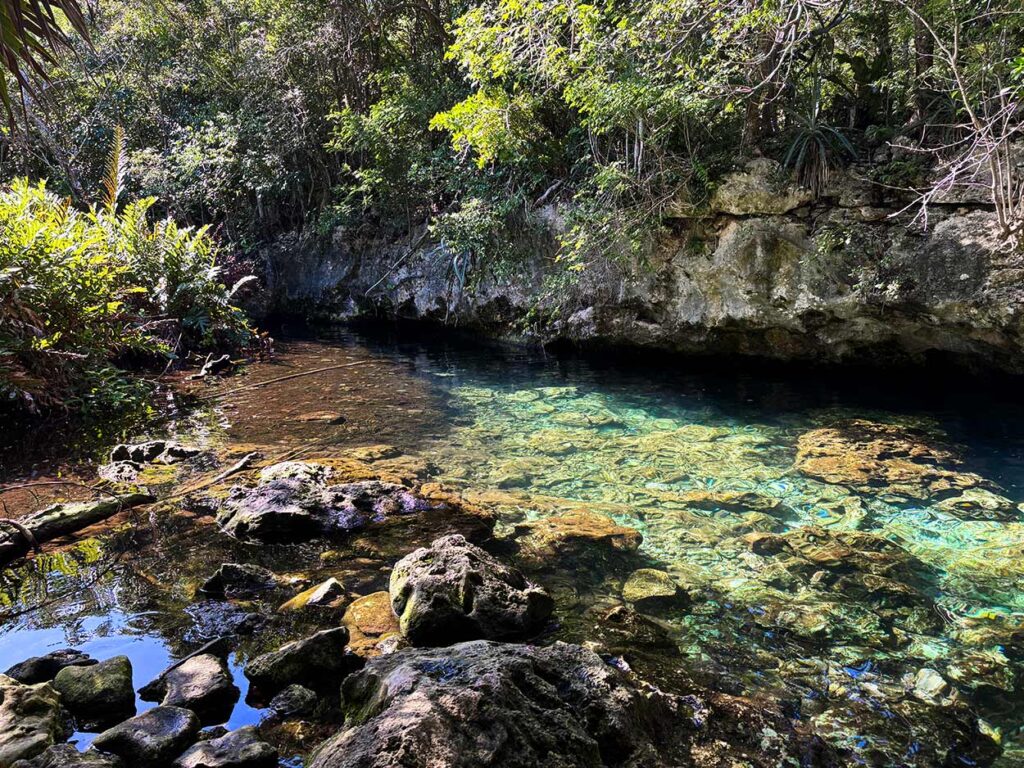
On my most recent trip to the Riviera Maya I knew that I wanted to visit a cenote. Cenotes are are naturally occuring limestone sinkholes that are filled with crystal-clear groundwater. Although there are some very famous and touristic cenotes, I wanted to visit some that were less well-known, and where I could be guided in a small group by a member of the local community. This is how I discovered Bejil-Ha, a locally-owned ecotourism agency that focuses on excursions to secret cenotes.
Bejil-Ha is located in Chemuyil, a village on the Riveria Maya that is between Akumal and Tulum. The ecotourism company launched in 2016 when a group of friends started a volunteer effort to protect their local cenotes from the dangers of pollution and overtourism. They expanded their work to include tours to smaller, lesser-known cenotes, and now have a large team of local young people who lead cenote tours in the jungle around their village.
If you’re looking for a locally-owned, environmentally-responsible, small group cenote tour on the Riviera Maya, keep reading to learn what you can expect on a day trip with Bejil-Ha.
Note: I did disclose that I was a blogger when booking this excursion, but I paid in full for my tour and this is an unbiased review. I don’t think anyone working on the day of my tour had been informed that I had a blog.

Arriving at Bejil-Ha in Chemuyil
Bejil-Ha is located in the village of Chemuyil on Mexico’s Riviera Maya. The village is a ten-minute drive from the town of Akumal, or a twenty-five minute drive from Tulum.
The company offered me a private transfer for $60 USD, but since I was traveling alone and staying by the Bahia Principe Grand Tequila Resort just six minutes away, I couldn’t justify the cost. Instead, I took a taxi to the tour (350 pesos, or $20 USD) and hopped on a colectivo minibus on the way back (30 pesos, or $1.75 USD).
If you do opt for a colectivo, you can find the stop on Google Maps. It’s called “Chemuyil Colectivo Stop” and it’s a five-minute walk (350 meters) from the Bejil-Ha offices.
Other travelers on my cenote tour arrived at the company office via scooter or private car. There was ample parking in front of their offices, and while I wouldn’t leave anything valuable in the car (they have lockers) I wouldn’t worry too much, as their staff are usually around throughout the day.
Bejil-Ha Cenote Tour: The Path of Water
I signed up for two tours with Bejil-Ha. The first tour was called The Path of Water, and it is their “signature” cenote tour experience. The tour departs from their office by bicycle, and visits three nearby cenotes. This tour typically departs in the morning, between 8:00 and 10:00 am.
⭐ Book With GetYourGuide | Book With Viator ⭐
Cenote Tour by Bike

I thought I’d share a bit about the bicycle part of the tour for anyone who isn’t a confident cyclist. I joke that I only ride a bicycle once per decade, and it had been many years since I last rode a bicycle. Even as a nervous (and frankly bad) cyclist I was able to do this tour, which was about half on paved streets and half on flat gravel paths. Each segment of the bike tour was between five and fifteen minutes, so you never had to cycle very far.
The bicycles at Bejil-Ha don’t use hand brakes, instead you pedal backwards to stop (like when you were a kid). I saw that helmets were available but nobody on my tour opted to wear one (I probably should have!). With two guides on the tour there was one at the front to lead the group and manage traffic, and another at the rear to make sure nobody got left behind.
First Stop: A Covered Cenote

The first stop on the Path of Water tour with Bejil-Ha was only about five minutes from their offices. This was a fully-covered cenote, completely encased by the cave overhead but with a few gaps in the rocks to let the sunlight in.
We started by swimming around the main cenote pool, using the provided snorkeling masks to look under the crystal-clear water. Then, we were invited to go further into the cave system, including swimming through a short underwater tunnel between rocks to reach a hidden cave area. In order to participate in this part of the excursion you had to prove that you could swim underwater for about ten seconds, by swimming below the log you can see in the center-left of my photo above.
A few people on my tour weren’t confident swimmers (they wore the optional life jackets) so they stayed in the main cenote area while the rest of us swam into the cave, passing through the narrow gap in the rocks one-by-one. This was a very cool experience, but if you’re claustrophobic I would suggest staying in the larger pool.
After about thirty minutes at the first cenote we hopped back on our bikes and continued down the road to the next stop.
Second Stop: A Semi-Covered Cenote

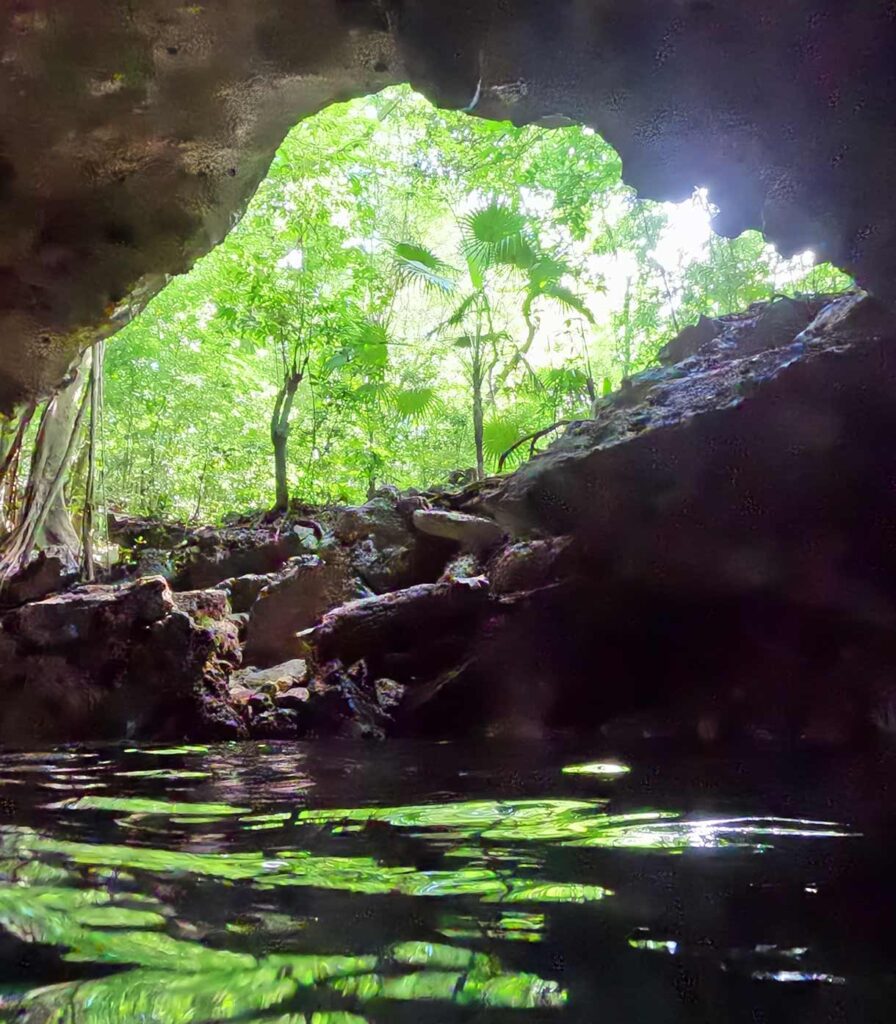
The second cenote was partially covered, with some open pool area and some water beneath the overhanging jungle rocks. This cenote felt like a scene from The Jungle Book, with lush green palm trees dancing above the turquoise waters and tropical birds singing overhead.
This cenote was unique because it was completely full of fish. You couldn’t turn your head without seeing hundreds of small fish swimming in the waters around you, and they would even occasionally stop for a nibble of your ankles if you didn’t keep moving in the water. If you’re a bit nervous about undersea creatures don’t worry – there weren’t any large fish (or crocodiles!) here.
A lot of time at this cenote was spent taking photos, with a Bejil-Ha photographer freediving underneath the rocks and taking pictures of the guests above, backlit by the sun. If you’ve always wanted a cool mermaid-style photograph then this would be the place to get one taken. While I didn’t order the optional photo package at the end of the tour, my recollection was that it was quite affordable.
We stayed here about forty minutes, as one of the families on our tour wanted to take a lot of photos. Then, we hopped back onto the bikes for the longest section of our cycle trip, which took us about one kilometer into the jungle to visit our final morning cenote.
Third Stop: An Open Cenote
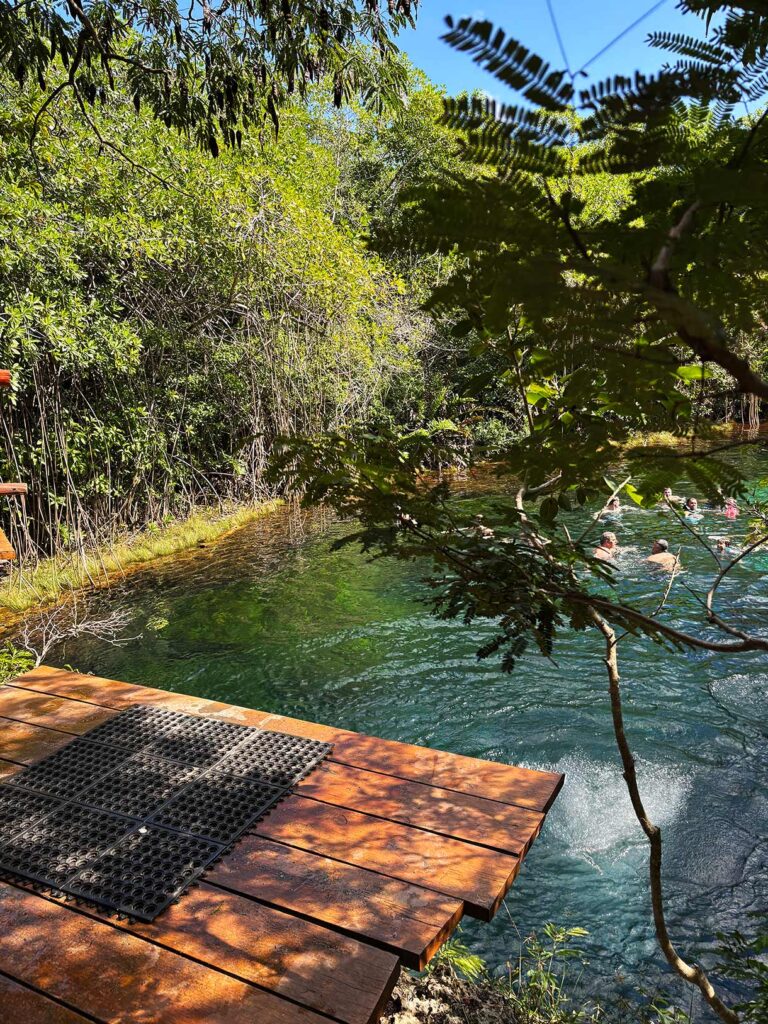
At the previous two cenotes, Bejil-Ha groups were the only visitors (in fact, our group of twelve usually had the cenote to ourselves). However, the last stop was at a large, open-air cenote that had some tourist infrastructure, so there were significantly more people besides our group at this last stop.
This cenote was fully open, with no cave infrastructure nearby. The big highlight here are the two wooden platforms (I’d estimate they’re about five meters above the water) that allow guests to jump into the clear waters below. While the atmosphere at the previous two cenotes was more tranquil and reflective, things here were a bit more fun.
We stayed at this cenote for about forty-five minutes, with most of us swimming around, diving underneath the water, and jumping off the platforms. One family spent most of their time posing for underwater photos with the Bejil-Ha photographer; I hope they don’t feel like they missed out on the fun!
It was early afternoon when we departed from this cenote and cycled back to the Bejil-Ha offices in Chemuyil. Many of us were also signed up for an afternoon tour (see below) so we had lunch together, chatted and got ready for our next adventure…
Book This Three-Cenote Tour Now!
Bejil-Ha Cave Tour: The Great Temple
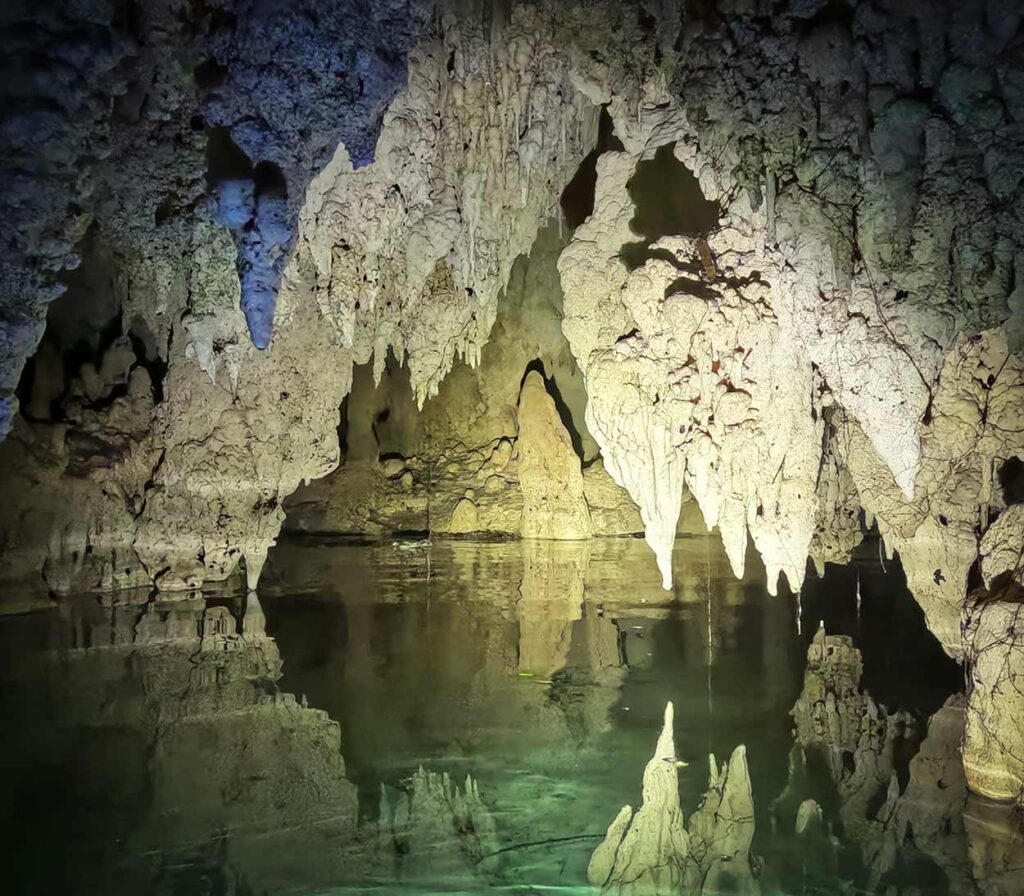
The next stop on my Bejil-Ha cenote tour was their “showstopper” cenote: Templo Mayor. Translating to “The Great Temple”, this is named after the great Aztec landmark in Tenōchtitlan and the great Mayan landmark in Chichen Itza. According to the local guides at Bejil-Ha, their Templo Mayor is just as special.
To begin this part of the tour we jumped into a Bejil-Ha van and began the drive deep into the jungle. We passed underneath the new Tren Maya tracks and kept driving along unpaved, unmarked roads for about thirty minutes.
We eventually reached the parking area for Templo Mayor, which is maintained and used exclusively by the team at Bejil-Ha (plus a few local cave divers). Our guide immediately lit some small campfires (organic mosquito deterrents), began organizing our materials and gave us some information about the history and importance of this cenote.
From the parking lot it was a two-minute walk into the jungle to the entrance to the cenote, which is accessed by a slippery, narrow, wooden spiral staircase. We carefully descended to an underground platform that had been constructed over the rocks to provide us with access into the waters of the cave.
Immediately, we were all wowed by the beautiful limestone stalactites hanging down from the ceiling overhead. They reflected off the surface of the water, creating an otherworldly symmetry. Armed with waterproof flashlights we slipped into the dark waters and begin exploring.
Our guide, Marvin, knew the cenote cave system like the back of his hand, giving us some free time to explore on our own and also guiding us into parts of the cave that we otherwise wouldn’t have been able to find our way back from. He explained the geology of the rock formations, the geography of the kilometers-long underground water system, and a bit about the biology of the fruit bats that flew overhead (I think we woke them up with our flashlights).
Overall, I think we spent about an hour in the Great Temple cenote, although it’s hard to keep track of time when you’re in a pitch-black, underground, underwater cave! As dusk began to settle outside we ascended to the surface, dried off and got back in the van for the drive back to Chemuyil.
Currently, Bejil-Ha is visiting Templo Mayor as part of a morning cenote tour that also includes a short jungle hike (some guests have even spotted monkeys during the walk!). You can book the six-hour excursion at the link below, or contact the company directly if you want to combine it into a full-day with the three-cenote tour by bicycle (like I did).
Village Lunch on a Bejil-Ha Tour
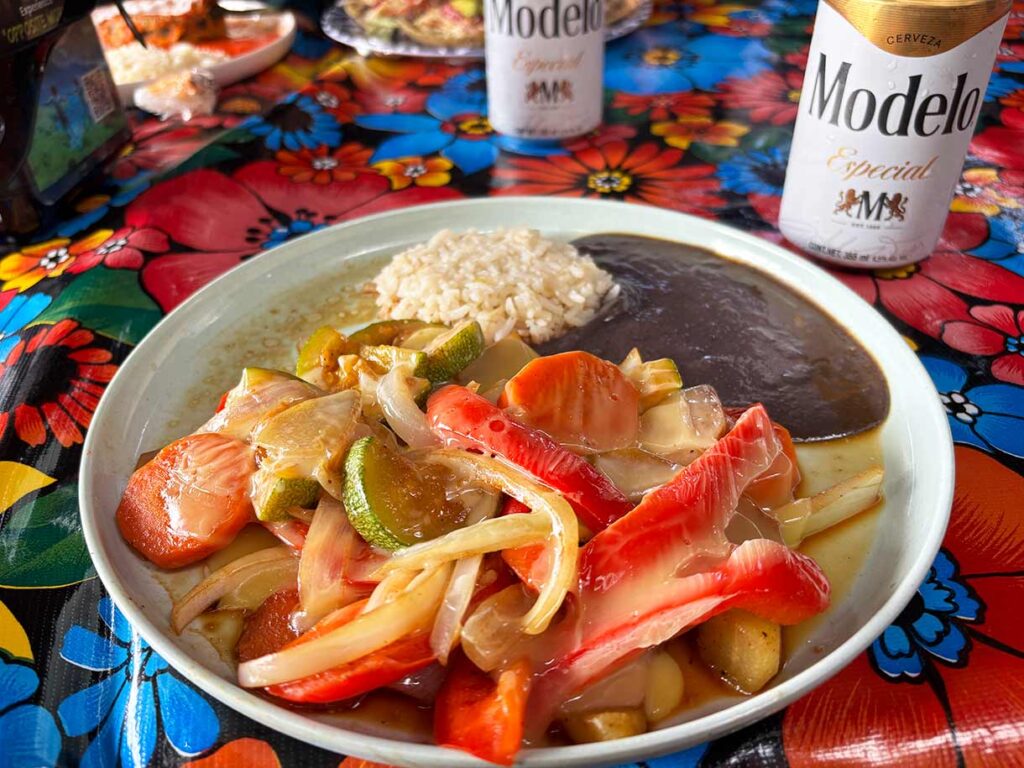
Because I was doing a morning and afternoon tour with Bejil-Ha I opted to have lunch with them. They work with local community members to prepare a variety of different typical Mexican lunch dishes, including some that are local to the Yucatan region. If you’re tired of resort food then talk to the Bejil-Ha staff about adding a lunch to your booking… you don’t regret it.
Other people on my tour had chiles rellenos (stuffed peppers), quesadillas and panuchos, and I had vegetarian fajitas with cheese (shown above, also served with tortillas). Drink options included beer, soda and agua de jamaica (hibicus water).
Cenote Tour Tips
Whether you take a cenote tour with Bejil-Ha or a different tour company, here are some things to keep in mind:
- I brought my iPhone with me for most of the day, but in the water (and in Templo Mayor) I exclusively used my GoPro. I recommend buying the package that includes the waterproof floating handle and two batteries, as it’s cheaper than buying them separately.
- You can’t wear any sunscreen, lotion or bug spray in the cenotes, as they pollute the water. Instead, protect your skin with a rashguard and a ball cap.
- Bejil-Ha has lockers in their office where you can leave your valuables during your tour. Some cenotes don’t allow any bags onto the grounds, and others don’t have flat, dry places to store your bag, so limit what you carry with you.
- The best shoes for this tour are slip-on water shoes. I wore mine from the first cenote until we returned from Templo Mayor.
- I wore my swimsuit and rash guard for the whole day (it dried quickly). Pack a towel and change of clothes for the return trip home, especially if you’re doing a full-day tour and will be returning in the cooler evening hours.
- There were outhouse-style toilets at our third cenote of the morning and at Templo Mayor. Bring your own tissues (but don’t flush anything – use the bins provided).
Other Cenote Tours
If you’re staying in a different part of the Riviera Maya, or Bejil-Ha’s tour schedules don’t work with your Mexico itinerary, these tours are also highly-rated (though I didn’t take them personally):
- Tulum: Cenote Trail Bike Tour – Starting from central Tulum (near the ADO bus station), you’ll travel about ten kilometers by bike to visit two or three cenotes.
- From Tulum: 3 Cenotes Adventure Tour with Lunch – This six-hour tour includes pick-up in Tulum and takes you by van to three cenotes. Lunch and snacks are included.
- Xcaret Xenote Experience – You don’t have to be staying at the expensive Xcaret resort to visit their famous cenotes. This family-friendly tour includes shared transportation from your Cancun or Riviera Maya hotel, followed by a full day of exploring four cenotes by kayak and/or snorkel. Breakfast and lunch are included.
- From Cancun: Tulum Ruins, Reef Snorkeling and Cenote Tour – This tour includes shared transportation from Cancun or the Rivera Maya to the ancient Tulum archeological site (where you’ll see ancient Mayan pyramids), a snorkeling trip by motorboat, a traditional Mexican lunch and finally a swimming stop at a nearby cenote. It’s a lot to pack into one day, but great for people with limited time on the Riviera Maya.
Of course, the advantage of doing a cenote tour with Bejil-Ha is that you are directly supporting a local community organization that works to protect and preserve their local ecosystem. If you consider yourself a sustainable and ethical traveler, you’ll feel good about choosing Bejil-Ha over a larger outfit.
I also have a guide to snorkeling with the turtles in Akumal Bay without joining a tour, as well as reviews of several Riviera Maya resorts like the Bahia Principe Grand Tequila and Akumal Bay Beach & Spa Resort.
Planning a trip to the Riveria Maya? Pin this post for later!
 |
 |