
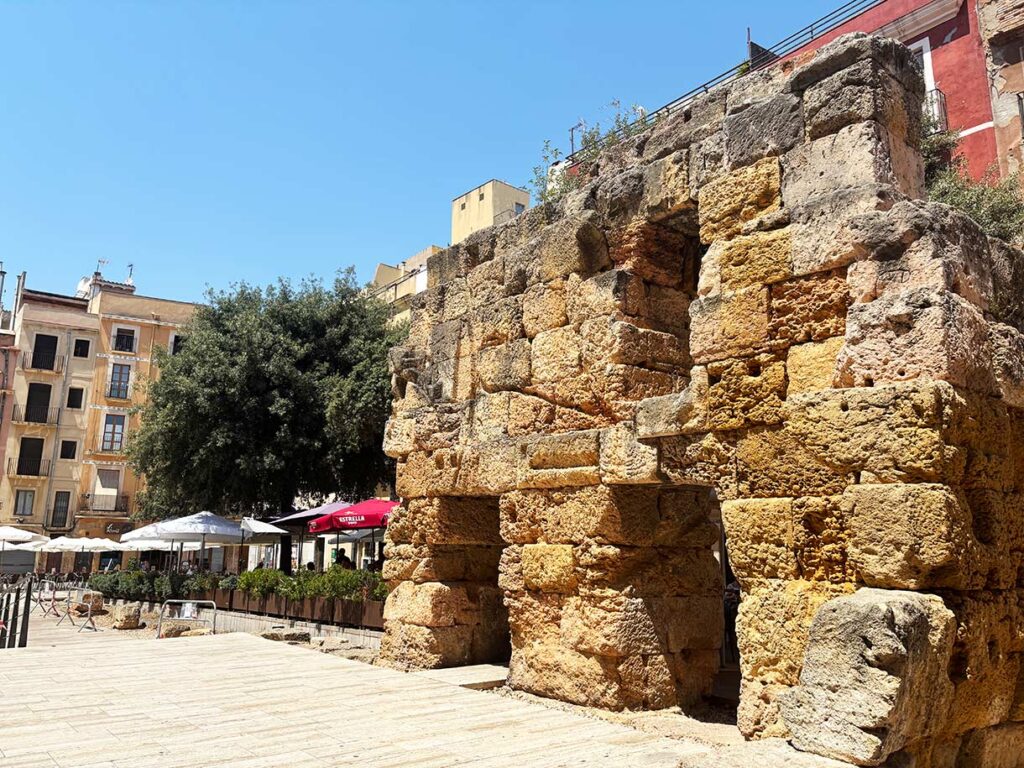
Looking to escape the hustle and bustle (and crowds) of Barcelona? Consider taking a day trip from Barcelona to Tarragona, a nearby coastal city with a compact historical center packed with ancient Roman ruins.
On my most recent trip to Barcelona I took a day trip to Tarragona, and it ended up being one of the highlights of my trip. Tarragona truly delivers on spectacular Roman ruins including aqueducts, towers and city walls, and is also home to a noteworthy cathedral and beautiful beaches.
In this Tarragona travel guide I’ll explain how to get to Tarragona from Barcelona by train, what to do in Tarragona in just one day, and where you might want to eat or stay if you’re thinking of extending your trip.

How to Get From Barcelona to Tarragona

Both high-speed and slower regional trains connect Barcelona and Tarragona. However, as the high-speed train station (Camp de Tarragona) is far from the city center and requires a coach or taxi connection to get to town, the regional commuter train is actually the best option for this route. Although it takes double the time (one hour and fifteen minutes total) it will actually get you to the city center faster.
For my own day trip, I caught the R15 commuter train at 8:26 am and arrived in Tarragona at 10:20 am. The ticket cost €8, and I purchased it from the automated vending machines at the Passeig de Gracia station. Note that daily, monthly and weekly transit passes for the city of Barcelona do not cover this route.
Understanding Tarragona
During the Roman Empire, Tarragona was known as Tarraco, and it was one of the largest and richest cities on the Iberian Peninsula. Emperors built great walls, towers, aqueducts and theatres for the many traders, merchants, artisans and statesmen who lived here. Today, the well-preserved Roman ruins have been designated as a UNESCO World Heritage Site, with the vast majority being open to the public and easily visited in just one day.
Aside from its Roman history, Tarragona is known for its coastal Catalan culture, with several small fishing neighborhoods, markets and shops selling local foods and Blue Flag beaches. Tarragona is even the birthplace of Catalonia’s castell tradition, where teams of local men compete to form the tallest human tower. The best time to see these traditions come to live is during the annual Santa Tecla Festival, which is typically held in September and warrants more than a one-day visit.
Things to Do in Tarragona
I’ve tried to limit my list of things to do in Tarragona to what is achievable in a single day from Barcelona. I’ve ordered them in the order that I did them (or would have done them, now having a better understanding of the city’s layout).
The Ferreres Aqueduct

For me, the Ferreres Aqueduct was absolutely the highlight of my trip to Tarragona. It was my first stop in the city, which I accessed by taking a bus from the end of the Rambla Nova to the turn-off for the aqueduct. From there, it was an easy ten-minute walk on well-signed trails to the aqueduct, which is also known as the Pont del Diablo (The Devil’s Bridge).
There’s no admission fee to visit the aqueduct, so you’re free to spend as much time as you want exploring the site. Following the red path will take you over the top of the aqueduct from one side the other, while following the blue path will take you right underneath the middle arch. You can easily do both just by walking up or down the hill on either side of the aqueduct.
To get back to Tarragona, you catch a bus at the same stop, in the same direction. It will take you to the nearby village of Sant Salvador before looping back towards Tarragona.
Tarragona Central Market

Back in the city center, stop by the Central Market of Tarragona. This bustling gathering point for the community features local vendors selling fruits, vegetables, meat, cheese, bread and other food items. It also has food stalls where locals love to stop for a quick bite to eat or something to drink.
Outside, take a look at the recently-renovated Modernist facade of the market building, which was designed by Josep Maria Pujol de Barbera, the city’s foremost architect. On the main facade, the Carillon Clock puts on a musical show each day at noon and 6:00 pm.
The Passeig Arqueologic


This is the perfect introduction to Tarragona’s Roman history. The Passeig Arqueologic is a semi-circular walking trail along Tarragona’s historic city walls, starting from the Portal del Roser. In their current iteration they were constructed in the 18th century to protect the city during the War of the Spanish Succession, but they were built by following and adding to the existing Roman walls which date back to the 2nd and 3rd century BCE, making them the oldest monuments in the city.
As you walk along the pathway you’ll pass by several historic defensive towers and bastions, see some views of the surrounding regions, and encounter quite a few cute cats!
You’ll want to buy a combined ticket at the entrance to the walkway, as it will also give you access to Casa Canals, Torre del Pretori, the Roman Circus and the Roman Aqueduct.
⭐ This guided day trip combines sightseeing at the Roman ruins in Tarragona with a walking tour of the nearby seaside side of Sitges. ⭐
Casa Canals

From the end of the Passeig Arqueologic you’re just two blocks away from Casa Canals, which is also included in your combined city ticket. This 19th-century mansion was built against some parts of the historic Roman city walls, which are still visible as you enter through the interior courtyard.
The Canals family was one of the richest families in this region of Spain, as is evidenced by the ornate interiors of their family home. You’ll be able to see the opulent ballroom, bedrooms and lounge that hosted the who’s-who of Catalonia, along with foreign dignitaries like King Charles VI who stayed here in 1802.
Casa Canals also hosts temporary exhibits, featuring works from visiting contemporary artists or displays about topics of local interest.
The Roman Circus

Included in your combined entrance ticket, the Roman Circus is where the citizens of Tarraco used to hold their horse-drawn chariot races. Only some parts are visible, as others are located under buildings that are currently in use as homes and businesses. However, in its heyday the track had space for 30,000 spectators who would come to watch the races.
The Roman Circus is connected to the Praeotorium Tower via the historic underground vault system, which was used as a dump during the Middle Ages and a military barracks during the 18th century. You’re free to wander through the many underground rooms here, some which have information and displays inside, others which are empty.
This guided tour of Tarragona includes a visit to the Roman Circus and several other historical sites, along with an expert guide.
Torre del Pretori

After walking through the vaults of the Roman Circus you’ll reach the underground portion of the Torre del Pretori. At the time of its construction in the Roman era this was a public building that served as the law courts and council chambers, then in the Middle Ages it was converted into a royal palace.
Today, the lower level of the tower features Roman antiquities on display. If the guard on duty is nice they’ll let you ascend the tower by elevator, but generally speaking they do expect visitors without mobility limitations to then ascend the stairs to the terrace on the top level (shown above) for panoramic views of both the city and the sea.
The Roman Ampitheatre

When you exit the Torre del Pretori you’ll be back in the historic center in Placa del Rei. From here, you have to walk back around the circus and tower to then reach the Roman Ampitheatre, which is the last stop included in your combined city ticket.
There’s an elevator that can take you from street level down towards the entrance to the ampitheatre, which sits between the historic old town and the Mediterranean Sea. It’s crazy to think that this site could fit about 15,000 people, whereas the Circus held double that number of spectators. Locals gathered here to watch events including athletics, gladiator fights and even executions.
On the day of my visit in July 2026 I would estimate that only about half the site was open, as there were clearly signs meant to be read by visitors that were 20+ meters away from any of the places where walking was permitted. The best views of the ampitheatre are actually from the Torre del Pretori and the streets above the ampitheatre, so if you don’t have time to go inside the site it’s not the end of the world.
The Cathedral of Tarragona

During the Roman era, the highest spot in the city of Tarraco held the Temple of Augustus. By the 12th century, construction had begun on this massive Catholic church, built in a blend of Gothic and Romanesque styles.
Admission to the cathedral is €12.50 for adults, with discounts for children, and it is not included in the combined city pass I’ve mentioned previously. A free audioguide is available but you will need to bring your own headphones. It will explain the archeological significance of the site, the interior and exterior architecture of the cathedral and the pretty cloister, which is the largest of its kind in Catalonia.
Rambla Nova

I know I mentioned Rambla Nova earlier, as it’s where you catch the bus to the Ferreres Aqueduct. However, I also wanted to point out this monument that you might notice on the pedestrian walkway in the middle of the road. It features a group of men making a castell, or human pyramid.
In Catalonia, castells started in Valls, a town just outside Tarragona, in the early 1700s. The tradition continues today, and at the city’s major festivals and special events you will find teams competing to form the highest human pyramids. Upcoming events and competitions for all the teams in Catalonia are usually listed on this website.
Beaches of Tarragona

Although I didn’t have time to relax on the beach during my visit to Tarragona, I noticed that it was a popular beach destination for travelers from all over the Costa Dorada. Many people got on the train with their beach gear in Barcelona, and got off when the train finally reached Tarragona.
The main stretch of beach right in Tarragona runs from just past the Roman ampitheatre in the north to El Serrallo in the south. From what I could see, the nicest part of this beach was north, towards Punta Grossa.
If you venture a bit outside the immediate center there are also smaller, less busy beaches like Platja Arrabassada and Platja Savinosa. Regional trains and buses will also get you to the smaller seaside towns that dot the entire coastline.
Balcony of the Mediterranean

Having recently visited the “Balcony of Europe” in Dresden, Germany, I was curious about the Balcony of the Mediterranean. From this panoramic walking path you can see the sea, the port, parts of the historic city center and the Roman ampitheatre, and it’s said that if you touch the iron railing you will have good luck.
When I visited Tarragona there was a casual summer festival set up here, with a number of food trucks, craft vendors and live music just kicking into gear around 5:00 pm.
Modern Art Museum
Tarragona has a modern art museum, located roughly between Casa Canals and the Roman Circus. Admission to the museum is free, and inside you’ll find a permanent collection that includes the famous Tarragona Tapestry by Joan Miro, as well as other works from the modern era. I honestly just got so engrossed in all the Roman ruins that I forgot to visit this museum, and now I’m kicking myself as that Miro tapestry is something I would happily pay to see!
El Serrallo
Unfortunately I ran out of time and didn’t make it to El Serrallo, a former fishing village that is now a waterfront neighborhood in Tarragona. Similar to Barceloneta in Barcelona, El Serrallo still has colorful fishermen’s homes, seafood restaurants and a waterfront walking path. It’s a short walk west of the train station, along the shore, and definitely worth visiting if you have an extra hour.
Hotels in Tarragona

When I was planning my day trip to Tarragona I opened Google Maps and discovered I already had several Tarragona hotels saved on my map. At first I was confused, but then I remembered that I had planned a trip to Spain in 2020 that I’d had to cancel (for obvious reasons) and I’d been planning to stay a few nights in Tarragona on that trip. Although my trip this year was only for one day, I thought I’d share the central hotels I had vetted previously:
- H10 Imperial Tarraco – This Tarragona hotel is a landmark, situated on the waterfront and overlooking both the Mediterranean Sea and the Roman ampitheatre.
- B&B Hotel Tarragona Centro Urbis – I was booked into this hotel, which is part of the popular, affordable B&B chain. I stayed at one of their properties in Madrid and was very impressed, which is why I’d booked here too.
- Hotel Lauria – This hotel has a super-convenient location at the waterfront end of the Rambla Nova, an easy walk (especially with luggage) from the train station, the beach and the Roman ampitheatre.
- Hostal 977 – Just down the street from the Cathedral, this hotel has some of the best reviews in Tarragona for its hospitality and comfort.
Restaurants in Tarragona

Again, on this trip I only stayed in the city for a day. I had lunch at the city’s only vegan and vegetarian restaurant, El Vergel, where I had a lovely set menu with seasonal, local ingredients and excellent service. Later, I stopped for a drink on the terrace of a bar called Korxo del Forum, on a plaza that overlooks the ruins of the old forum walls.
If you’re not a vegetarian, you can look for restaurants serving local dishes like cassola de romesco (casserole cooked in romesco sauce), paella, arroz negre (black rice, made with squid ink) and other dishes with fresh local seafood. If you happen to visiting the city from January to April, look for calcots, sweet spring onions, in various interpretations.
Looking for more Barcelona travel tips? Read these related articles before you go!
🏰 How to Take a Day Trip from Barcelona to Girona
📍 How to Spend One Day in Barcelona (A Complete Itinerary)
⭐ The Best Things to Do in Barcelona (Only My Favorites!)
🥗 20+ Great Vegetarian Restaurants in Barcelona, Spain
💕 The Best Neighborhoods to Stay in Barcelona
🖼️ 10 Things to Do in Figueres, Spain
Planning a trip to Spain? Pin this post for later!
 |
 |