

I spent two months traveling across India as a solo female traveler. One of my favorite cities in India was Jaipur, the famous “Pink City” in the heart of Rajasthan. Here, I found the perfect mosaic of the things that attracted me to India: opulent palaces, spectacular temples, interactions with wildlife, delicious regional cuisine and opportunities to shop at authentic local boutiques. I stayed in Jaipur for almost a week, and now I’ve narrowed down the best things to do in Jaipur into an easy-to-follow three-day Jaipur itinerary.
If you follow my three-day Jaipur itinerary you’ll have a truly balanced experience in Jaipur and you’ll leave feeling as though you had authentic local experiences on top of visiting the famous touristic highlights. Make sure to read through to the end of this Jaipur itinerary, as I’ll also highlight the Jaipur hotels that I recommend (at every price point) and some possibilities for longer visits.

Day 1 in Jaipur – Inside the Pink City
Jaipur is known as The Pink City, after local residents painted the town pink (literally) to celebrate the visit of Queen Victoria’s son (later to become King Edward VII) in 1876. On your first day in Jaipur you’ll explore the rosy city center, and as the sun begins to set you’ll venture further afield to an attraction of another color.
Jaipur City Palace


In the very center of Jaipur you’ll find the gem of Jaipur: the City Palace. You can arrive via the Badi Chaupar metro stations, or take a rickshaw straight to the visitor entrance (located on the east side of the complex).
Prior to independence from Britain, India had more than 500 royal families who governed their family’s traditional territories in collaboration with the colonizing forces. As Britain withdrew from India these princely states were merged to form India as we know it. Although India’s royal families no longer have any significant political powers, they still retain ownership of the family’s great riches. In fact, the seven-floor Chandra Mahal building in the City Palace is still the private residence of these royal descendants, and a flag flying overhead indicates they are in residence at the time of your visit.
Your ticket will give you access to most of the beautiful outdoor courtyards. In Pitam Niwas Chowk you’ll find four spectacular gates that signify the four seasons; my favorite was the Peacock Gate, shown above. Can you guess which season would be symbolized by a peacock?
As well, you’ll be able to visit a number of different indoor spaces, including the Mubarak Mahal, or Welcome Palace, a city history museum on the ground floor of the Chandra Mahal, an armoury and the Diwan-e-Aam where Jaipur’s maharajah would meet with members of the public.
If the upper levels of the Chandra Mahal are open during your visit (this will depend on if the royals are at home or not) then it’s worth buying the add-on ticket to see the interior of their royal residences. In particular, the Sukh Niwas, or Blue Room, is uniquely beautiful.
Jantar Mantar (Giant Sundials)

Beside the City Palace you’ll find a unique UNESCO World Heritage Site called Jantar Mantar. Here, Sawai Jai Singh, the king who founded Jaipur, constructed nineteen gigantic instruments to tell time and track astronomical activity. Now almost three hundred years old, these monuments will certainly capture your imagination.
The biggest draw at Jantar Mantar in Jaipur is shown above: the Vrihat Samrat Yantra. Believed to be the world’s largest sundial, it stands 88 feet high and is said to calculate time accurately to within two seconds.
Personally, I didn’t understand how the different instruments worked. There wasn’t much English signage and the crowds made it hard to see some parts of the instruments up close. However, I think there’s definitely something interesting to be learned here, so I would recommend you pay for a guide to explain what you’re seeing. Just make sure to tell them that you need to be in and out in about an hour, as something tells me that a guide who is this passionate about astronomy and mathematics would likely want to speak at length. 😉
Wind Palace
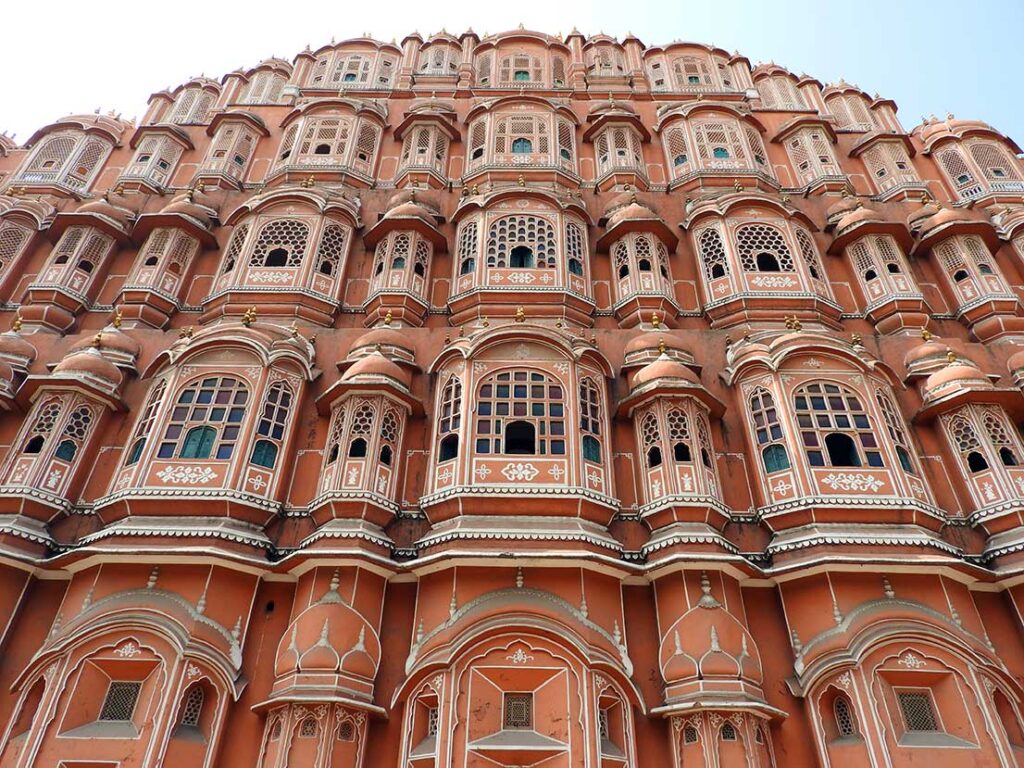
The building that adored a million postcards is the Hawa Mahal, or Wind Palace, in Jaipur. Just across the street from the City Palace and Jantar Mantar, the Hawa Mahal is a must-see landmark on your first day in Jaipur.
The famous pink facade here is little more than a facade – from the side of the building you can see that it lacks any depth. Instead, these 953 honeycomb-inspired windows were placed here, on the back side of the palace building, to allow royal women to watch city life go by without being seen by commoners (especially common men!). A cool breeze passes through the windows, creating a refreshing indoor temperature and giving the palace its name.
The real star of the show here is the back, street-facing facade, but it’s also possible to go inside the palace. You’ll have to weave your way down some narrow alleys to reach the front entrance, and once you’re inside you’ll discover a little secret: rather than stairs, the floors of this building are connected by a series of ramps.
To take an iconic photo of the Wind Palace, you can go for lunch (or just a drink) at one of the restaurants across the street, like Tattoo Cafe & Lounge or Wind View Restaurant. The food is relatively expensive (compared to other casual Indian restaurants) and nothing to write home about, but the views are epic. Both restaurants accept reservations if you want to guarantee a table.
Birla Mandir (Jaipur’s White Temple)

To end your first day in Jaipur, hop in an auto-rickshaw and travel south of the city center to the Birla Mandir. The Birlas are an important family of Indian industrialists, and they have constructed ornate Hindu temples in their own name across India. While some of their temples were constructed by earlier generations of the family and date back nearly 100 years, the Birla Temple in Jaipur was built more recently, in 1988.
Jaipur’s Birla Mandir is famous for its extraordinary white facade, constructed entirely from marble. Bring a plastic bag with you, as you’ll need to take off your shoes and walk barefoot across the marble terrace and inside the temple interior. Photography is allowed outside, but not inside, where you’ll find cavernous marble rooms with walls engraved with Hindu art.
While you’re at Birla Mandir you may notice a surprisingly European-looking castle on the hill behind you. That is Moti Doongri Fort, designed to mimic a Scottish castle. Owned privately by the Jaipur royal family, it is open to the public once a year on Maha Shivaratri, a holy day that typically falls in February or March.
⭐ Private Tour Option ⭐
Navigating Jaipur can be a bit stressful. If you’re not confident about finding your way around in crowds or negotiating fares with an auto-rickshaw driver on your first day, this Jaipur Instagram Tour visits most of the sites noted above, has great reviews and is reasonably priced.
Day 2 in Jaipur – Amber Palace Excursion
On Day 2 of your Jaipur itinerary you will travel north of the city center to Amber, also known as Amer, which used to be a separate city but is now part of Jaipur. Here, you’ll find a hilltop UNESCO World Heritage Site Fortress that is home to an elephantine palace (more on that later!). Wear study walking shoes today as you’ll be going up some hills and along some trails.
Amer is only about fifteen kilometers north of Jaipur, but getting there and back can be confusing and some drivers will rip you off (a lot). My recommendation is that you work with your hotel concierge to organize your transportation, either by private driver or auto-rickshaw. They should be able to negotiate a fair price for your trip there and back, including photo stops along the way. It’s easy to get to Amber by Uber or Ola, but it’s harder to find a driver to bring you back.
The Amber Palace


The names Amber Fort and Amber Palace are used interchangeably (sometimes it’s even called the Amber Fort Palace or the Amber Palace Fort) so I will use both throughout this guide.
It’s hard to describe the scale of the Amber Fort – the grounds cover almost 1.5 square miles and nearly all of that space is open to the public. You’ll enter the grounds through the Sun Gate and the ticket office will be across the main courtyard, straight head.
Ticket in hand can you can now begin exploring the different sections of the palace. Before you go up the stairs, pass through the gilt doors that lead into the Siladevi Temple. Then, head to the second courtyard, home to the Diwan-i-Am, a hallway designed for public audience. The third courtyard welcomes visitors into the maharaja’s apartments, and the fourth hides the ladies’ quarters.
The real highlight here is getting lost in the winding walkways that connect all of the different parts of the palace complex. Walking up, down, left and right you can easily find yourself alone in an open courtyard or windowed apartment room, looking out over the hill beyond the fortress.
Although I recommend visiting the Amber Fort early in the morning to beat the crowds, if you do come later in the day you could consider staying for the evening light and sound show. Chairs are set up in the Kesar Kyari Garden (at the bottom of the hill, by the lake) and two nightly shows (one in English, one in Hindi) narrate the history of the Rajput royalty and their dynasty. The technology is not the most current, but if you just want to rest your feet and sit outside in the cooler evening air, consider staying.
🐘 Elephant Riding at Amer Fort 🐘
As you can see from the photo, the Amber Palace is located at the top of a hill. At the bottom of the hill, some mahouts, or elephant trainers, offer visitors rides up on the backs of elephants. Please do not participate in this animal cruelty.
The elephants who ferry visitors up and down the hill at the Amber Palace are not treated humanely, and it’s easy to find video footage of the elephants being beaten and jabbed with metal hooks. In early 2024 an exhausted elephant attacked a tourist who was simply walking past, seemingly acting out of desperation to escape the abuse she experienced daily.
The walk from the road up to the palace should only take five to ten minutes. 99% of visitors can easily do the walk unassisted, while the remaining 1% are encouraged to ascend by Jeep, which is an affordable, humane option.
Jaigarh Fortress

Another advantage of coming to the Amber Palace early in the day is that allows you enough time to also visit the nearby Jaigarh Fortress, which you can see in the distance of this photo. Unfortunately I arrived too late in the day to visit, which is one of my biggest regrets about my own Jaipur itinerary!
Jaigarh Fort is located about 400 meters above Amber Fort, in the Aravalli Hills. It was built in 1726 to protect the Amber Fort, and offers unparalleled views of the fortress and the surrounding lakes.
The real highlight of visiting Jaigarh Fort is the journey to reach it. Before you exit the Amber Palace, look for a dark, narrow tunnel (ask security if you can’t find it). From here, you’ll descend the old stairs to the subterranean walking path (complete with bats flapping around overhead) and walk for just over 300 meters until the path emerges above ground. From that point, it’s about another kilometer along the fortified stone pathway to Jaigarh Fort.
Once you reach Jaigarh Fort you’ll need to buy a separate ticket to go inside. There, you’ll find a pretty garden courtyard, a small museum and the largest cannon in Asia.
The ideal way to return to Jaipur from here is to have the same driver who dropped you off at Amber Fort meet you at the exit to Jaigarh Fort, after your walk and visit are complete. This is a common tourist route and your driver should be amenable to it, as long as you organize it in advance.
Jal Mahal Water Palace

Surely India’s most haunting building, the Jal Mahal, or Water Palace, is a popular photo stop on your way to or from Amber Fortress.
This five-story building (yes, five stories!) is situated in the middle of the artificialMan Sagar Lake, on the road from Jaipur to Amber. The history of the building is confused, although what is sure is that this royal palace was never intended to be a full-time residence, nor was it ever intended to be almost fully submerged underwater. However, as the water needs of the community grew, the construction of a nearby dam caused the water level to rise and flood the lower four floors of the building, rending it unusable.
It’s not possible to go inside the Jal Mahal, and recently even boat tours around the palace have been prohibited. Instead, you can stop along the shore for a few photos and some time to reflect on how India has changed in the years since the palace was built.
(If you are looking for India’s famous floating palace hotel, that’s the Taj Lake Palace Hotel in Udaipur. It’s definitely a splurge, but it’s also a once-in-a-lifetime experience. The hotel is only open to overnight guests.)
⭐ Private Tour Option ⭐
Your accommodation can book you a driver for the day, or you can also pre-arrange a private tour. This Full-Day Sightseeing Tour of Jaipur can be adjusted to replace the city center activities you did on Day 1 with time to do the hike to Jaigarh Fort.
Day 3 in Jaipur – Monkeys & Markets
You probably saw some monkeys when you visited the Amber Fort (in fact, you might have even seen some around central Jaipur!) but Day 3 of my Jaipur itinerary is going to start with some next-level monkey sightings, before you wrap up your visit to the city by shopping for souvenirs at the busy local markets.
Galta Ji (The Monkey Temple)


Full Disclosure: The photo of the temple shown above is a stock photo because I wasn’t able to finish this activity! Read on to see why, and how you can avoid making the same mistake.
Galta Ji is an important Hindu pilgrimage site, consisting of several temples carved into the sides of hills that surround sacred pools filled from natural springs. To reach Galta Ji you can walk uphill from the edge of the city center for about 30 minutes (assuming all goes well…) or you can pay a driver to drive you ten kilometers through the hills to the entrance on the opposite side.
What I didn’t mention above is that the sacred pools of Galta Ji serve as a water source for nearly 5,000 macaque monkeys. I love monkeys, and by the time I visited Jaipur I had already encountered wild monkeys in the jungles of Singapore, visited the Ubud Monkey Forest in Bali, and had a run-in with a monkey in the kitchen of my guesthouse in Bharatpur. However, I was completely unprepared for the aggressive behavior of the monkeys at Galta Ji.
I obviously didn’t carry any food with me on the walk to Galta Ji, and I kept my water bottle inside my double-zipped purse, but I still had monkeys grabbing at me and my bag. I could also see mother monkeys behaving territorially as I passed them on some narrow parts of the trail, and was subject to non-stop hissing and teeth-baring. As a solo traveler, as I got further away from the crowds of the city center I realized that it was literally just me with thousands of monkeys, and the situation felt unsafe. So, I turned around and returned to the entrance, which remains a major regret to this day.
Fortunately, I am here to tell you how to avoid the same fate! Obviously, going by car to the hillside entrance is an easy workaround. Alternately, if you want to go up on foot, you can hire a local guide who will escort you to the temple and back. There are lots of guides waiting at the entrance, and I think it’s 100% worth it (especially if you’re a solo female) to be accompanied by someone who is more familiar with monkey behavior and who, to be frank, will come to your defense if necessary.
Golcha Cinema

From the exit to Galta Ji, you’ll now return to the center of the Pink City to end your visit to Jaipur with a little bit (or a lot!) of shopping. An easy landmark to get dropped off or picked up at the Golcha Cinema, a 1950s Art Nouveau-inspired building on the edge of the bazaar district. You could also stop by to watch a Bollywood movie – you don’t need to understand Hindi to have fun watching the melodramatic local flicks. Instead of popcorn, it’s customary to eat one of the theatre’s famous samosas during the show.
About 50 meters up the road you’ll find Sahu Chai, one of Jaipur’s oldest and most famous chai restaurants. If you’ve been reluctant to try street foods and drinks in Jaipur, this third-generation chai shop is clean, safe and reputable.
Bapu Bazaar and Beyond (Shopping in Jaipur)

Jaipur is known for being one of the best cities for shopping in India (many say it’s second only to Delhi). As with most cities in India, different areas and different streets are known for specializing in different products. However, for the best overall variety of high-quality goods, you’ll want to focus your shopping in the Bapu Bazaar and a few nearby streets.
Clothing, Textiles & Souvenirs


Bapu Bazaar can be overwhelming, but if you allow yourself to swept into the crowds and and to follow your eyes, ears and nose, there is so much to explore in Jaipur’s best shopping district.
As you can see, leather goods are one of the most popular items to buy in Jaipur. Made by hand and ornately decorated with embroidery, rhinestones and tassels, these bags and shoes are a great souvenir of your trip to the city.
You’ll also notice there are many jewelry shops in the Bapu Bazaar area. Some sell inexpensive bangles and costume jewelry (shop carefully to avoid buying plastic trinkets made in China) while others use expensive gold and real gemstones. For high-quality jewelry you should cross from the Bapu Bazaar over to the Johari Bazaar (just to the east) where you can see the gem-cutters and jewelers at work.
This is also a hotspot for buying traditional Indian clothing and textiles. As you can see from the top photo the organization of the stores can seem quite hectic, but if you know what you’re looking for you’ll be amazed by how quickly the shop owners can find it amongst their piles of fabrics!
🛍️ If Jaipur is your only shopping stop in India and there’s something you really want to bring home, it might be worth hiring a local shopping guide to efficiently take you to only high-quality shops with fair prices. 🛍️
Spices, Street Food, Fruits and Vegetables

To end your visit to Jaipur, I highly recommend a street food tour that will showcase the best street food vendors in Jaipur’s markets. I did a tour like this on my last night in Jaipur, and it was so interesting to learn about the different raw ingredients (I remember one vendor who insisted I try a buffalo-shaped raw water chestnut and wouldn’t take no for an answer) and prepared foods (I also remember another vendor laughing uproariously as I struggled with the heat of a snack he insisted wasn’t spicy!).
One of the big advantages of taking a street food tour is that your guide will take you to the vendors who use the freshest ingredients and have the best hygiene, so there’s little risk of any tummy problems after (although I was in India for two months and ate lots of fruits, veggies, salads and juices, and never once got sick). Some tours worth checking out include:
- Heritage Walk & Street Food Tasting – I recommend choosing the late afternoon or early evening tour run by this group, where you’ll sample all sorts of sweet and savory dishes while also learning about the local arts and culture of Jaipur.
- History Street Food Tour with a Local Guide – Again, I’d recommend the evening tour run by these guides, where you’ll learn how typical Rajasthani dishes are prepared and discover more about local life in the city.
In my experience, the street food tour showcased places that I wanted to return to later that night for more shopping. Bring your phone with you and drop a pin each time you’re somewhere that piques your interest.
Where to Stay in Jaipur

It will be easier to follow this Jaipur itinerary if you’re staying in a hotel in the center of Jaipur that is used to assisting foreign tourists. Proximity to the main attractions means that you won’t waste time stuck in traffic, and familiarity with the needs of first-time visitors to Jaipur means that hotel staff can help you get around the city, find good restaurants and stay safe during your visit.
I am happy to recommend the hotel I stayed at in Jaipur, called Hotel Arya Niwas. The hotel was founded in a traditional haveli, or townhouse, that dates back 150 years, and has since expanded into one of the adjacent modern buildings as well. Rooms are very clean and comfortable, and the on-site restaurant serves delicious meals that you can enjoy in the tranquil garden (or inside, of course!). The concierge here doesn’t take a commission from taxi and auto-rickshaw drivers, so you can trust you’re getting a reliable driver at a fair price.
If you’re backpacking, I can also recommend Madpackers Jaipur. I didn’t stay at this location, but I frequently stayed at other Madpackers Hostels in India, and they are great for solo travelers on a budget. In Jaipur, their hostel is across from the City Palace. They have a beautiful rooftop terrace where you can meet other people, and organize lots of different tours and activities.
I don’t have any experience with luxury hotels in Jaipur (honestly, Hotel Arya Niwas felt luxurious enough for me!) but if you’re up for a splurge, the five-star Rambagh Palace is part of the famous Taj Hotels group and it’s literally the former home of the Maharaja of Jaipur. 🤩
🗺️ Beyond Jaipur
If you have more than three days, I would recommend broadening your Jaipur itinerary to include some other destinations around Rajasthan.
Of course, the Taj Mahal is an obvious choice for a day trip from Jaipur. If you don’t want to spend the night in Agra, you have a couple of different options departing from Jaipur:
- Taj Mahal and Agra Tour – This full-day excursion departs Jaipur early so that you arrive at the Taj Mahal in the morning. After visiting the UNESCO World Heritage Site you’ll explore the nearby Agra Fort, and have the option to visit some other nearby attractions if desired. You’ll return to Jaipur that evening.
- Sunrise Taj Mahal Tour & Transfer to Delhi – The most magical time to see the Taj Mahal is at sunrise, and this full-day excursion makes that possible. You’ll depart Jaipur early in order to reach Agra for sunrise. After spending the morning in the Taj Mahal and checking out the Agra Fort your driver will continue onwards to Delhi, where you can catch an outbound flight or explore the Indian capital. I love this option for people who want to use their time efficiently.
Another place worth visiting in Rajasthan is Bharatpur, where you’ll find the Bharatpur Bird Sanctuary in Keoladeo National Park. During the winter months hundreds of different species of birds migrate through this region, and an affordable guided tour by bicycle rickshaw will help you get up close and person with those exotic birds and other animals that reside in the protected natural area.
Before you go to India, I recommend reading my India Travel Questions and Answers. I wrote down all of my own questions before I traveled solo to India, and then I answered them at the end of my trip!
Planning a trip to India? Pin this post for later!
 |
 |