

One of the highlights of my one-month trip across Portugal was the day I spent in Cascais. This charming beach town is an easy train ride away from Lisbon, making it perfect for a day trip or overnight visit. Although the town is small, there are lots of fun things to do in Cascais, from swimming at some of Portugal’s most beautiful beaches to visiting the eclectic collection of museums housed in stunning Art Nouveau villas.
To help you plan your own trip to Cascais, I’ve got a complete rundown of all the beaches, attractions and sights that I explored while I was in Cascais, plus a few helpful hints to make your visit more convenient, comfortable and enjoyable.

The Paula Rego House of Stories

Paula Rego was one of the most important Portuguese artists, and most important female artists, of the 20th century. In 2009 the Paula Rego House of Stories was opened in Cascais to showcase her works, which include hundreds of paintings and illustrations. The artist herself selected architect Eduardo Souto De Moura to design the unique buildings, featuring red concrete pyramids that stand out against the bright green grass and vivid blue sky.
In my opinion, the exterior of the building is more interesting than the collections inside (personally I hadn’t heard of Paula Rego before arriving in Cascais), but since admission is only €3, this can be a great place to escape the heat for an hour if you’re visiting Cascais on a hot summer day.
Santa Marta Beach / Praia de Santa Marta

One of the most Instagrammable beaches in Portugal, Santa Marta Beach is a little slice of heaven. You’ll need to clamber down the rocks to swim in the narrow stretch of protected waters underneath the old stone bridge, but it will be worth it! At high tide the beach is fully submerged underwater (as shown above), but when the tides go out there is a small stretch of golden sand where you can put down a bag or even a beach towel.
Even if you don’t bring your swimsuit, it’s worth walking over to this beach in Cascais just for a few photos. Keep your hand on your bag when you’re on the stone bridge, though, as I’ve read recent reports of pickpockets targeting awestruck tourists!
Historic Town Center
Although Cascais had been an important fishing center for hundreds of years, the town as we see it today really started coming into its own following the earthquake that struck Lisbon in 1755. In the decades that followed, families from the Portuguese nobility began moving to Cascais and constructing holiday homes where they could hobnob with other members of the elite.
The streets of the historic center are paved with Portugal’s famous black-and-white tiles (which require careful footwear selection to avoid slips and falls!). Many of the original 18th- and 19th-century buildings have been preserved, with their sunny white facades and decorative blue tiles. Look for landmarks like the Dom Pedro I statue, shown above, placed prominently in front of the historic Old Town Hall.
Most of the center is pedestrianized, making for pleasant strolling throughout the day. Stop by the Tourist Information to pick up a well-marked map that will help you plan your walking route.
Beaches of Cascais
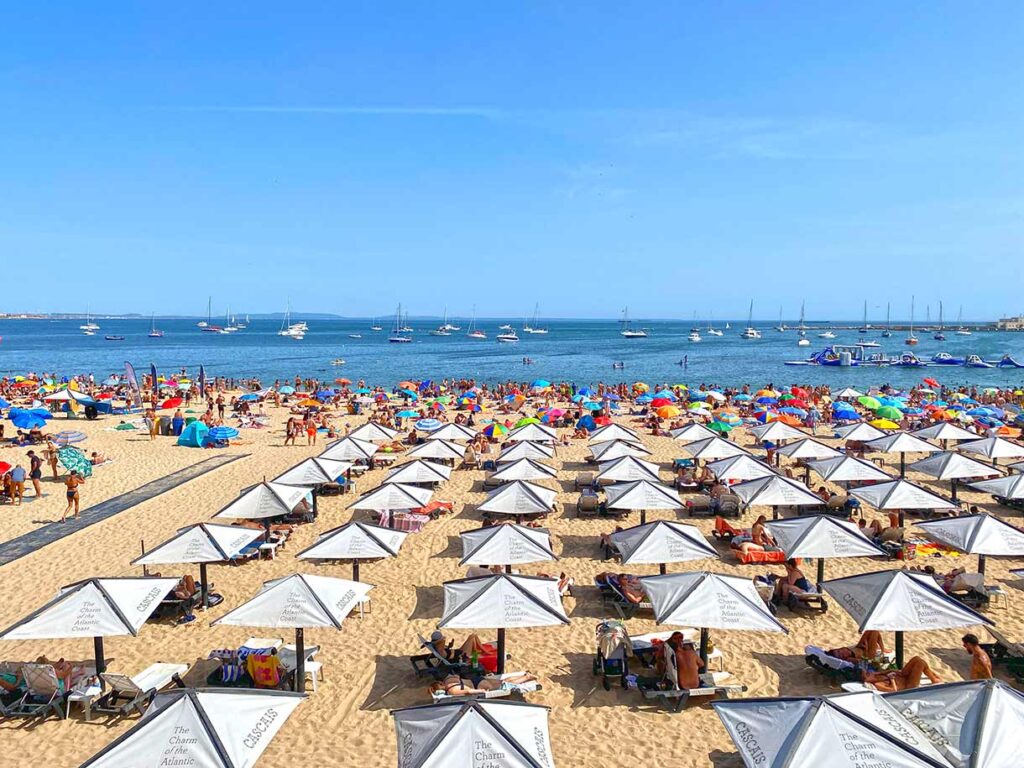
Of course, one of the most popular things to do in Cascais is simply to spend the day at the beach. For Alfacinhas, the local word for people from Lisbon, Cascais is the easiest place to go to hit the beach.
Just across from the Cascais train station you’ll find the expansive Praia da Conceicao and Praia da Duquesa. These are two ends of the same beach, where you can find calm waters, beach bars and sunchair rentals.
A few steps down the shore, in the direction of the city center, you can stop at Praia de Rainha. This is a smaller beach where locals bring their own towels and umbrellas to relax in the sun.
Finally, in the heart of town, Praia da Ribeira is packed with locals and day-trippers alike. Here, you’re just steps away from restaurants, bars and shops, in the protected waters of Cascais’ marina.
There are many other beaches further along the coast in both directions: back towards Lisbon (especially around the seaside town of Escoril) and outwards Cabo da Roca.
I personally didn’t pack a swimsuit for my day trip to Cascais, and that was one of my biggest regrets. Even if you can only slip into the water for half an hour before you catch your train back to Lisbon I think it’s totally worth it. Just keep in mind that public washrooms and changing facilities are very limited, so consider buying a drink from one of the beach bars to use their toilets or wear clothes that allow you to slide out of your wet swimsuit easily.
Natural Swimming Pools

If you’re coming to Cascais with kids, you’ll probably want to spend an hour two at the natural swimming pools just beside Praia da Conceicao and Praia da Duquesa. Here, concrete barriers create a protected swimming area that can be accessed by ramp or stairs (these can be slippery, so I recommend a good pair of water shoes). This swimming area is also watched by lifeguards in the high season, making it perfect for families with children who are just learning to swim.
Remember: Portugal does not have any Mediterranean coastline. Whether you’re at the beach in Cascais or along the Algarve, you are swimming in Atlantic waters. Even in the summer, the water can be surprisingly cold.
Santa Marta Lighthouse & Museum

One of the landmarks of Cascais is the Santa Marta Lighthouse on the banks of the Tagus River. Dating back to 1867, the lighthouse alerted Portugal’s seafarers to their arrival in Cascais.
When I visited the lighthouse it was free to visit the exterior grounds and the adjacent, small museum about lighthouse technology. Nobody offered to sell me a ticket, although I’ve read that you can pay €5 to ascend to the top of tower for panoramic views of Cascais. Looking back at my photo (above) the sign on the door likely indicates that the tower was closed while I was there.
If you are able to buy a ticket to go up the lighthouse, hang onto it because it also grants you admission to the nearby Casa de Santa Marta, where you can see how Cascais’ aristocratic families once lived.
Villas of Cascais

Speaking of aristocrats, Cascais is the heart of a unique style of architecture embraced by wealthy Portuguese families in the late 1800s and early 1900s. Known as Summer Architecture, this unique approach to building design focused on living a life of leisure. Designs facilitated rest and relaxation, incorporated exotic elements from abroad, and unexpected elements that capture the eye… and the imagination.
As you walk through Cascais it’s easy to imagine wealthy families lounging on their ornate terraces overlooking the sea, sipping on cocktails blended with tinctures brought back from Portugal’s overseas colonies, and reposing in their gated villas, away from the common working class.
Some of the most important examples of Summer Architecture in Cascais include:
- Palacete Seixas
- Casa Antonio Lencastre
- Palace of the Dukes of Loulé (today, the five-star Albatoz Hotel)
- Casa dos Porticos
- Casa Eduardo Luis Pinto Basto
You’ll find most of these villas either along the waterfront or around Emidio Navarro Avenue (a few streets behind the Paula Rego House of Stories).
Cacais Citadel

The Citadel of Cascais is a testament to the town’s seafaring past, and of the myriad conflicts that occurred throughout Europe’s history. Constructed during the Renaissance, the fortress here was designed to protect the town, and the river route to Lisbon, from invading forces such as the English (in the 1400s) and the Spanish (in the late 1500s).
Today, you can freely walk through the grounds of the citadel. Inside, you’ll find the five-star Pestana Citadela Cascais hotel, independent shops and art galleries, a restaurant, and the former royal residences. Only the latter requires a ticket, which costs €4 and grants visitors access to the opulent apartments inside.
The Cascais Town Museum

Cascais has a new museum, and if the town has captured your imagination then you’ll want to pop inside to learn more. Well-signed in both English and Portuguese, and featuring several modern interactive exhibits, the Cascais Town Museum explores the history of the town, and its surroundings, from the New Stone Age all the way to the 1900s. As of press time (Spring 2024), admission was free.
Even if you don’t go inside the Town Museum, make sure to stop by for a photo of the pretty tiles on the second-floor facade of this heritage building.
Parque Marechal Carmona

This shady park on the edge of Cascais’ historic center is the perfect place for a picnic. Visit the shops in town to pick up fresh bread, cheese, fruit and beverages, and then relax under a shady tree to enjoy your treats.
If you’re in Cascais with kids then they might appreciate a quick break at the park’s playground and duck pond, while fans of architecture will want to check out the historic villas and other buildings (such as the Chapel of San Sebastian) that line the edges of the park grounds.
Casa Sommer

Speaking of historic villas, make sure to stop by Sommer House, or Casa Sommer, in Cascais. Named after its original owner, one of Portugal’s most important industrialists, Casa Sommer is an excellent example of Summer Architecture (though I feel like I have to mention that there is no connection between the words Summer and Sommer here!).
Today, Sommer House serves as the public branch of the municipal archives, and is home to important artifacts and documents from Cascais’ history. The most important of these is the Foral, which was a royal document formally establishing the town here in Cascais in 1514. Unless something particular special is being temporarily exhibited, admission to Casa Sommer is usually free.
Counts of Castro Guimaraes Museum

Another stunning Summer Architecture building that has been converted into a museum, the Palacio dos Condes de Castro Guimaraes is located on the waterfront edge of Parque Marechal Carmona. When the tide comes in at Santa Marta Beach (see above) it actually touches the walls of this historic property.
Today, the palace serves as a museum of decorative arts, and displays paintings, manuscripts, archeological discoveries and furniture from Portugal’s colonies across Asia. These pieces are housed in rooms that are still decorated in their original, ornate style, giving visitors yet another glimpse into the lives of the wealthy families who lived in Cascais at the turn of the twentieth century.
More Cascais Travel Tips
If this Cascais travel guide has inspired you to visit the seaside town, here are a few extra things you should know before you go.
How to Pronounce Cascais
The first thing you need to know about visiting Cascais is how to pronounce the city’s name! There are two hidden “h” sounds in the word, so it sounds like “cash-cayzh”.
Getting to Cascais
The best way to get to Cascais is using the interurban train from Lisbon’s Cais do Sodre station. The fare is €2.40 at publication time (Spring 2024) and you can pay by tapping your Navigante card. The trip takes about 45 minutes and stops at Belem midway through the journey.
In the high season the train from Lisbon to Cascais gets really crowded and is often standing room only. If you don’t want to stand for 45 minutes, you can just wait for the next train.
Restaurants in Cascais
I didn’t have the best luck with restaurants in Cascais. I had lunch at the semi-famous Galeria House of Wonders (you can read more about this rather-unusual restaurant in my guide to vegetarian-friendly Lisbon restaurants) and it was disappointing. I queued for the ice cream at Santini’s, and it was good, but nothing special. As a bonus, I was rudely accosted by the owner of Aqafarina (an Italian restaurant) in the street, so I also don’t recommend you eat there.
I haven’t eaten at any of these restaurants myself, but if I was going back I would probably look into Taberna Clandestina Cascais (for tapas), Taberna Economica de Cascais (for seafood, not vegetarian-friendly) or Roots Cafe (for brunch and casual fare). I also noticed the cafe at the Paula Rego House of Stories looked to be busy with locals, so that could be a good option too.
Hotels in Cascais
Hotels in Cascais are expensive and book early for the high season. If you want to stay overnight, I’d start by checking out these three Cascais hotels:
- Westlight Cascais Chalet – This adults-only hotel is right across the street from the beach.
- Hotel Cascais Miragem Health & Spa – Surprisingly affordable for a spa hotel, this property is across the street from the natural swimming pools.
- Artsy Cascais – A luxury boutique hotel in one of the coolest buildings in Cascais.
Tours to Cascais
If you’re pressed for time there are lots of Lisbon tour companies that combine a trip to Cascais with a visit to other attractions around Lisbon, like Sintra, Pena Palace and the Cabo da Roca coastline. Here are a few of the highest-rated options:
- Pena Palace, Sintra, Cabo da Roca, & Cascais Daytrip – You’ll get an early start on this trip, which departs Lisbon at 8:20 am in order to beat the crowds at Pena Palace before heading to the beaches and coast.
- Private Half-Day Tour of Sintra, Cascais and the Cabo da Roca – For something a little less hectic, this private tour begins with time to stroll through Sintra, photo stops along the rugged coastline and a guided tour of Cascais.
- Lisbon: Hop-On Hop-Off Bus Tour including Belem and Cascais – Way more scenic than a crowded commuter train, Lisbon’s hop-on, hop-off buses include daily service to Cascais. The 72-hour pass is perfect for sightseeing in the city and beyond.
Is Cascais Worth Visiting?
In my opinion, Cascais is definitely worth visiting. It’s true that Cascais is expensive, but it’s absolutely not a tourist trap. If you’re on a tight budget, it can be an affordable day trip from Lisbon. If you have more room in your budget, spending one or two nights here is the perfect way to relax away from the hustle and bustle (and hills!) of Lisbon.
I spent a month exploring Portugal, all the way from the Douro Valley in the north to the Algarve in the south. Click here to read all of my Portugal travel guides and click here for a curated list of the Portugal day trips and tours that you shouldn’t skip.
Planning a trip to Portugal? Pin this post for later!
 |
 |