

When I travel, my favorite thing to do is simply to walk around and explore a city on foot. I know I’m not alone, because when I talk to other travelers they often share that their favorite travel memories involve all the little hidden gems they just happened to come across when they were wandering through a new city. So, with Portugal becoming an increasingly popular travel destination, I thought I would share my own insight to the topic of whether or not Lisbon is a walkable city.
On my recent trip to Portugal I spent more than one week in Lisbon, and I only got in a car once: when I needed to get to the airport for a very early flight. The rest of the time I explored Lisbon by walking and using public transportation. Would I say that Lisbon is walkable? Well, below I’ll talk about the pros and cons of walking in Lisbon, and how I recommend you combine different modes of transportation (including walking!) for the most enjoyable stay.

Walking Around Lisbon

When you’re out and about in Lisbon you’ll notice that the streets are filled with people walking, including both locals and visitors.
Lisbon is a pretty city and there is lots to see when you’re walking around, from colorful facades to black-and-white tiled sidewalks (more on those below) to historic churches to panoramic lookout points. Especially in the early morning and the early evening, when things are less crowded, strolling around one or two neighborhoods in Lisbon is very pleasant.
However, Lisbon becomes less walkable when you’re trying to cover large distances by foot. The main difficulties that you’ll face when walking in Lisbon are the hilly geography, the slippery sidewalks and the lack of protection from the elements. Those three factors can make walking in Lisbon a challenge for many visitors.
Sidewalks in Lisbon
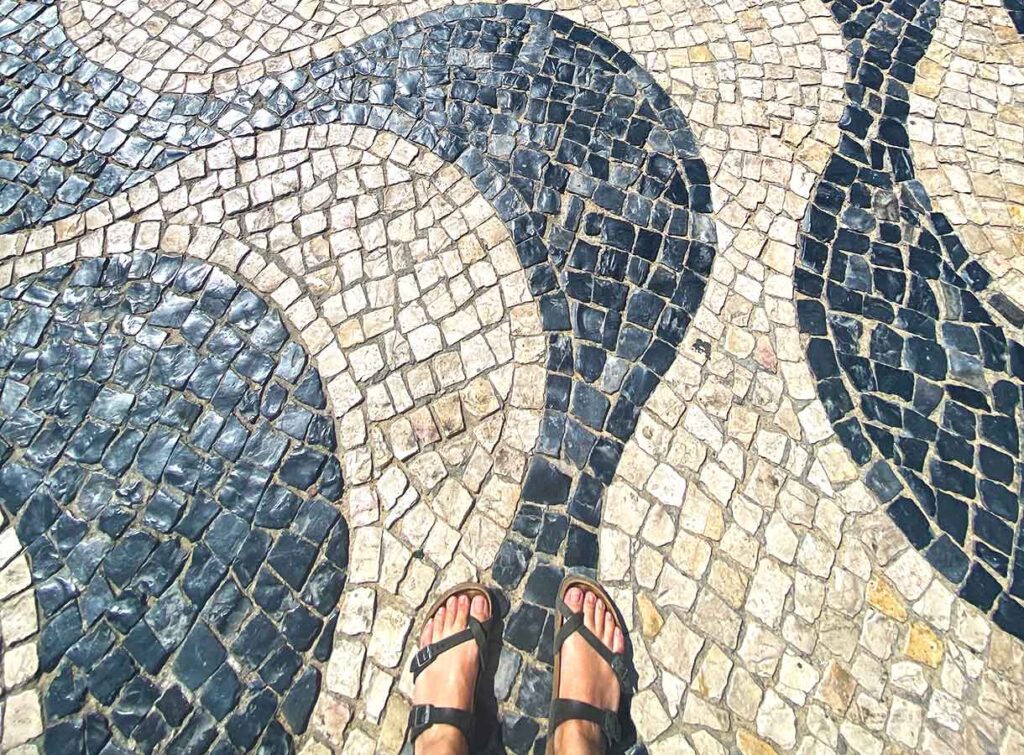
The sidewalks in most of Lisbon are paved in calcada portuguesa, which uses small, black and white tones to create pretty designs in the pavement. Calcada portuguesa are beautiful – and they’re also extremely slippery.
As more and more people walk on top of the stones, their surface first becomes smooth, and later slippery. Rain adds to the dangers of the slick surface, and puddles form in places where the tiles are more worn down. Sometimes the stones come loose, which creates a tripping hazard. These sidewalks are so dangerous that Porto has replaced all of them (in the center) with regular cement, and most former Portuguese colonies have done the same. Lisbon is an outlier in keeping these pathways in the historic center.
❗ Read more about the differences between Lisbon and Porto. ❗
Although I didn’t ever fall when I was walking in Lisbon, there were definitely moments where I slid and had to correct myself. I also witnessed numerous other people fall on the sidewalks. To be safe, make sure you’re wearing shoes with a non-slip sole, and (only if it’s safe) consider walking on the edge of the street instead of the sidewalk.
Another thing to note about the sidewalks of Lisbon is that they offer very little protection from the elements. I was in Lisbon in the summer, and it was nearly impossible to walk in the shade. Once you start walking, plan to be out in the hot sun (or the wet rain) until you reach your destination.
Hills and Stairs in Lisbon
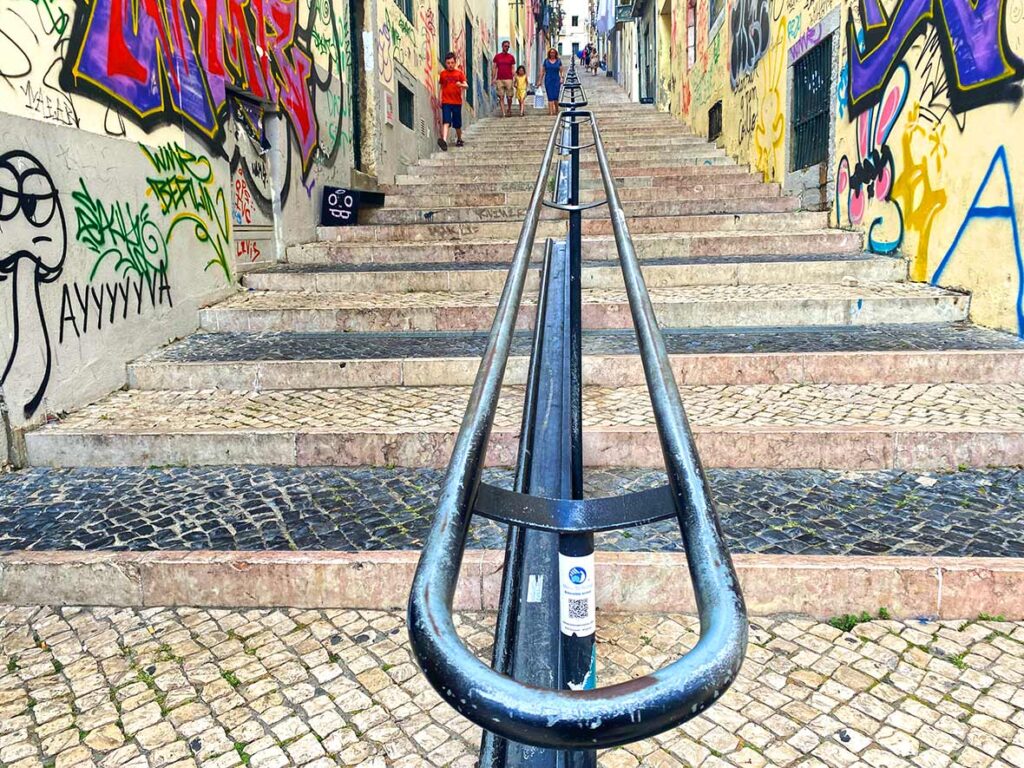
The primary reason why Lisbon is a difficult city for walkers is due to the fact that Lisbon is very hilly, and its hills are steep. The geography of Lisbon is such that you not only encounter hills when walking inland from the waterfront (south to north), but also when walking parallel to the waterfront (east to west, or vice versa). There is no escape from the seven hills of Lisbon.
Here are some of the common uphill walks in Lisbon that may pose a challenge:
- Cais do Sodre Station to the Barrio Alto – 950 meters walking, with a 123 meter elevation gain (13% incline)
- Fado Museum to Porta do Sol Viewpoint – 400 meters walking, with a 50 meter elevation gain (12.5% incline)
- Marim Moniz Square to Restauradores Square – 600 meters walking, with a 40 meter elevation gain (7% incline)
Some of the hills in Lisbon have steep, sloping sidewalks lined with the famous, slippery Portuguese tiles. In other areas, the only way to move up and down is via a series of stairs, like those shown above. Stairs are often well-worn and have uneven surfaces. Sometimes, it can be hard to tell from a map whether or not your destination will be up a big hill, which can be challenging for travelers who struggle on hills.
Distances in Lisbon
If you can overlook the hilly streets of Lisbon (both as you huff and puff your way up, and as you try to slip and slide down) you’ll find that the historic center of Lisbon is relatively small, and distance between attractions aren’t too far apart.
If you imagine a circle with the Arco da Rua Augusta as its center point, nearly all of Lisbon’s top attractions are within a one-kilometer semi-circle from that point (the other half of the circle is the waters of the Tagus River). So, even the furthest two attractions, like the Time Out Market and the Fado Museum, are just two kilometers apart. Your only barrier to getting from Point A to Point B is the hills.
Many travelers will spend their entire Lisbon trip within this semi-circle, but it’s worth it to explore a few of the attractions that are further afield, such as those in Cascais, Belem, and the LX Factory. These can be reached by train or tram in 60, 20 and 15 minutes, respectively.
The Best Shoes for Walking in Lisbon
In light of the steep and slippery streets of Lisbon, you need to pack the right shoes for your trip. I have an entire guide to the best shoes to pack for Portugal, but the thirty-second summary is that I recommend you pack:
- One pair of trusty, comfortable running shoes
- One pair of no-slip boots (cooler months) or sandals (warmer months)
- One pair of basic waterproof sandals to wear to your hotel pool or at the beach
Those three shoes will cover you for every situation and every type of terrain you’re likely to encounter in Lisbon and beyond.
Is Lisbon Walkable?
Overall, I would say that Lisbon has many beautiful, walkable neighborhoods, but as an overall city it is not very walkable. The combination of steep hills and slippery sidewalks makes walking long distances uncomfortable and inconvenient.
So, instead of planning to walk all over Lisbon, I recommend that you consider using some of the alternatives that I’ll discuss below to move between neighborhoods in Lisbon. Once you’re in a neighborhood, like Alfama, Bairro Alto, Santos, Chiado or Baixa, you can explore that district on foot before hopping on transportation to move to the next part of the city.
Of course, there are exceptions to every rule, and I am only speaking generally. If you’re in excellent health, love walking up hills and have perfect stability and balance, you’ll probably enjoy the challenges posed by walking in Lisbon. If that’s you, I salute you!
⭐ Click here for my new, curated list of my favorite activities and excursions all around Portugal. ⭐
Alternatives to Walking Around Lisbon

Lisbon has a comprehensive public transportation system that is an excellent alternative to walking in Lisbon, especially when the weather is very hot or very wet. Public transportation consists of a network of metro, buses, trams and funiculars. Nearby towns such as Belem and Cascais are also easily accessible via the interurban rain network.
The most efficient way to get around Lisbon without walking is by metro, as there are stops near most of the major tourist attractions, tickets are affordable and service is frequent.
Unfortunately, the elevators and escalators in Lisbon’s metro stations are extremely poorly-maintained and frequently out of service. I asked the staff in the Cais do Sodre station about accessibility when I saw that all of the elevators and escalators were out of service, and they told me that travelers with mobility impairments who needed to exit the station would need to purchase a new ticket, backtrack to the Baixa-Chiado station (600 meters away and 100 meters uphill from Cais do Sodre), hope their elevators or escalators were working and then walk downhill from there.
I was shocked by their flippant attitude towards accessibility, and this is supported by the metro system’s website that recommends passengers phone the call center before every journey to see if the elevators and escalators are operational at the stations they plan to use.
For travelers with mobility impairments, the bus system is probably a better option since you’ll never find yourself stuck below ground with no way to reach street level. According to Lisbon’s transportation provider, 80% of buses are fully accessible for travelers with reduced mobility, including access ramps and spaces for wheelchairs.
The trams and funiculars in Lisbon can be helpful, but they have become tourist attractions themselves and there is often a long queue just to get on board. Check to see if a bus follows a similar route; it will likely be faster and more comfortable.
I spent a month traveling around Portugal, from the Algarve to the Douro Valley and everywhere in between. Click through to read about some of the destinations that I would recommend you visit on your next trip to Portugal!
If you’re looking for a very walkable city in Europe, I would recommend considering Barcelona instead!
Planning a trip to Portugal? Pin this post for later!
 |
 |