
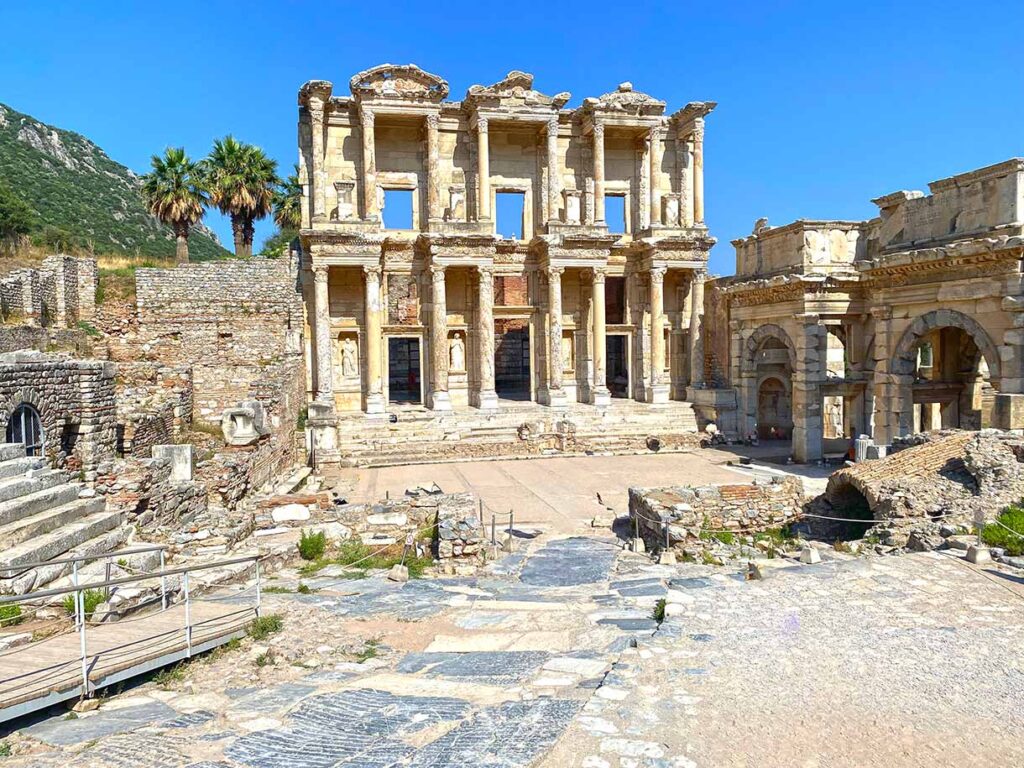
Ephesus is one of the most important archeological sites in Turkiye, and it’s easy to understand why. There are so many beautiful, monumental, awe-inspiring things to see in Ephesus that it will literally take your breath away. Even better, it’s one of the easiest archeological sites in Turkey to access, with convenient connections to Izmir, Kusadasi and even Istanbul!
I recently spent a day in Ephesus with my parents. Because they are older, we had to be really intentional in our planning to accommodate their energy and mobility levels. During the trip planning stage I found a lack of practical information about the actual experience of visiting Ephesus, so I wanted to write my own Ephesus travel guide to share what we learned about visiting this UNESCO World Heritage Site easily, comfortably and enjoyably.
This guide starts with a broad overview of what you can see at Ephesus, and that is followed by some helpful travel tips and practical information about visiting. If you still have any questions when you’re done reading, let me know in the comments and I will reply ASAP!

What to See at Ephesus Ancient City
Ephesus was a large city and its ruins are spread over a relatively wide area. Some of the region’s most famous attractions are located outside of the boundaries of the official ancient city archeological site. These include the Temple of Artemis, the House of the Virgin Mary and the Grotto of the Seven Sleepers, which are all nearby but not inside the site.
Here, I’m going to focus on the things to see in Ephesus’s ancient city area, which is about one kilometer southwest of the village of Selçuk, as well as the nearby Ephesus Museum.
The Terraced Houses
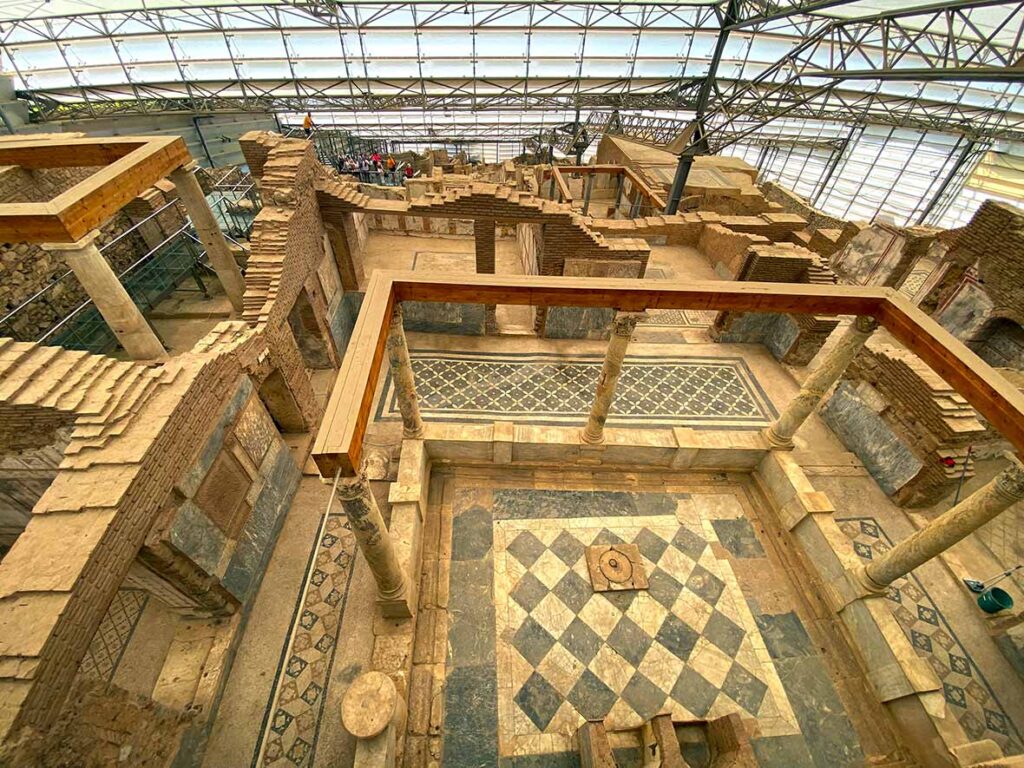
One of the main attractions at Ephesus, the Terraced Houses are of such great archeological significance that they require a separate admission ticket (but they are included in the Turkey Museum Pass, if you go that route). These houses are definitely one of the best things to see at Ephesus and are worth the admission fee.
These seven houses are where Ephesus’ richest residences once lived, and even though almost 2000 years have passed since they were built, you can still see evidence of their grandeur in their expansive size, their intricate mosaic floors and their ornate wall art.
Today, the terraced houses are protected by a ceiling and system of walkways, ensuring no damage from visitors or the weather. This is an active archeological site and you may see researchers from nearby universities engaging in excavation work while you visit.
Ephesus Great Theater
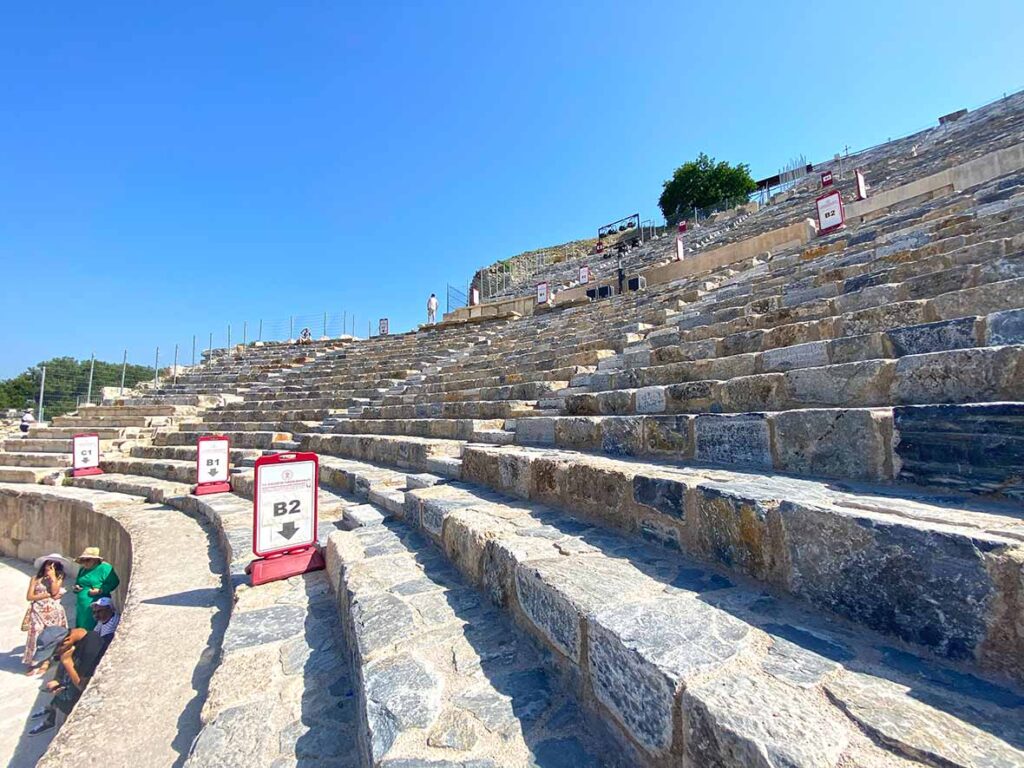
While it’s not quite on the scale of the stadium at Aphrodisias, Ephesus’ Great Theatre is still remarkable for its size. It had seating for almost 25,000 spectators. At the time the theater was built, the harbor was just behind it. The crowd could watch performances on the stage and in the background they would see the beautiful sea.
Today, you can walk freely around the theater, or come on a summer evening to take in an opera, ballet, music or theater performance. Check the official website before your trip to see if there are any performances scheduled.
The Celsus Library
Much to my disappointment, no books remain in the Celsus Library at Ephesus (why did I think there would still be books?). However, what does remain is the striking facade of this ancient building, which is one of the most iconic things to see at Ephesus.
The Celsus Library was built around 115 CE, with work being completed during the reign of Emperor Hadrian. It was the third-largest library during its time (after Alexandria and Pergamum), housing approximately 12,000 scrolls. Within 200 years of its construction the library was destroyed, and its facade fell about six hundred years later. It lay in ruins for almost 1,000 years, until archeologists reconstructed it in the 1970s.
When you visit Ephesus today you can see the facade of the Celsus Library as you walk down Curetes Way and pass the Terraced Houses. You can walk through and under the facade, into the empty, open space that once held so much of civilization’s knowledge.
Looking for more Turkey travel tips?
Follow Fearless Female Travels on Facebook for actually-useful tips on traveling in Turkey, affordable travel advice, solo female travel inspiration, and more!
Curetes Way (Curetes Road)

Curetes Way, also written as Curetes Road, is the main walking path from the Upper Gate to the Library of Celsus. As you walk along this column-lined marble stone road you’ll see countless significant monuments and ruins, many of which are well-signed in both English and Turkish.
Unless a route is clearly closed, you’re free to step off of Curetes Way to explore the smaller alleys, paths and lanes that branch off the main street. This will give you a glimpse into old houses, shops, temples and fountains that made up daily life in Ephesus.
Temple of Hadrian

One of the most important ruins that you’ll see as you walk along Curetes Way is the Temple of Hadrian. It’s hard to miss the ornamented arches and elaborate reliefs of this Roman temple.
Hadrian was a Roman emperor from 117 to 138, and history looks kindly upon his time in power because he advanced literacy and infrastructure across the Roman Empire (yes, Hadrian’s Wall in the UK was built during his reign). In fact, he became known as one of the “Five Good Emperors”, a title that many of his predecessors and successors were unable to achieve.
Archeologists believe that this temple served multiple purposes, honoring not only Hadrian but also the goddess Artemis and even the regular citizens of Ephesus.
Church of Saint Mary at Ephesus

Some people confuse the Church of the Virgin Mary with the House of the Virgin Mary, so I wanted to clarify the difference between the two.
The Church of the Virgin Mary at Ephesus is located inside the archeological site, behind the lower gate. To reach it, follow the signs from the Harbour Road (before the washrooms). You’ll find the remains of a fifth-century church, shown above, which was dedicated to the Virgin Mary.
The more famous House of the Virgin Mary is not located inside the archeological site. It’s about seven kilometer south of Selcuk, on Mount Koressos. Some people believe that Mary, the mother of Jesus, spent her last years living in this house. This belief was born from a vision that a mystical German nun had in the early 1800s, although most historians believed that Mary primarily lived in Jerusalem.
The truth? That’s way above my pay grade.
The Ephesus Musuem

Okay, I lied, I have to include one place that is not inside the actual archeological site, and that is the Ephesus Museum. It’s located in the town of Selcuk, about 3.5 kilometers from the Ephesus Archeological Site. However, it’s definitely worth visiting the Ephesus Museum because it adds so much context to what you’re seeing at the site.
You can visit the museum before or after you go to the site (check out my guide to traveling during a heatwave for tips on deciding when to do museums versus outdoor activities). Inside, you’ll find hundreds (thousands?) of beautiful artifacts that were found in Ephesus and other nearby archeological sites, along with information in Turkish and English about what you’re seeing.
On your way in and out of the museum, look up at the top of the nearby poles to see if you can spot any families of storks!
Other Things to See in the Ephesus Ancient City

What I’ve shared above is by no means a comprehensive list of what to see at Ephesus – it’s really just an overview of some of the most famous and interesting things to do while you’re there. Half the fun of exploring Turkey’s many archeological sites is wandering freely and “discovering” things that you didn’t expect. However, I did want to note a few other things that you should probably make a point of seeing while you’re at Ephesus:
- The State Agora – The main public square for the citizens of Ephesus.
- Bouleuterion – I can never spell that word on the first try. A bouleuterion is like a little theatre where state business and politics were conducted. At Ephesus, it’s full of really cute cats!
- Harbour Street – Once upon a time, the waterfront was only half a kilometer from Ephesus, and this was the road between the two.
- Ephesus Baths – I wish I was born in a time that had public bathhouses where a thousand (really!) people could gather naked and conduct important business in a steam room. Alas.
Ephesus Travel Information

Here are a few helpful hints to make your trip to Ephesus a little bit easier (and cheaper, and more fun!).
Is Ephesus Worth Visiting?
If you’re already in Izmir or Kusadasi and have a free day, then yes, Ephesus is worth visiting. However, if you are coming to Turkey intentionally to visit amazing archeological sites, I would suggest that you head further inland to Laodicea, Aphrodisias and even Hierapolis, where the sites are just as amazing but there are significantly fewer crowds.
Ephesus Ticket Prices
When I was in Ephesus (July 2023), tickets to Ephesus cost 400 Turkish lira (TL), and the terraced houses were an additional 200 TL.
When we were in Istanbul, we purchased an official 15-day Turkey Museum Pass for 2500 TL. This included entry to a number of sites in Istanbul and across Turkey, including both Ephesus and the terraced houses. For us, it was a good value as it provided skip-the-line entrance at most attractions.
Note: Due to skyrocketing inflation, the cost of a Turkey Museum Pass went up to 3500 TL a month after we purchased it. Admission prices to Ephesus also increased recently, with regular admission rising to 700 TL and the terraced houses rising to 320 TL. Expect prices for passes and archeological site admission to continue fluctuating in the months ahead.
Which Ephesus entrance is better?
Ephesus has two entrances:
- North Side – The north entrance is known as the Lower Entrance, since it’s at the bottom of hilly Ephesus. The advantage of entering here is that you’ll be going in the opposite direction of any cruise ship tour groups (they usually start at the other side) and you won’t be slipping and sliding down the old marble pathways. The disadvantage, of course, is that you’ll walking uphill as you explore the site.
- South Side – The south entrance is known as the Upper Entrance, because it’s at the top of the hill. The advantage of entering here is that you’ll be walking downhill as you explore, but the disadvantages are that you’ll be walking downhill on slippery stones, and you may find yourself surrounded by hoards of cruise ship passengers being led around by guides with flags on a stick (if you know, you know).
If you came to the site by car I recommend taking one of the taxis at the exit back to where you entered, rather than doubling back and walking through the entire site again. A fair price is between €5 and €10 (or the current equivalent in lira).
Please do not use the horse-drawn carriages to travel around Ephesus (including between the two gates). The horses are overworked in the hot weather, and choosing to ride them is choosing to continue supporting this unethical business practice.
How much time do you need at Ephesus?
We spent about three hours at Ephesus, and that was enough time to walk slowly along the main streets and see the highlights noted above.
If you rushed (and had excellent walking shoes!) you could probably get through the site in about 90 minutes.
On the other hand, if you’re a major fan of archeology and want to see more of the ruins that are off the main track, you could likely spend about five hours within the site. Just bring lots of sunscreen and water!
When is the best time to Visit Ephesus?
There are two main factors to consider when you’re deciding the best time to visit Ephesus: the number of cruise passengers in the Kusadasi port, and the weather.
Ideally, you want to visit Ephesus on a day when there are fewer cruise passengers in town. Ideally, that would be no boats, but one boat is probably fine. If possible, avoid visiting Ephesus if there are two or more large cruise ships in port, as that could easily add 1000+ people to the archeological site.
You can check the Kusadasi port schedule here.
The other thing that you’ll need to consider is the weather. In particular, the summer heat in Turkey can be extreme, and there is little shade in the Ephesus archeological site. Check the weather forecast against the cruise schedule, and do your best to visit on a morning or late afternoon when the forecast calls for (relatively) cooler weather.
If you can’t avoid visiting in the summer heat and/or at mid-day, make sure to read my guide to traveling during a heatwave for some tips to help you avoid heat exhaustion.
What to Wear to Ephesus
When you’re planning what to wear to Ephesus, I recommend:
- Sturdy walking shoes that will keep you stable on slippery, uneven cobblestones
- Sun-protective clothing (including a hat) if you’ll be there on a sunny day
- A bag with room for water (ideally one liter per person) and a folding paper fan
How to Get to Ephesus
The good news is that Ephesus is one of the easiest-to-reach archeological sites in Turkey. It is well-connected to Izmir and Kusadasi, it’s within walking distance of the village of Selçuk (see below), and you can even do it as a day trip from Istanbul with the help of a tour company and some short domestic flights.
How to Get to Ephesus from Istanbul
The drive from Istanbul to Ephesus takes about seven hours, making a day trip by car or train impossible. If you’re interested in visiting Ephesus from Istanbul, my personal recommendation would be to stay in the Aegean Coast region for a few days and visit several of the area’s archeological sites.
However, it is actually possible to take a day trip from Istanbul to Ephesus, as the two cities are connected via cheap domestic flights. This isn’t the kind of thing you’d want to organize yourself, so I recommend signing up for one these highly-rated full-day trips:
- Ephesus Full-Day Tour from Istanbul – This private tour includes flights, transfers and a private guide. You’ll pay the admission fee separately at each site you visit.
- Ephesus & Pamukkale 2-Day Tour from Istanbul – Since you’re in the area, why not make it an overnight trip and see the “Cotton Castle” of Pamukkale too?
- Full-Day Trip from Istanbul to Ephesus and Pamukkale – I can’t even believe it’s possible to fit these two trips into a single day, but using an open-jaw ticket (into Izmir and back from Denizli) this tour company manages to make it possible!
How to Get to Ephesus from Izmir
Izmir is about 80 kilometers north of Ephesus, and the drive between the two locations takes about an hour. It’s not realistic to take a taxi between the two locations because the cost would be more than €200.
To get from Izmir to Ephesus, most travelers choose to travel by train. The train from Izmir will take you to Selçuk, from which you can follow the directions below to walk or taxi to the main gates.
Considering the distance, it may be more convenient to take a tour to Ephesus from Izmir. You may want to look into these options:
- Full Day Ephesus Tour (8 Hours) – This is the top-rated tour of Ephesus from Izmir. Accompanied by a guide, you’ll explore the highlights of Ephesus that I’ve noted above, along with other hidden gems within the archeological site.
- Ephesus Guided Day Trip (+ Sirince Village) – You’ll get an early start on this tour, visiting Ephesus as well as the House of the Virgin Mary, the Temple of Artemis, Isabey Mosque and finally Sirince Village, which is known for its fruit wines (I recommend the melon flavor!).
How to Get to Ephesus from Kusadasi
From central Kusadasi, it takes about 30 minutes to drive to Ephesus. If you have a rental car it’s an easy drive, but if you’re planning to go by taxi you need to know that drivers don’t accept one-way fares. In the high season, return fares can be as high as €120, while they’re closer to half that in the low season.
A more affordable option to get from Kusadasi to Ephesus is to take one of the public buses that travel from Kusadasi to Selçuk every 30 minutes. When you’re boarding, let the driver know that you are heading to Ephesus and he’ll drop you off at the turnoff to the archeological site, which is about 500 meters from the entrance.
Of course, you can also join an organized tour to Ephesus from Kusadasi. Here are a few options to consider:
- Ephesus Shore Excursion (from the Cruise Port) – Designed for travelers arriving by cruise shop (but open to anyone!) this tour of Ephesus starts at the Kusadasi port in the morning and returns by early afternoon.
- Ephesus Private Guided Tour – You won’t have to wait for any latecomers if you book a private tour of Ephesus from Kusadasi. This tour can pick you up at your hotel or the cruise port and whisk you directly to the archeological site along with your licensed guide.
How to Get to Ephesus from Selçuk
Selçuk is the closest town to Ephesus. If the weather is agreeable it takes about 45 minutes to walk from town to the Lower Gate (you’ll pass by the Temple of Artemis en route). Otherwise, if you want to conserve your energy or the weather isn’t great, you can take a taxi, take a minibus (from the bus terminal – look for the drivers shouting “Efes!”), drive your own vehicle or join a tour group.
I have lots of posts about traveling in both Istanbul and the Izmir region. Check out all my Turkey travel guides and let me know if you have any questions!
Traveling to Turkey? Pin this post for later!
 |
 |