
India is a really big country, and it’s hard to know the best cities to visit in India on your first trip to the country. Should you focus on the north? Stay in the south? Travel the entire country? Which places to visit in India are easy, comfortable and interesting enough to warrant a spot on your India travel itinerary?
Those were questions I grappled with before my own first trip to India. I spent two months as a solo female backpacker in India, and it was a life-changing experience. Every new destination that I visited had something unique to offer, and as the weeks went on I found myself falling into the natural rhythms of India travel.
To help you plan your own first trip to India, I’ve identified fifteen of the best cities to visit in India if it’s your first trip to South Asia. These destinations are all very different, so even if you can’t visit all fifteen you can combine a few to design your own interesting, inspiring India itinerary.

The Best Cities to Visit in North India
Most travelers focus their India trip on North India, since this is where you’ll find the Taj Mahal. North India also feels familiar, as it’s where most of the Indian food served abroad originates. I’m glad I started my trip to India in the north (I flew into Delhi) because things up here move at a pretty fast pace, and it’s good to tackle some of these busy tourist attractions while your energy levels are still high. I spent about a month exploring North India, and these are the places I would recommend you visit on your own first trip to India.
1. Delhi

For many travelers (myself included!) Delhi is the gateway to India. Arriving at Indira Gandhi International Airport, you make your way through the relative calm of the terminal before emerging into the open arrivals area and being introduced to the frenetic energy of India within meters.
Delhi is one of the best places to visit in India because it has a number of memorable attractions, a relatively efficient metro system, and convenient connections onward (including to Agra and Jaipur, the other two points on India’s famous “Golden Triangle”).
For me, the highlight of my visit to Delhi was my evening trip to Swaminarayan Akshardham, a modern Hindu temple and cultural complex just south of the city center. It’s amazing to be somewhere so beautiful and so completely devoid of cameras and cell phones. It’s a magical feeling. To prepare for your visit, and to understand what you can and can’t bring, read their website carefully.
Other things I enjoyed in Delhi included the Lotus Temple (a Baha’i temple), the Red Fort, exploring the Chandni Chowk market, taking a street food tour (to be honest, I went on a lot of street food tours in India!) and having one posh (and expensive!) night out in Hauz Khas.
If you’re solo in Delhi, staying in a hotel can be a bit isolating. I recommend choosing either a hostel or a guesthouse. The hostel I stayed at has since closed, but if I was going back today I’d probably choose either J House (love that location) or Moustache (part of a reputable chain that attracts lots of foreign travelers). If you’d prefer to stay in a guesthouse, I’ve heard great things about Prakash Kutir B&B.
2. Agra

The second stop on most North India itineraries, Agra is home to the Taj Mahal, a UNESCO World Heritage Site and one of the Seven New Wonders of the World.
I’ll admit I was a bit of a jaded traveler by the time I arrived in Agra, but going up to my hostel rooftop and seeing the Taj Mahal rise above all of the rest of the buildings in the city was breathtaking. Visiting first thing the next morning was even more memorable. To make the most of your trip to Agra, you want to visit the Taj Mahal at sunrise. Don’t wait until it’s hot and crowded – wake up early and be the first person in line!
There are other things to do in Agra besides just visiting the Taj Mahal. Across the river, Mehtab Bagh is a sixteenth-century park with beautiful sunset views of the Taj. Agra Fort rivals that of Delhi, and the nearby Kinari Bazar has more than 200 vendors selling clothing, jewelry, bags, handicrafts and street food.
My Agra hotel recommendations are linked in the post above. I recommend staying close to the Taj Mahal gates so that it’s just a short walk to the gates at 5:30 am. If you choose to stay further afield, have your hotel arrange your transportation to the Taj Mahal in advance.
3. Jaipur
Jaipur makes up the third point on India’s famous Golden Triangle, and its wealth of tourist attractions make it one of the best places to visit in India for first-time visitors. There is so much to see and do in Jaipur that you could easily stay a week… though I narrowed it down to the best of the best in my three-day Jaipur itinerary.
In Jaipur, I stayed at Hotel Arya Niwas. I loved staying in a traditional haveli, or palace, set back from the main road and with a pretty garden cafe. Half of the hotel is in the original heritage building, while the other half is in a new building (that retains the historical design and traditional features).
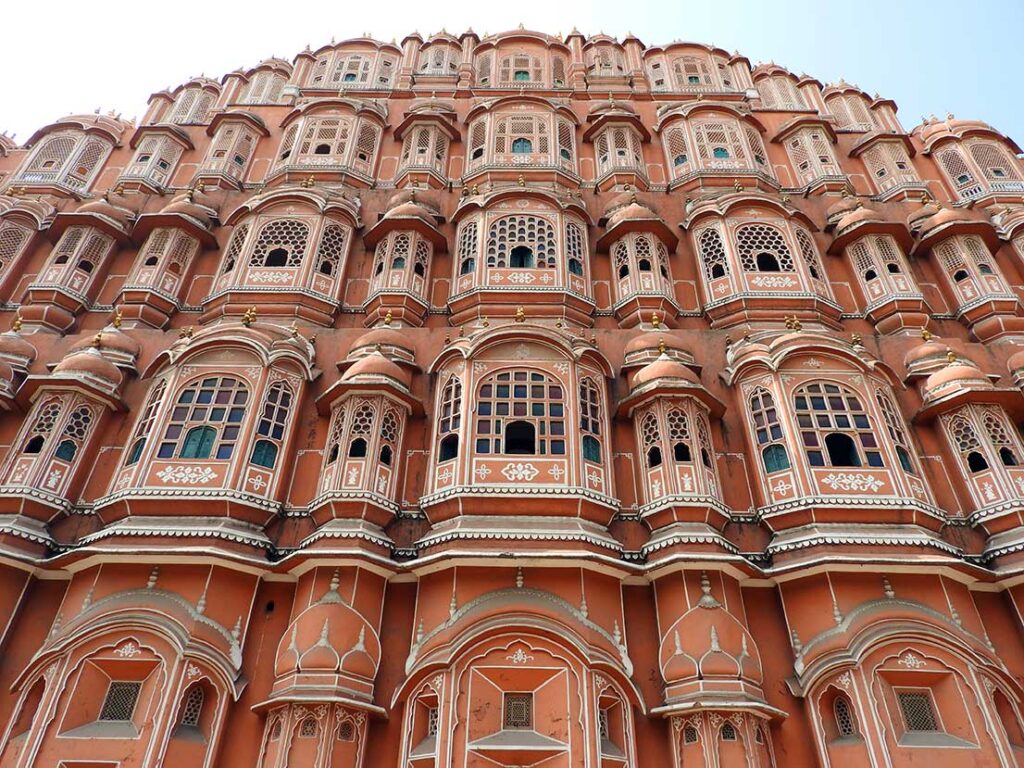
Jaipur is known as The Pink City, as so many of its beautiful buildings are a vibrant shade of blush. One of the most famous pink buildings is the Palace of Winds (shown above), from which the women of the royal court could discreetly watch the city beneath them. For the best views of the Palace of Winds, have lunch on the terrace at one of the restaurants across the street. It’s true the views will be better than the food, but they views are also unparalleled.
Outside of the city center, Jaipur has two more can’t-miss attractions: the Amber Fort and the Galta Temple (also known as the Monkey Temple). The Amber Fort is a UNESCO World Heritage Site, constructed on a hillside from yellow and pink sandstone and built around six distinct courtyards, each with their own entry gate. The Amber Fort is connected via a “secret” underground tunnel to nearby Jaigarh Fort. Galta Temple is a sacred Hindu temple built into the rocks beside a natural spring and occupied by hundreds of hungry monkeys.
4. Udaipur

We’re leaving the Golden Triangle now, and traveling a bit further afield in Northern India. Udaipur is India’s City of Lakes. In fact, Udaipur is often called The Venice of the East.
With seven lakes surrounding the city, life in Udaipur revolves around the water. The city’s most iconic landmark is the Taj Lake Palace, a luxury hotel inside an 18th-century royal palace that floats in the middle of Lake Pichola. Access to the hotel is restricted to guests with reservations, but lots of boat tours circle the hotel and give sightseers a fantastic view (especially at sunset).
From the water to the sky, another popular attraction in Udaipur is the Mansapurna Karni Mata Ropeway. This busy gondola whisks visitors from water level up to a series of hilltop Hindu temples with beautiful views of the landscape below.
Udaipur’s City Palace was my favorite of all the city palaces I visited in India. It’s actually a series of connected palaces, built from bright white marble and granite that stand out against the backdrop of the lake. The intricate interior decor was especially breathtaking, and I loved sneaking peeks through the many stained glass windows.
When you’re in Udaipur, you’ll want to choose a hotel that captures the waterfront mood, preferably with a beautiful rooftop terrace overlooking the lake. Jagat Niwas Palace is an excellent affordable luxury option – again, it’s a traditional haveli with beautifully-decorated rooms and a waterfront location just beside the City Palace. If you’re on a budget, Moustache Udaipur is a hostel with some beautiful private rooms (including one with a king-sized bed and flower bath!) in addition to standard dorm rooms.
5. Pushkar

Pushkar is a pretty white city built around a pretty, and sacred, lake. If you’re traveling to India in late October or early November, you should see if your travel dates overlap with the world-famous Pushkar Camel Fair. This multi-day event is unlike any other, and it makes Pushkar one of the best places to visit in India on your first trip to the country.
The Pushkar Camel Fair combines a large livestock fair with a holy pilgrimage to Pushkar, which is home to the only Brahma temple in the entire world. The fair is launched with a camel race, and over the following days there is a series of colorful exhibitions, concerts and shows.
Interestingly, Pushkar is a “pure veg” city, meaning that all of the restaurants in the city adhere to Hindu dietary regulations. You won’t find meat, chicken, fish or even eggs on the menus here, making it a great destination for vegetarian travelers. There are so many amazing Indian vegetarian dishes that even a devout carnivore will fall in love with meatless meals in Pushkar.
If you’re looking for an interesting Pushkar hotel option, check out PushkarOrganic, a new organic farmstay (with a swimming pool!) located an easy auto-rickshaw ride from the lake.
6. Bharatpur

Sometimes, the hustle and bustle of India’s best cities can be overwhelming, and you just want to escape into nature. Fortunately, just an hour outside Agra you’ll find Bharatpur, a small city that is home to one of India’s best, and most-accessible, national parks.
The Bharatpur Bird Sanctuary goes by several names, including Keoladeo National Park and even Ghana National Park. It is home to at least 350 species of birds, most of whom visit during the winter (from mid-October to April). You can rent a bicycle and go through the park on your own, or you can hire a bicycle rickshaw guide who knows the best birding spots and will show you where to find everything from owls to flamingos to monitor lizards.
I’ve got a full guide to visiting Bharatpur, including information on the park, the city itself (the fort here is worth a quick visit!) and hotel options near the park gates.
7. Rishikesh

An outlier on my list of the best places to visit in North India, Rishikesh is located far from the destinations I’ve just mentioned. You’ll find Rishkesh in the state of Uttarakhand, in the Himalayan foothills midway between Delhi and the Chinese border. The Ganges River flows through Rishikesh, making it a spiritual travel destination for both Indian and foreign tourists.
Rishikesh’s iconic landmark is the Laxman Jhula, a pedestrian bridge suspended across the river. It connects two villages: Tapovan and Jonk. On the Jonk side of the bridge, Trimbakeshwar Temple honors a number of gods across its thirteen floors, but Lord Shiva is placed at the top.
Rishikesh is also home to a number of ashrams and yoga retreats. You might already be familiar with The Beatles Ashram, where The Beatles wrote much of their White Album while partaking in meditation and spiritual guidance. Since it’s no longer hosting overnight guests, travelers looking to stay in an ashram could look into Parmarth Niketan Ashram, while Yoganandham is among the best-known yoga retreats in the town.
The Best Cities to Visit in South India
Not as many foreign travelers make it to South India, and those who do come down this far often don’t make it past Goa. That’s a mistake, because South India has so much to offer. To me, it felt like things moved more slowly here, whether I was doing yoga by the sea or sipping tea in the hills with a view over the foggy tea plantations. I spent a month exploring South India, and it’s definitely where I will return first on my next visit to the country.
If you’re thinking of visiting this beautiful part of India, you’ll also want to read my more detailed seven-day Kerala itinerary.
8. Goa

If you’re looking for a tropical beach getaway in South India, then Goa is one of the best places to visit in India for that kind of trip.
I started my trip to Goa with a stay at a yoga retreat in India, called Lotus Nature Cure. I spent seven days here, doing two yoga classes each day, enjoying healthy vegan meals and partaking in traditional Ayurvedic treatments. The retreat included daily excursions to the nearby Benaulim Beach or other off-the-beaten-track spots in Goa, including an ethical spice plantation and a hilltop temple hike. Once I was feeling refreshed, I headed south to Palolem Beach (shown above) and then north to Vagator. Of the two, I preferred Palolem for its variety of services, international restaurants and long expanse of beach.
I also spent a few nights in Panaji, the state capital of Goa. This is a developed city with many Portuguese-style colonial buildings and tourist attractions including casinos, the Goa Museum and the 17th-century Immaculate Conception Church.
9. Alleppey

If you’ve ever wanted to experience a real-life Jungle Cruise, Alleppey is a must-visit destination on your first trip to India. Located in the southern state of Kerala, Alleppey is famous for its evocative backwaters, which can be explored by a private, public or charter boat.
The ultimate experience in Alleppey is a houseboat rental, where you sail for two or three days through the more remote backwater canals, passing waterfront temples, fishermen at work and families going about life on the water. You’ll eat and sleep on board the boat, giving you the chance to sample fresh South Indian cuisine (which is typically eaten with your hands, rather than with utensils).
You’ll want to reserve your houseboat experience in advance, preferably with an operator that comes highly recommended. For a single-day (not overnight) backwater trip, you can organize it upon your arrival in Alleppey. The tour I took started on the public ferries, and then once we reached the smaller canals we continued via canoe.
Since you’re unlikely to spend too much time on land in Alleppey, it’s a good place to choose a more affordable accommodation option like Marari PeterLand Homestay or Haven Alleppey Beach Villa.
10. Mumbai

Personally, Mumbai didn’t capture my heart the way other Indian cities did, but its rich history (and international airport!) make it one of the most popular cities to visit in India. Thus, you might want to consider spending just one day in Mumbai.
I stayed in Colaba, at the bottom end of Mumbai’s biggest peninsula. This is said to be the cultural capital of the city, and it’s where you’ll find the Taj Mahal Palace Hotel (shown above), the Gateway of India monument and lots of restaurants and bars. From here, you can catch a boat to the famous Elephanta Caves, where fifth-century stone statues honor the Hindu god Shiva.
Mumbai’s waterfront is also a popular attraction. A stroll along Marine Drive starts near Colaba and runs about three kilometers north to Girgaon Chowpatty, a public beach (not safe for swimming, both unfortunately and unsurprisingly). Just to the north, the trendy neighborhood of Bandra also has its own waterfront promenade, known as the Bandra Bandstand.
I think the biggest headache in Mumbai is getting around the city. Try to stay somewhere really central, and see if your accommodation can organize a private car and driver for the duration of your visit. The Trident Nariman Point has a good location at the south end of Marine Drive, and it’s one of the most affordable five-star hotels in the area. In Bandra, the Taj Lands End is part of the same chain as the Taj Palace, but you’ll find lower prices, more breathing room, and even a swimming pool at this newer location.
11. Kochi

After the frenetic energy of Mumbai, you might be looking for somewhere to visit in India that is a lot more relaxed. Kochi absolutely fits that bill, making it one of the best places to visit in India for first-time India travelers. In particular, you’ll want to focus on Fort Kochi, where you’ll find the most stunning colonial architecture and the most charming arts and culture.
Many parts of Fort Kochi are within close walking distance, but you’ll probably want to hire an autorickshaw for at least half a day to head over to Mattancherry Palace, a 16th-century Dutch/Portuguese Palace. The area around the palace is known as “Jew Town” and is home to a synagogue and Jewish cemetery, along with antique shops and several popular restaurants.
On the other side of town, the area around Vasco de Gama Square is perfect for exploring on foot. This is where you’ll find Kochi’s famous Chinese fishing nets (visit at sunset for the best photos), several Christian churches (including Saint Francis Church, where Vasco de Gama himself was originally entombed) and the Cochin Cultural Center, which puts on unmissable nightly performances of traditional Kathakali theatre shows. Go early to watch the performers put on their elaborate makeup.
12. Hampi

Hampi is one of the most popular side trips from Goa, for travelers who want to combine their beach time with India’s rich history and ancient temples. You can do the trip by train (during the day, usually four trains per week) or by bus (typically overnight, at least one daily outside of the monsoon season).
Hampi reminds me a lot of Bagan, Myanmar, in that it is a former ancient capital, overflowing with stunning temples and monuments, that is now a UNESCO World Heritage Site. There are over sixty ruined temples here, along with other fifteenth-century archeological remains such as market complexes, shrines, former elephant stables and monuments. To see them all, it’s best to hire a bicycle or scooter for the day – to give you some sense of the scale, Hampi is believed to have been the second-largest medieval-era city in the world.
Hampi is also known for its unique geographical features. In particular, the hills are dotted with large granite boulders, which also line the banks of the Tungabhadra River. This stone was used to carve Hampi’s famous “musical pillars”, which emit harmonious sounds when tapped with sandalwood sticks.
Be careful when you’re booking your hotel in Hampi. I’d recommend looking into the Mango Tree & Manasa Guesthouse or the Gopi Guest House, which are on the same side of the river as most of the ruins. If you stay on the other side of the river be careful to catch the last boat back; otherwise it’s an expensive 40-km journey to your hotel via the nearest bridge.
13. Mysore (Mysuru)

Curiously, Mysore keeps winning the title “Cleanest City in India”, although that’s not the main thing that makes it one of the best cities to visit in India. I will note, though, that Mysore is studied across India, as its thoughtful infrastructure, effective recycling programs and engaged politicians actually do mean it’s noticeably more clean than most of the other cities on this list.
Mysore is a city you visit to take in the atmosphere, rather than to run around from attraction to attraction. Sure, the Mysore Palace (shown above) is beautiful, and yes, the other nearby palaces are also pretty, but the real fun of visiting Mysore is getting lost in the Devaraja Market and strolling around Kukkarahalli Lake.
Mysore also has several government-run factories where visitors can see how two local luxuries are produced. At the Government Sandalwood Oil factory you can learn how this oil is extracted and infused into everything from soap to perfume, and at the Government Silk Factory you can see how Mysore’s famous mulberry silk is woven. Of course, you can also do a little shopping at both factories too!
Mysore doesn’t have the widest range of (good) accommodation, so book early into a highly-rated guesthouse like Roambay, which has comfortable private rooms in addition to dorms and common areas where you can connect with other travelers in India.
14. Munnar

I was so glad that I scheduled several days in Munnar during my first trip to India. After beachy Goa and busy Mumbai, it was so lovely to escape 5000 feet above sea level into Kerala’s luscious, refreshing hills.
Munnar is the perfect destination in India for active travelers who want to stretch their legs. The hills around Munnar lend themselves perfectly to hiking, and there are lots of guides in town who can help you organize full-, half- or multi-day hiking excursions. Many companies also offer 4×4 excursions, taking you off-road in the natural areas around Munnar.
While you’re up in the hills, make sure to stop by one of Munnar’s tea plantations to learn more about how this drink is made, from plant to teacup. I opted to visit the Tea Museum, which is operated by Indian mega-conglomerate Tata. An alternative, just outside of Munnar, is the Kolukkumalai Tea Plantation (the highest in the world!), which also offers hiking excursions and overnight accommodations .
15. Mudumalai National Park

Okay, this one isn’t technically a city! If you follow my advice and go bird-watching in North India, then you should probably also go tiger-watching in South India! Midway between Mysore and Kochi, this large, protected natural area offers visitors some of the best chances of spotting India’s exotic wildlife in its natural habitat.
Private vehicles are not allowed to tour the nature reserve, so upon arrival you can sign up for one of the tours offered in an open-top 4×4 vehicle. With your guide, you’ll head out and look for some of the park’s many species of wildlife: elephants, Bengal tigers, leopards, sloth bears, jackals, hyenas and more than 250 species of birds. Unfortunately, the Mudumalai Tiger Reserve still allows visitors to ride elephants, but I’m confident that my smart and kind readers will opt out of this offensive activity.
Consider staying overnight in the park so that you can do your safari in the morning or evening, when animals tend to be the most active.
Wondering if a trip to India is right for you? Before I traveled to India I wrote down all of my own India travel questions, and after I’d been in India for more than a month I went back and answered them all. Click here to read my own responses to the questions I had.
Planning a trip? Pin this post for later!
 |
 |