

If you’re planning to stay in Paris for more than a few days, a visit to a Parisian supermarket will inevitably be part of your trip. Grocery shopping in Paris is an experience in itself, thanks to the French passion for food that is fresh, seasonal and local, and also thanks to the novelty of shopping for food in a different country.
On my previous trips to France I rented apartments in Nice, Avignon, Marseille and Aix-en-Provence, but this summer was the first time I’d rented an apartment in Paris. Since my stay was several weeks long I wanted a place where I could whip up light, fresh meals made from ingredients sourced at the local grocery stores and markets.
In this guide I’m going to share what I learned about grocery shopping in Paris, including where to shop, what to buy and what to expect inside a Parisian supermarket. Allons-y!

#1 – Paris Has Lots of Grocery Stores (Don’t Worry!)

You are never more than a few minutes from a grocery store in Paris, even if you might not recognize the brand name. In almost every neighborhood in Paris you’ll be able to find one of these French supermarkets:
- Monoprix – Monoprix is the grocery store chain that you’re most likely to stumble across in your Paris wanderings. Regular Monoprix stores are similar to American Target stores, and their smaller stores that start with Monop’ fill the gap for daily shopping in the neighborhoods where Parisians live.
- Franprix – Franprix is owned by the same company as Monoprix. Franprix has more stores than Monoprix, but they’re mostly of the smaller, neighborhood variety. Selection and prices between the two chains are similar.
- Carrefour – Carrefour has expanded in ways that Monoprix and Franprix haven’t, with more than 14,000 stores in 40 countries. That kind of volume does allow them to price some items more cheaply than other stores. Carrefour City shops are smaller, and Carrefour Express are the smallest in the family.
- G20 – The headquarters of this supermarket chain are located just outside Paris, near the Orly airport. I really like these stores as I find they’re often clean, not crowded and mostly patronized by locals. The photo above, and the photo of the produce in Tip #3, were both taken at the G20 across from my favorite budget hotel in Montmartre.
There are other popular French supermarket chains including E. Leclerc and Intermarché, but they haven’t really broken in the market in the city center – most of their large stores are dotted around the center along major roadways. There are also some international chains that have reached the French market (more on those towards the bottom of this guide).
#2 – Some Surprising Foods are Not Refrigerated

If this is your first visit to Europe, you may be surprised by what is refrigerated in a French supermarket, and what isn’t!
In most of Europe, eggs are not stored in refrigerators. In the USA and Canada, eggs are washed before they reach the supermarket. This reduces the risk of salmonella, but also washes off the egg’s protective coating, called the cuticle. Without the cuticle, the egg is not shelf-stable.
In Europe, chickens get vaccinated against salmonella. This means that the eggs don’t need to be washed, and the cuticle allows them to remain shelf-stable for between three and four weeks.
Even milk is rarely stored in the refrigerator in France. Most Europeans drink UHT (Ultra High Temperature) milk that has been pasteurized at a temperature high enough to make the milk shelf-stable. UHT milk can sit on a shelf for six months or longer, but once opened it does need to be refrigerated and consumed within seven days. If you find your cappuccino or cafe latte tastes different in Europe, it’s probably because of the different milk.
You may also find sausages, cheese and other charcuterie ingredients on normal shelves, rather than in the refrigerated section. If you try any of them, let me know!
#3 – You Have to Weigh Your Own Fruits & Vegetables

Just look at those beautiful fruits and vegetables at the G20 supermarket in Montmartre, Paris! 😍 This photo was taken in March, and despite the chilly weather the fresh produce was abundant.
Something that makes French supermarkets different than North American supermarkets is that cashiers aren’t expected to memorize the codes for a thousand fruits and vegetables. Instead, if you want to buy any unpackaged produce you put it in a plastic bag, put the bag on the provided digital scale, select the item you’re weighing and print off a sticker showing the weight and price. Use the sticker to seal the bag closed and to make the cashier’s life a lot easier!
#4 – Sunday Shopping Can Be… Inconvenient


If you know that you need to buy groceries in Paris, don’t put it off until Sunday afternoon! Many supermarkets in Paris close on Sunday, and the ones that do open often close their doors by 12:00 or 1:00 pm.
Other French supermarkets will open on Sunday but not bring in any cashiers, so you can only pay with your credit card at one of the self-checkout machines.
Even if the store is open regular hours, you may find they have unusual rules. For example, the Monoprix near my apartment in Le Marais didn’t sell alcohol on Sundays.
Also, I know we’re talking about grocery shopping in Paris here, but this is even more important if you’ll be traveling to any smaller towns or villages as part of your France trip. In rural areas, Sunday closures are still the norm, rather than the exception, especially for any independent grocery stores.
#5 – Wine is Cheaper Than Water


Not always, but sometimes!
Back home in Canada, I don’t think it’s possible to buy a bottle of wine for less than $10 (yes, even at Costco!). However, I’m always amazed by the huge selection of affordable wines in Parisian supermarkets. You’ll find many bottles between €5 and €10, with some even costing less than €2!
If you have time, try to do a wine and cheese tasting in Paris. If you do this towards the beginning of your stay, it will help you know which wines and cheeses to buy at the supermarket (or order in a restaurant) during the rest of your trip.
Now, about the water. The tap water in Paris is perfectly potable, but may locals are in the habit of drinking bottled water instead. You can definitely find very inexpensive 1.5-liter bottles of water (often in a package of six) but you can also find fancy glass bottles of luxurious mineral water that yes – can be more expensive than some wines!
#6 – Quantities Are Smaller Than in North America

The average apartment in central Paris measures less than 50 square meters (540 square feet). With so little space, there isn’t room to keep Costco-sized boxes of cereal and 24-packs of paper towels around the house.
French supermarkets typically sell items in smaller quantities. Instead of selling huge tubs of yogurt, you can see in the photo above that the supermarket sells many different packages of four or six individual yogurt cups. Further down the aisle you can see the fresh milk, sold in one-liter bottles instead of four-liter jugs.
Smaller quantities mean more trips to the grocery store, products moving in and out more quickly, and fresher products on the shelves and in homes.
#7 – French Supermarkets Don’t Sell Medicine
I live in Canada, where I can go to the supermarket and buy a patio furniture set (I did that last summer!), a week’s worth of groceries, a new dress, some painkillers and antibiotic eye drops. Our supermarkets really are a one-stop shop. Typical grocery stores in Paris will have a basic selection of personal care items, but they don’t stock over-the-counter or prescription medications. For these, you will need to go a pharmacy.
In France, pharmacies usually make their presence known with an illuminated green cross sign on the front of the building. Inside, trained pharmacists can dispense prescription products and over-the-counter medications for things like colds and pain relief. French pharmacies also often sell beauty products, but don’t expect to find food and drink… for that you need to go back to the supermarket!
#8 – Bag Checks Are Common
With the rise of self-checkout machines, French supermarkets are upping their security game. Consequently, it’s common to have a security guard checking bags at the exit to make sure people aren’t leaving with goods they haven’t paid for (accidentally or on purpose).
You can reduce your chances of having to go through a bag check by leaving your big backpacks and totes in your accommodation, and just coming to the store with a small purse and your empty reusable shopping bags. If you enter a supermarket with products you purchased at a different supermarket, make sure you have the receipt handy and be prepared for extra scrutiny at the exit.
#9 – Unique Foods to Try at a Grocery Store in Paris

Rented an apartment or an aparthotel in Paris? Lucky you! Having a kitchen in your accommodation allows you to shop and cook like a local. Consider adding these unique buys to your Paris shopping basket:
- Belin crackers – The French aren’t big snackers, but when they put out a bowl of nibbles to accompany a pre-dinner drink, these are the crackers they serve.
- French potato chips – Personally I’m a big fan of the black cherry and sheep cheese flavor made by Brets, but non-vegetarians I know also love the roasted chicken flavor.
- Bonne Maman jams and jellies – While some flavors of their jams and jellies are available in North America, the selection in France is much better. Buy a few jars to spread of slices of fresh baguette from the boulangerie.
- Pots of crème brûlée – The refrigerator section in any French supermarket will be full of indulgent, single-serve desserts. I’m partial to crème brûlée and chocolate mousse.
- Mâche – Known as lamb’s lettuce in English, this leafy green is often hard to find in North America but makes for the perfect neutral base for salads you whip together in your Airbnb.
(Wondering about aparthotels? As the government cracks down on Airbnbs, aparthotels are filling the gap by providing hotel rooms with small kitchens or kitchenettes. On a budget? Citadines Bastille Marais and Citadines Les Halles have very good ratings and are in a great location. Looking for something more upscale? Look into the brand-new Le Jardin de Verre by Locke in the Latin Quarter.)
#10 – Food to Bring Home from a Grocery Store in Paris

The French focus on fresh foods means that the best products from French supermarkets should be enjoyed during your visit, as they may not travel well or still be fresh when you get around to eating them. However, there are a few suitcase- and shelf-stable products that you can pick up in France to enjoy when you return home:
- Creme de marron – If you like Nutella, you’ll want to try its French cousin: chestnut cream. Spread it on toast, pancakes or crepes for a sweet treat.
- Hot chocolate – Famous French cafes like Angelina’s now sell their hot chocolate mix in supermarkets, both in powdered and pre-mixed liquid formats.
- Les Anis de Flavigny – These little French candies are made in a Benedictine Abbey according to a recipe dating back to the 1500s. They are made by coating an aniseed in sweet flavored syrup, but the real draw is the collectible metal tin with beautiful illustrations that the candies come packed in.
- Mustard – Dijon isn’t just a style of mustard, it’s also a city in France. You can visit, or you can just stock up on authentic French mustard from brands like Maille and Edmond Fallot.
- French butter – More and more tourists are choosing to bring French butter, with its higher fat and salt content, home with them. Stores like Le Grand Epicerie will vacuum-seal the butter to make it safe for your suitcase, but you should still confirm with your local customs office that you’re allowed to import dairy products.
#11 – Reusable Shopping Bags Make Great Souvenirs
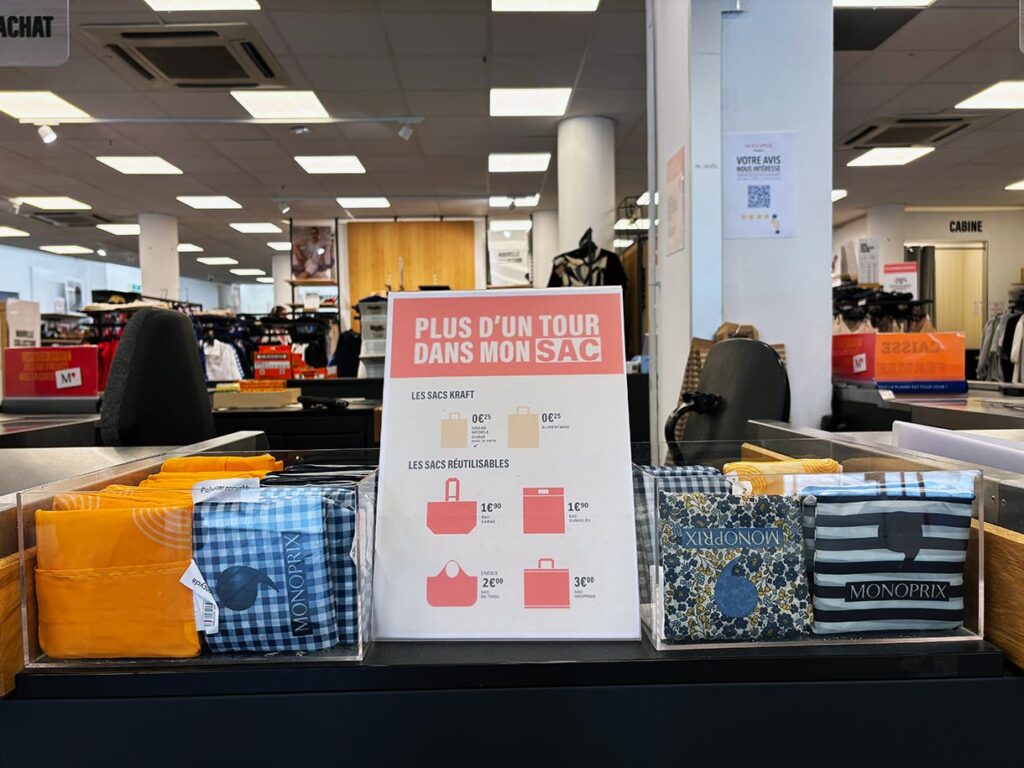
This is one of my favorite budget travel tips. I don’t spend a lot of money on traditional souvenirs, as I prefer to buy things I will actually use later (like clothing, perfume and skincare products). However, I do make an exception for reusable shopping bags from the places that I visit.
Reusable shopping bags make great souvenirs and gifts because they are inexpensive, they are lightweight, they pack down flat, and they’re super-useful when you get back home! I love shopping at my boring Canadian supermarket and then loading my purchases into a colorful reusable shopping back from one of my past trips.
Monoprix is well-known for its selection of reusable shopping bags, but I’ve also found nice ones at Carrefour and Franprix. Sometimes there will be a few at the register but a bigger selection in the homewares section, so make a point of swinging through on your way to the cashier.
#12 – Supermarkets to Visit in Paris
Some supermarkets in Paris are tourist attractions in their own right. Don’t travel to Paris just to visit these Parisian grocery stores, but also don’t miss popping inside if you happen to be in the area!
Gourmet Shopping – Le Grand Epicerie & Galeries Lafayette Le Gourmet

Los Angeles has Erewhon, Italy has Eataly, and Paris has Le Grand Epicerie and Le Gourmet. The former is owned by LVMH (the parent company behind Louis Vuitton and Moët Hennessy) and covers nearly 3,000 square meters. It’s a one-stop shop for everything gourmet on the Left Bank. Of course, you can’t expect a budget shopping experience in a luxury supermarket, so be prepared to open your wallet if you visit this shop a short stroll from the Jardin du Luxembourg.
Le Gourmet is part of the Galeries Lafayette family, with a multi-story store just opposite their flagship department store near the Palais Garnier. Covering four floors and more than 4,000 square meters, Le Gourmet is home to wine cellars, restaurants, gourmet food vendors, pop-up shops and an upscale grocery store.
Mid-Range Surprises – Epic
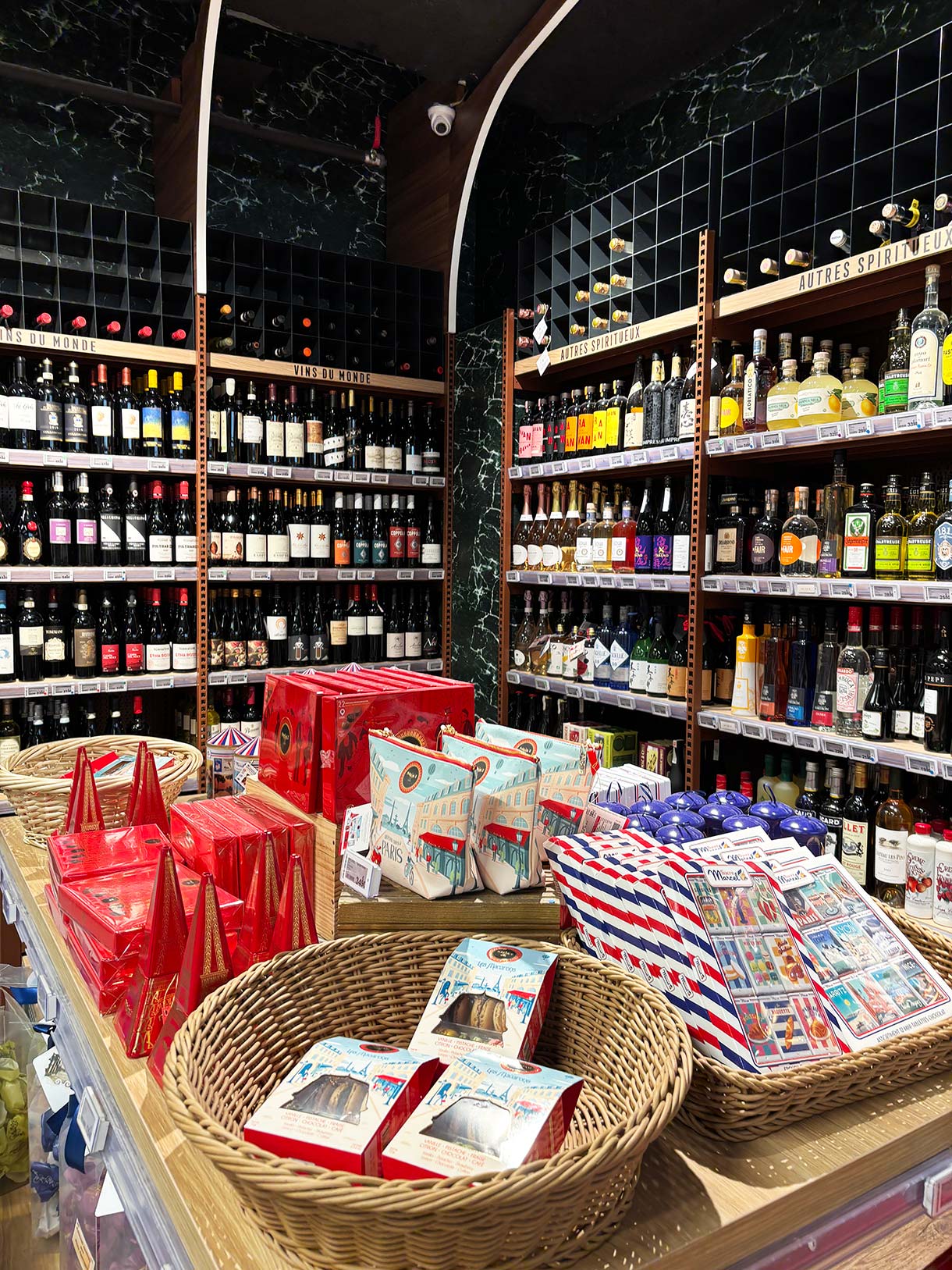
Slightly more expensive than a traditional neighborhood supermarket, but significantly less expensive than the two luxury shops noted above, Epic is a new concept grocery store in Paris with one location in Saint-Germain-des-Pres and a second in Palais des Congres. This large, spacious supermarkets stocks a mix of day-to-day groceries for local shoppers and quirky, niche and independent products that are perfect for special events and souvenirs.
Frozen Foods – Picard


Picard is a popular chain of stores across France that exclusively sells frozen foods. If you’ve rented an Airbnb or other vacation rental in Paris, this is a great place to grab easy-to-prepare meals like soup, stew, stir-fry and pasta. I have this weird thing about not using the oven in my vacation rentals so I stick to dishes that can be heated on the stovetop, but if you’re comfortable using the oven then you’ll also be able to heat up everything from quiche to duck breasts!
🍦 Tip: If you’re traveling with a family and €7 ice cream cones aren’t in your budget, pop into Picard and check out their boxes of frozen ice cream bars, which are a great value at about €4 to €5 per box of four. 🍦
The Biggest Monoprix – Gare Montparnasse
If you’re looking for a big supermarket in Paris, head to the Monoprix at Gare Montparnasse. Spread over two floors, this is one of the largest supermarkets in Paris with the best assortment of products. It also stays open later than typical Parisian supermarkets, so you can swing by after your evening sightseeing to grab breakfast for the next day.
Discount Grocery Stores – Aldi and Lidl
Europe’s two biggest discount supermarket chains have locations across Paris. Aldi and Lidl keep costs down in the same way that Costco does – instead of selling ten different brands of the same product, they will only sell one or two and negotiate with the supplier for the best possible price. However, unlike Costco you don’t have to buy huge quantities at these shops. Aldi and Lidl also don’t splurge on fancy displays or having lots of staff, so if you need help with something you might be on your own. Still, the savings are worth it!
Note: Both Aldi and Lidl are based in Germany, but in every country where they operate they source a good selection of local products.
Before you go, you’ll also want to read these Paris travel guides:
🥖 The Oldest Restaurants, Bakeries and Cafés in Paris
🌹 How to Make a Custom Perfume in Paris
🥗 Healthy Food in Paris: What to Eat and Where
🖼️ How to Get the Most Value from a Paris Museum Pass
🛍️ 18 Beautiful Covered Shopping Passages in Paris
🏰 How to Take a Day Trip to the Chateau de Fontainebleau
Planning a trip to Paris? Pin this post for later!
 |
 |