
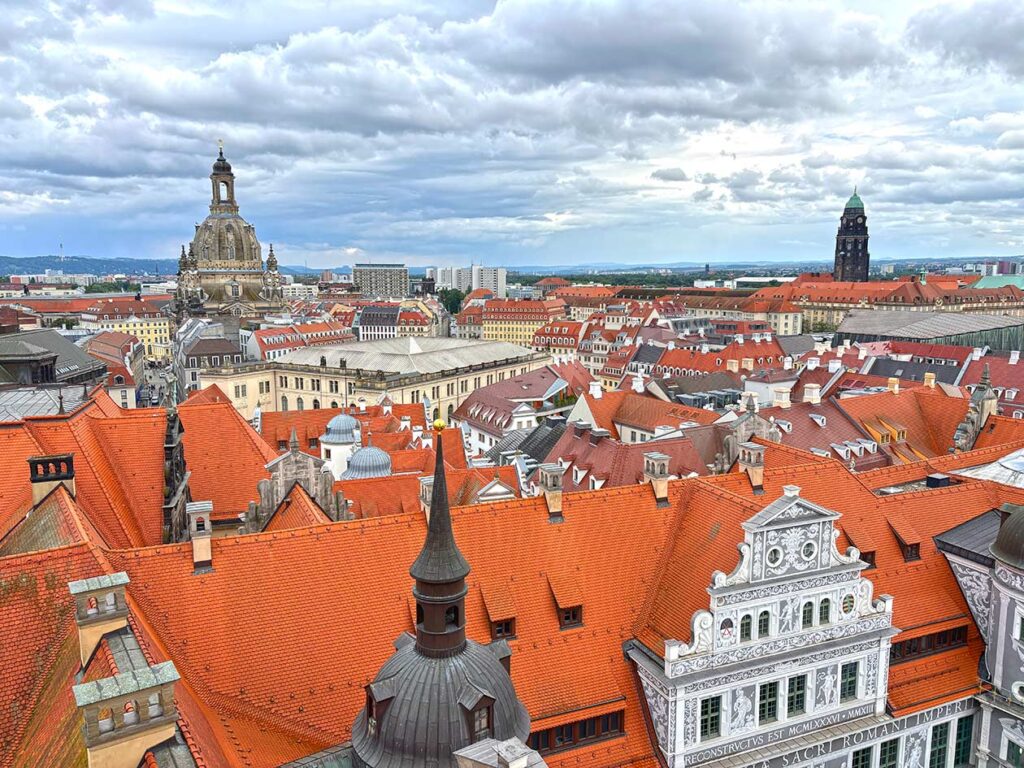
Although Dresden is well-known amongst history buffs, it rarely gets added to foreign travelers’ Germany itinerary. Most visitors skip over Dresden, and the rest of Saxony, without a second thought. However, in doing so they miss out on visiting a well-connected city in eastern Germany that offers a fascinating range of historic and modern things to do.
I recently spent a week in Dresden as part of a longer one-month trip around Saxony. Based on my one-week visit, I narrowed down the best things to do in Dresden into a two-day itinerary. Day One takes you on a walking tour of the historic center, with stops at one or more of Dresden’s world-class museums. On Day Two, you’ll head further afield and cross the Elbe River to visit some of Dresden’s more modern neighborhoods.
Dresden Hotel Recommendations
Choose a centrally-located hotel in the Old Town (Altstadt) or New Town (Neustadt) to make the most your two days in Dresden:
⭐ Motel One Dresden am Zwinger – An affordable hotel right just steps from the Dresden Zwinger and the Royal Palace
⭐⭐ Neustadtperle – A charming apartment inside the colorful Art Passage
⭐⭐⭐ Hotel Suitess – Understated luxury in a central hotel with views of the Frauenkirche
Dresden Itinerary – Day 1

Your first day in Dresden will be focused on exploring the historic center, which is where many of the city’s most famous attractions are located. It seems like a lot of different things to do, but many are just sights you’ll walk past or visit for a few minutes.
This part of your Dresden itinerary will be loosely organized from east to west, in the other you would see these attractions if you were exploring the city on foot.
You’ll have time to visit the exhibits inside the Royal Palace or you could choose another museum or art gallery to visit instead.
Brühl’s Terrace and Brühl’s Garden


Bruhl’s Terrace is a pretty riverfront promenade that runs about half a kilometer along the Elbe River in the Dresden’s Old Town, or Altstadt.
The walkway is nicknamed “The Balcony of Europe”, although I’d describe that as quite generous. It was originally constructed as part of the city’s fortifications, but then later transitioned into sort of a home base for some of the new art galleries that the city was building. In the 19th century, it finally opened up to regular members of the public, like you and me.
Boat tours depart from the piers beneath Bruhl’s Terrace and sail along the river to the city’s famous Blue Wonder bridge. If you’re not really museum people, you might want to swap the last activity today (a museum visit) for the boat tour.
Albertinum Modern Art Museum

The Albertinum is a museum in Dresden that houses two distinct collections.
First, there is a modern art collection, with works from the 1700s until today. You’ll find works from artists like Monet, Degas and van Gogh, along with prominent German artists.
Second, the museum houses the state sculpture collection, featuring pieces dating from antiquity to today. Nearly all of the sculptures here survived World War 2, but they were briefly taken from the city to the Soviet Union until the late 1950s.
If you enjoyed visiting museums like The Louvre in Paris, then you might want to stop inside The Albertinum during your Dresden trip.
Dresden Academy of Fine Arts


You probably won’t go inside the historic Dresden Academy of Fine Arts but you’ll likely walk past this pretty building engraved with the names of famous artists and topped with a glass dome (known locally as the “Lemon Squeezer”) and a statue of Pheme, the goddess of reputation (which can be famous… or scandalous).
Part of the Academy of Fine Arts building complex is Oktogon, which focuses on contemporary art. It mainly features rotating temporary exhibits from up-and-coming local artists, and sometimes serves as a space for corporations to display their contemporary art collections to the public.
At the time of my visit the Oktogon was playing an English audio track of someone reading out their mundane daily journal entries over a loudspeaker in front of the building. It was quite surprising to be walking through Dresden, Germany on a summer afternoon only to hear a voice loudly documenting what they had eaten, where they had gone and what they had done that day.
Neumarkt Square

From the riverfront, it’s a five-minute walk to Neumarkt Square. Standing in the middle of the square, it’s important to remember that all the historic buildings surrounding you are actually reconstructions of buildings that were decimated during the bombing of Dresden in World War 2.
A statue of August II the Strong stands on one side of the square, while a smaller “Peace Fountain” is located on the opposite side. August II was responsible for the development of the area around the square, including grand Baroque homes.
There is a Tourist Information office inside the QF Passage shopping center on the plaza, as well as public toilets (payment required).
Frauenkirche


The most important landmark on Dresden’s Neumarkt Square is the Frauenkirche, or Church of Our Lady.
The Frauenkirche was originally constructed in the 1700s as a Lutheran church, and it had one of the largest domes in Europe. For years, it stood as a symbol of the city’s unwavering unwillingness to convert to Catholicism… until it was completely destroyed during the Second World War.
Reconstruction of the church was not immediate, and began only after the fall of the Berlin Wall. Construction took about ten years from the mid-1990s until the mid-2000s, and formally reopened in October 2005.
Today, admission to the church is free. Hours vary by season and by day of the week, but typically you can expect it to be closed over lunch and the early afternoon. Inside, visitors can see the new Kern organ (with 4,876 pipes), the elegant inner dome and the Baroque altar.
The church’s crypt houses an exhibit about the history of the building, including its original construction, the destruction of the church, the reconstruction, and how it stands as a symbol of peace and reconciliation today.
Fragments of the Frauenkirche

In the square behind the Fraunenkirche you can see a fragment from the original church dome. The plaque affixed to the fragment describes an inspector’s horror upon arriving in Dresden immediately after it was bombed and realizing that through the fog and dust he couldn’t see the church’s dome anymore.
Palace of Culture

Anyone who has traveled throughout the former USSR will recognize the architectural style of Dresden’s Palace of Culture. The building’s facade features an eye-catching mural entitled “The Path of the Red Flag”, which was created by a local university professor and his students in the 1960s. The mural depicts the “red flag” of socialism being passed from generation to generation.
The Palace of Culture is still used as a cultural center today. Inside there is an auditorium, a library, a science forum and two coffee shops. The Dresden Philharmonic is based out of the auditorium here.
Altmarkt Square

Across the busy Wilsdruffer Strasse from the Kulturpalast is the Altmarkt, or Old Market Square. Today it’s probably best known for its modern shopping center, but there are a number of plaques around the square noting important historical events that occurred in the area.
In the winter, this is where Dresden’s pretty Christmas market is held. Dresden’s Christmas market is one of the oldest and largest in Germany. More than 200 vendors set up in the square to sell handicrafts, food and drink, to a backdrop of seasonal music and entertainment.
The NH Hotel Dresden Altmarkt is another good option for a comfortable, centrally-located hotel in Dresden.
Kreuzkirche

Just off the Altmarkt you can find the Kreuzkirche, or Church of the Holy Cross. While most of the churches in Dresden were destroyed during World War 2, the Kreuzkirche had actually already burned down four times before being bombed. Thus, reconstruction was nothing new for this Lutheran church.
The interior of the church is spacious and minimalist, creating a sombre and contemplative atmosphere. It’s the perfect backdrop for performances by the famed Dresdner Kreuzchor boys’ choir, who perform for tens of thousands of people around the world each year.
Busmann Chapel

Dresden’s only Gothic church, and its oldest church, the Sophienkirche, once stood near this spot. However, like most buildings in Dresden, it was destroyed during World War 2.
Following the reunification of Germany, officials decided to reconstruct the Bussman chapel as part of a memorial to the Sophienkirche. They encased the reconstructed chapel in glass and designed it as a “Think Room”, where people can spend time thinking about both the history of the church and of the historical roots of contemporary global issues.
Hours are limited and vary seasonally, so check the official website if going inside is a priority.
Cholera Fountain

I just had to flag that Dresden has a fountain called the Cholera Fountain, which should warrant a double-take from anyone who knows how cholera is spread. I had to look into the history of this oddly-named water source and learned that it was actually built to show gratitude for the city having been spared during a cholera pandemic that spread across the world in the 1820s and 1830s.
Even knowing that, I have to say that if the Cholera Fountain did work you wouldn’t catch me filling up my water bottle here!
The Dresden Zwinger

The Dresden Zwinger is a large palace that was built in the Baroque style for Augustus II the Strong, the former King of Poland and Grand Duke of Lithuania. It is one of the most important Baroque buildings in all of Germany, featuring extensive garden pavilions and gallery spaces.
There are three key museums housed inside: the Old Masters Gallery, the Royal Cabinet of Mathematical and Physical Instruments, and the Dresden Porcelain Collection. The latter is the most famous, known around the world for its “zoo” of life-sized porcelain animals. If you love porcelain you might want to cut something else from today’s itinerary to make time to go inside.
At the time of my visit the Zwinger was undergoing extensive construction and I didn’t think I would enjoy visiting the interior with all the restoration work happening around me. The renovations were scheduled to be completed in December 2025, so if you’re visiting in mid-2026 onward you should be good.
The Procession of Princes

One of the most famous landmarks in Dresden, Germany is the Procession of Princes, or Fürstenzug. This mural is located on a narrow pedestrian street that runs from the Neumarkt to the back of the Royal Palace.
It’s free to walk down the street and look at this work, which spans more than one hundred meters in length and is said to be the largest piece of porcelain art in the world. Amazingly, the piece suffered only minimal damage during World War 2, so most of what you’re seeing dates back to the early 1900s.
The mural here depicts thirty-five Saxon nobles, from the Margrave of Meissen who served in the 1100s to George of Saxony, who was leader from 1902 to 1904 (the latter added himself, and a few others, to a piece that was originally finished in 1876). Each person is labeled with their name and the years they were leader, and they are surrounded by symbols and figures representative of their era.
The Dresden Opera House

Following its destruction during the Second World War, Dresden’s Semperoper opera house was rebuilt according to the original design, using traditional materials and techniques. Said to be one of the most beautiful opera houses in the world, is now open for both guided tours of the building and performances of ballet, opera and other performing arts.
In the background of my photo you can see the domed roof of the Yenidze, a former cigarette factory. It was designed in an Ottoman style to reflect the region from which its tobacco was imported. I didn’t make the trip over that way but I’ve heard there’s now a biergarten under its dome!
The Royal Palace of Dresden


You’ll end your first day in Dresden at the Residenzschloss, or Royal Palace. Once the home of royals, today it is a museum complex featuring numerous different exhibit spaces.
The main draw here is the Historic Green Vault, which requires a separate, €18 timed ticket (book in advance). No photography is allowed inside, but it’s not dissimilar from the second photo above (which I took in the New Green Vault, where photos are permitted).
Basically, the Historic Green Vault is a collection of ridiculously opulent decorative arts, sorted by material. You’ll pass through a room filled with amber to one full of ivory, then to a silver room and a gold room. The collection isn’t behind glass, and is set against a background of gilded and opalescent walls. Entrance includes an audioguide that is supposed to explain each piece, but I was never able to get my audio to sync to what I was looking at.
A ticket to the rest of the Royal Palace (excluding the Historic Green Vault) also costs €18. This includes access to the armory, Turkish Chambers (including the horses shown above and a massive Ottoman tent), numerous other exhibits and the Hausmannsturm, a tower that gives you beautiful views of the city and the Elbe River. It also includes access to the New Green Vault, which contains about 1,000 works of Baroque art that (in my opinion) closely rival what you can see in the Historic Green Vault. If you’re on a budget, consider skipping the Historic Green Vault and just visiting the new one instead.
I want to flag that the staff throughout the entire castle are by far the rudest I’ve ever encountered in a museum. They were rude to me and I observed them being outright hostile to other visitors. The rules about things like coats and bags are strict, but you may find that even if your bag fits in the sizer a security guard may arbitrarily prevent you from bringing it into the galleries (and their decision is likely based on how you look and the language you speak).
Ending Your First Day in Dresden
I suggest that you end your day with a traditional German dinner at Watzke am Goldenen Reiter, a brewery and restaurant just across the river from the Royal Palace. It’s an easy and pretty walk across the Elbe to the Golden Rider statue that gives this bierhaus its name. Inside the warm restaurant you’ll find typical Saxon dishes (including some vegetarian and vegan options), homemade beers and friendly service.
Dresden Itinerary – Day 2
On your second day in Dresden you’re going to leave the historic center and explore some of the surrounding neighborhoods on the opposite side of the river. There are fewer things on today’s itinerary, partly because they’re further apart and partly because you’ll spend more time at each.
If your Dresden hotel offers a breakfast buffet then fill out on delicious German bread, butter and cheese, otherwise head to a local coffee shop for a lighter start to your day.
The Most Beautiful Milk Store in the World (Dresdner Molkerei Gebrüder Pfund)

I’ll bet you’d never wondered where the world’s most beautiful milk store was located, but now that you know it’s just steps away from the historic center of Dresden you simply have to pop in for a peek!
Located across the river in the Neustadt district, the Dresdner Molkerei Gebrüder Pfund is officially the world’s most beautiful milk store (sometimes referred to as the world’s most beautiful dairy shop). The Guinness Book of World Records has officially recognized the unique beauty that its hand-painted Villeroy & Boch tiles, gilded mirrors and elegant ceramics bestow upon its interior.
There is an on-site cafe where you can stop for a glass of buttermilk, a bowl of cheesy pasta or a slice of creamy cake. You can also shop for local specialties in the ground-floor boutique, but think twice before packing stinky cheese on the plane on the way home!
The Kunsthofpassage (Dresden Art Passage)
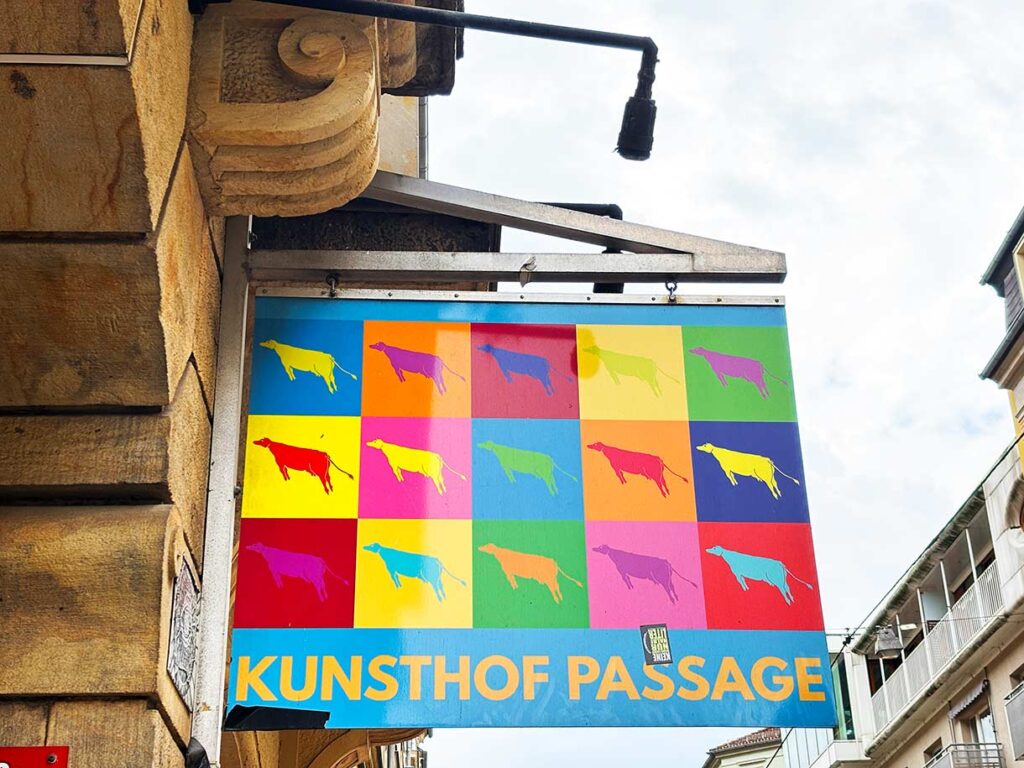

From the milk shop it’s a short walk to the Kunsthofpassage, one of the most unique spots in Dresden. This residential alleyway was revitalized with the help of artists and architects who turned its facades into musical instruments. I have a complete guide to exploring the Kunsthofpassage, including information about opening hours, shops and restaurants inside, and architectural details to watch out for.
If you’d like to stay inside this cool passage, consider staying in the same apartment that I rented: Neustadtperle. You’ll have a spacious living room, separate bedroom, large bathroom and balcony. Kunsthofperle is nearby, and I think they’re owned by the same creative hosts.
Optional: Museum Visit

Dresden has two museums that I personally skipped due to lack of personal interest, but you might want to check out. They both fit nicely into your itinerary here. From the Art Passage, take the tram back across the river, through the historic center, to the busy Straßburger Platz tram stop. Now you’re within walking distance of two unique Dresden museums:
- The Transparent Factory – Shown above, this was Volkswagen’s electric car factory and exhibit space in Dresden. It is currently undergoing a transition from being a working factory to exclusively serving as a museum and interactive learning gallery. Book a tour or interactive experience directly with Volkswagen here.
- The German Hygiene Museum – This is considered to be one of Dresden’s premier attractions, but I was too squeamish to visit this museum containing both historic and contemporary artifacts relating to health and the human body. (Don’t worry – it’s actually said be be very kid-friendly!)
On Fridays there is also a regional market just two blocks south of this tram stop. The weekly Sachsenmarkt sees a number of vendors set up along Lingnerallee to sell fresh fruits and vegetables, baked goods, meats, cheeses, prepared meals, flowers, clothing and small housewares.
The Dresden Funicular

From Straßburger Platz, buses leave regularly for the Loschwitz district on the opposite side of the river, east of the city center. Get off after crossing the “Blue Wonder” bridge, and head a few blocks ahead to ride Dresden’s unique suspended railway. This is the second-oldest suspended railway in the world, and one of only eight still in operation today.
I have a complete guide to riding the suspended railway in Dresden, including where to find the station, ticket prices, the on-board experience and what to do at the top.
You could also consider riding the traditional funicular railway instead, as it’s in the same hillside villa neighborhood. Details are also in the guide above.
Ending Your Second Day in Dresden
For dinner tonight, head back to the Neustadt area for an innovative dinner. If you’re a vegetarian or vegan, Steffenhagen has delicious plant-based schnitzels served with fried potatoes. For omnivores, lila Soße in the Art Passage has seasonal daily specials and creative small plates (but I have to warn you that the service leaves something to be desired).
If You Have Another Day

If you have a third day in Dresden, continue a day trip outside the city. You could follow my one day in Leipzig itinerary, or you could look into a day trip to the nearby Saxon Switzerland National Park.

I spent the entire summer in Saxony and wrote all about my trip! Since you’re interested in Dresden, you’ll probably also like these articles:
🚂 How to Ride the Narrow-Gauge Railway from Zittau to Oybin
⭐ How to Spend One Day in Leipzig, Germany
💎 The Best Things to Do in Freiberg, Saxony, Germany
🚅 How to Take the Train from Paris to Berlin
📽️ The Best Things to Do in Gorlitz, Germany
Planning a trip to Germany? Pin this post for later!
 |
 |