
Freiberg is one of the most interesting cities in Saxony, Germany. It has almost a thousand years of mineral-rich mining history, which it now shares with visitors through museums, public art and unique excursions.
Although many people will stop in Freiberg just for an hour or two to visit the city’s famous mineral museum, I think it’s worth spending a full day (or even two!) here. Freiberg’s charming historical center is rich with exciting things to do and pretty sights to see, and it also holds a number of attractions that will especially appeal to families with children.
I visited Freiberg in 2025 as part of a month spent in Saxony, Germany, and my time in the city remains a highlight. In this guide I’ll walk you through my ten favorite things to do in Freiberg, and at the end I’ll link you to my comprehensive guide to visiting the city’s mineralogical museum (which also includes some Freiberg hotel and restaurant recommendations).
⚠️ Important Note! There is more than one Freiberg in Germany. This Freiberg travel guide is about the town called Freiberg in Saxony, often written as Freiberg (Sachs) or Freiberg (Sachsen). The most commonly confused Freibergs are this one in Saxony and Freiburg im Breisgau, on the outskirts of the Black Forest in Baden-Württemberg. There’s also a Freiberg am Necker and a Freiberg an der Elbe… don’t get them mixed up!

#1 – Terra Mineralia

The main reason most travelers come to Freiberg is to visit Terra Mineralia, a mineralogical museum with more than 3,500 gemstones, minerals and meteorites displayed across five levels of a historic castle. Many consider Terra Mineralia to be the best mineralogical museum in the world.
I have a complete guide to visiting Terra Mineralia, including information on tickets, getting there and what you can see inside the museum. Make sure to read it before your trip to Freiberg!
#2 – Krugerhaus German Mineral Museum

For the true rockhounds, Terra Mineralia will only be your first stop on Freiberg’s Tour de Gems. Next door, in the sixteenth-century yellow building shown above, Krügerhaus is home to a collection of minerals and gems exclusively from Germany.
There are an additional 1,000 specimens on display here, with many coming from the surrounding Ore Mountains and Krusnohori mining region (a UNESCO World Heritage Site since 2019). The best way to see the Krügerhaus in Freiberg is on a combined ticket with Terra Mineralia. At publication time, a combined adult ticket is €14.
#3 – Kreuzteiche (Cross Pond)

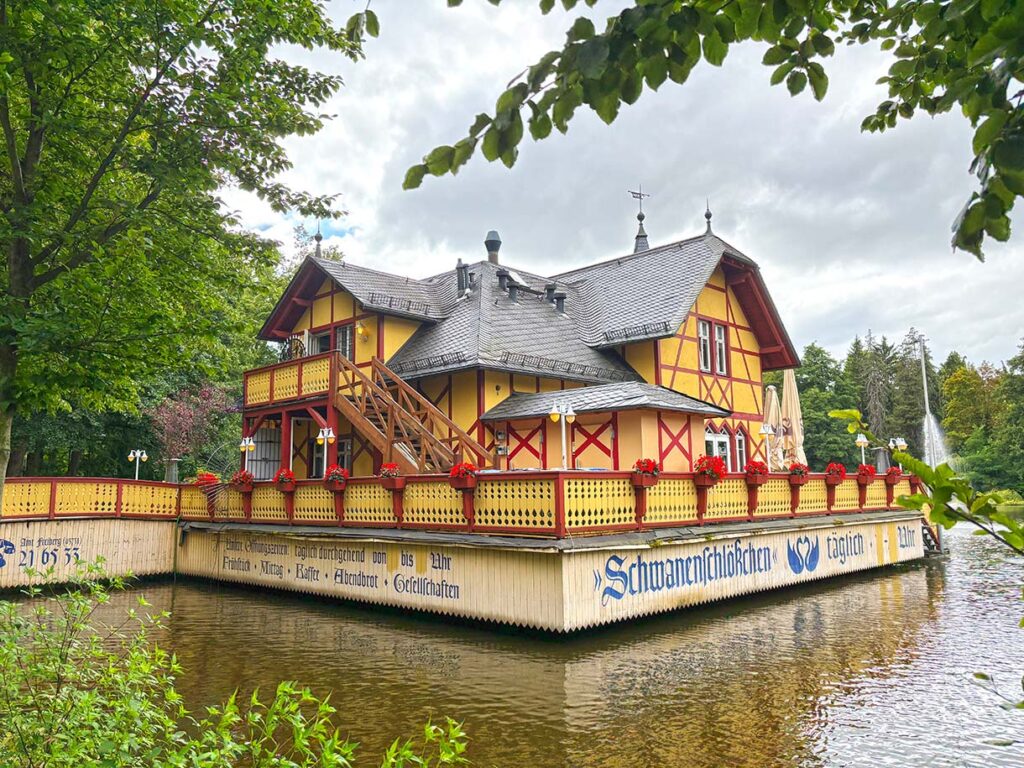
Directly behind Schloss Freudenstein (the castle that holds Terra Mineralia), a lake-filled park stretches around the west side of Freiberg’s historic city center.
Exiting through Schlossplatz you can follow the old castle walls north to the pretty Kreuzteiche, or Cross Pond. Here, the pretty Swan Castle restaurant floats atop the water and serves typical Saxon dishes like Sauerbraten (marinated, roasted meat) and other German favorites like Bratkartoffeln (fried potatoes) and stuffed cabbage leaves (Rouladen). Note that this restaurant is not particularly vegetarian-friendly! 🦢
Alternately, if you turn left as you leave Schlossplatz you can follow the park south, through Albertpark, and then west towards Freiberg’s community swimming pool and small zoo.
# 4 – Exploring the Historic Centre
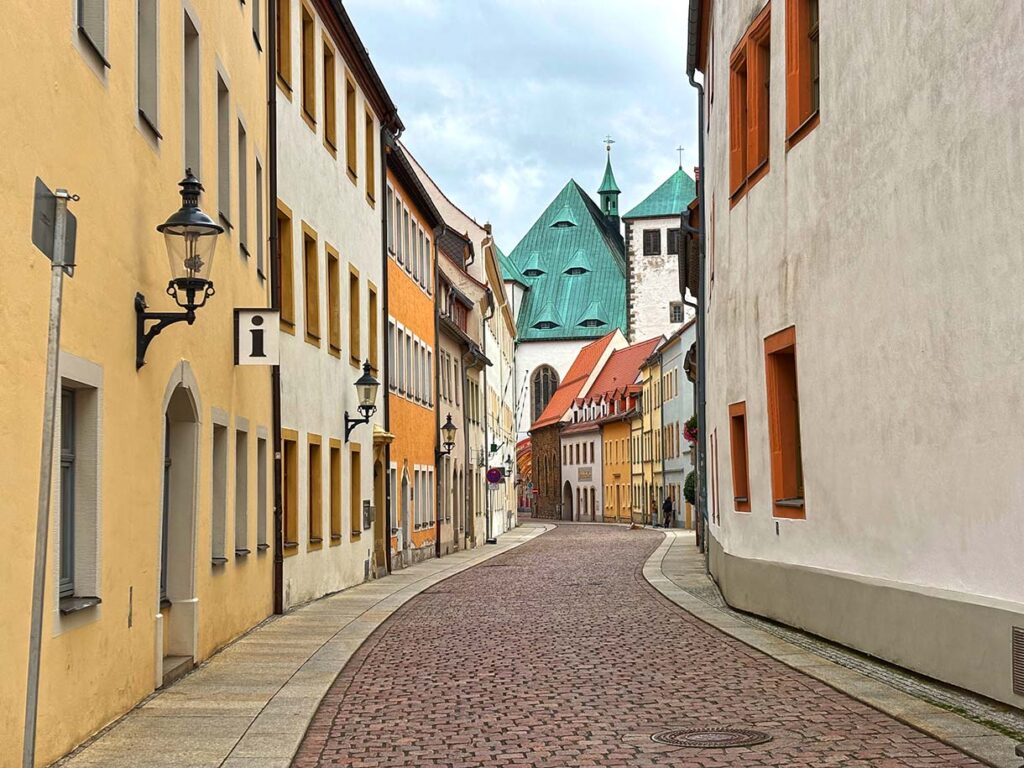

Aside from visiting Terra Mineralia, the thing that I found most enjoyable about visiting Freiberg was simply strolling through its historic city center. I was in town on a Sunday, and there were few pedestrians and even less traffic. At times, it felt like I was alone in a 16th-century mining town!
Many of the buildings in Freiberg have dormer windows (eye-shaped windows in their steep roofs), while others feature Gothic facades or Renaissance fortifications. They’re situated along narrow cobblestone streets, with historic street lamps hanging overhead.
On some Friday nights, the tourist information office organizes a walk through the historic center, illuminated only by a miner’s lantern. Book through the office (online or in person) – tickets cost €12.50 for adults and include a glass of warm mulled wine or hot tea.
#5 – The City & Mining Museum of Freiberg

Founded in 1861, the City and Mining Museum of Freiberg (also called the Municipal Museum) tells the interconnected history of the region’s mining industry and the development of the city. The building itself is the old residence for the clergy at the Freiberg Dom.
At the time of my visit the museum’s permanent galleries were closed for renovations, but they are expected to reopen in the near future. Expect to find handicrafts made from local minerals, paintings and other artworks by local artists and well-preserved machines and tools from the local mines. The re-opened museum should feature even more hands-on and interactive exhibits, which will make it popular for families visiting Freiberg with kids.
#6 – Freiberg Cathedral

Speaking of clergy, don’t leave Freiberg without visiting its famous cathedral – also called the Freiberg Dom or the Cathedral of Saint Mary. This large church stands on the Untermarkt, just across from the City and Mining Museum.
This large Romanesque church was first built in 1180, but most of it succumbed to fire in 1484. Fortunately, a few of the most important artifacts in the church survived, and many others were added following the construction.
Today, the church is best known for its Golden Gate, a huge sandstone portal from the 1200s that survived the fire. It’s also known for the large Silbermann organ that was added in the early 1700s, featuring more than 2,500 pipes. Finally, the limestone-carved tulip pulpit is famed for its ornate design.
Regular admission to the church is €6, with a supplement of €1 charged when the organ is playing. You can generally expect the cathedral to be open daily from 11:00 am to 4:00 pm, but do confirm before your visit.
#7 – Follow the The Silver Trail
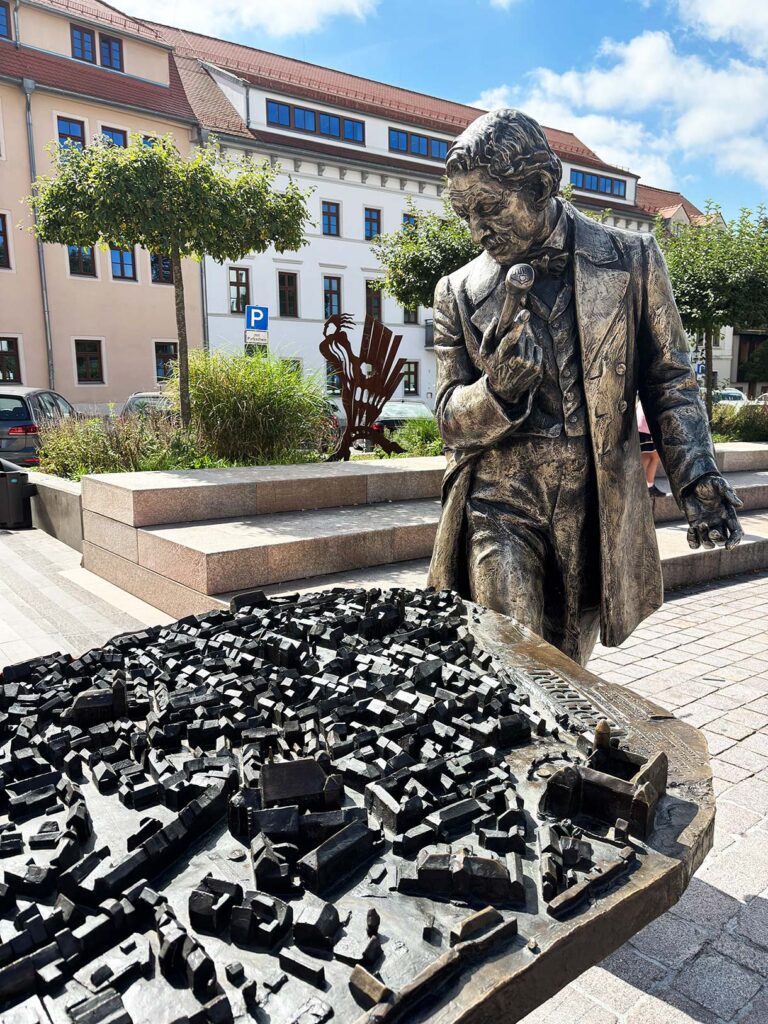
The tourist information office in Freiberg has put together a recommended walking route called The Silver Trail. This will take you to many of the sights I’ve mentioned in this guide, plus some others.
Eleven spots on the three-kilometer route are marked with silver sculptures, like the one shown above in front of Schlossplatz. Hidden in each of the sculptures is a figure of a mouse named Sylvie, making for a fun scavenger hunt for children (or adults!).
You can pick up a paper copy of the walking route at the tourist information office, or download it onto your phone via the Apple Store or Google Play.
#8 – Obermarkt (The Upper Market) & Untermarkt (The Lower Market)
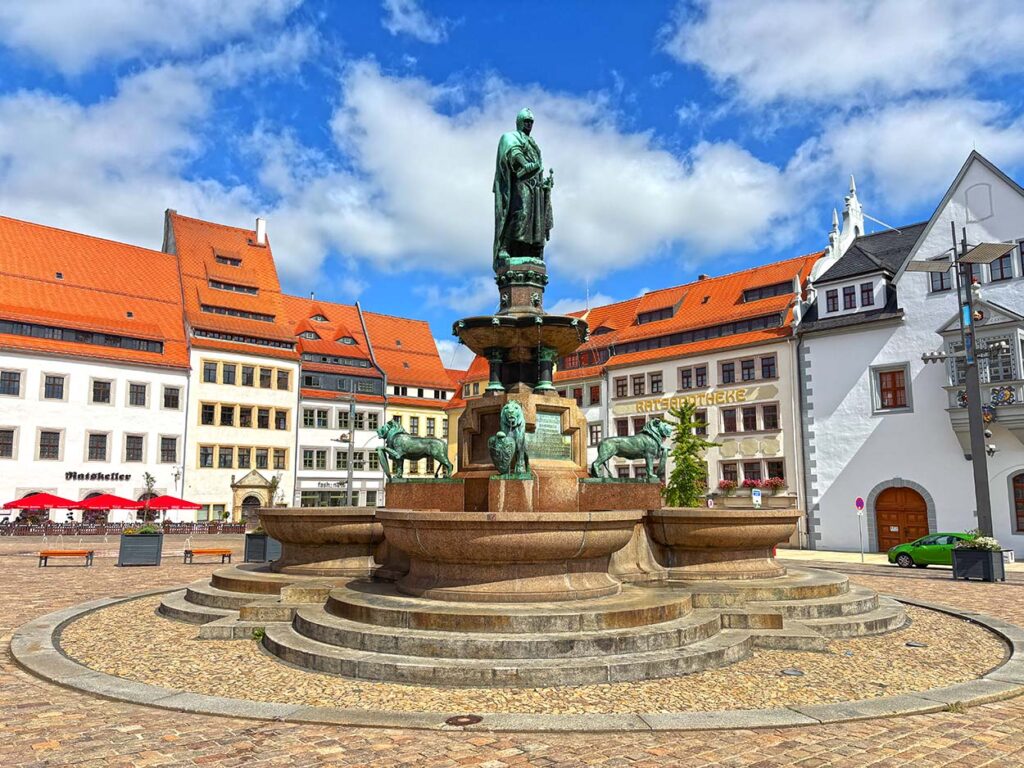
Freiberg has two pretty market squares: the Obermarkt (shown above) and the Untermarkt (in front of the cathedral). Both market squares are lined with restaurants, local shops and office buildings.
The Obermarkt has a star-shaped water fountain along with a statue of Otto II (Otto the Rich), a 12th-century nobleman who was instrumental in founding a town in Freiberg (following the discovery of nearby silver deposits). Hotel Am Obermarkt is a popular accommodation choice just half a block away.
The Untermarkt is home to a fountain topped with a statue of two tanners at work, as well as a viewing shaft allowing visitors to peek into the town’s earliest drainage system. Sadly the middle of the market square is now used as a parking lot, making it less attractive than its counterpart.
#9 – Nikolaikirche
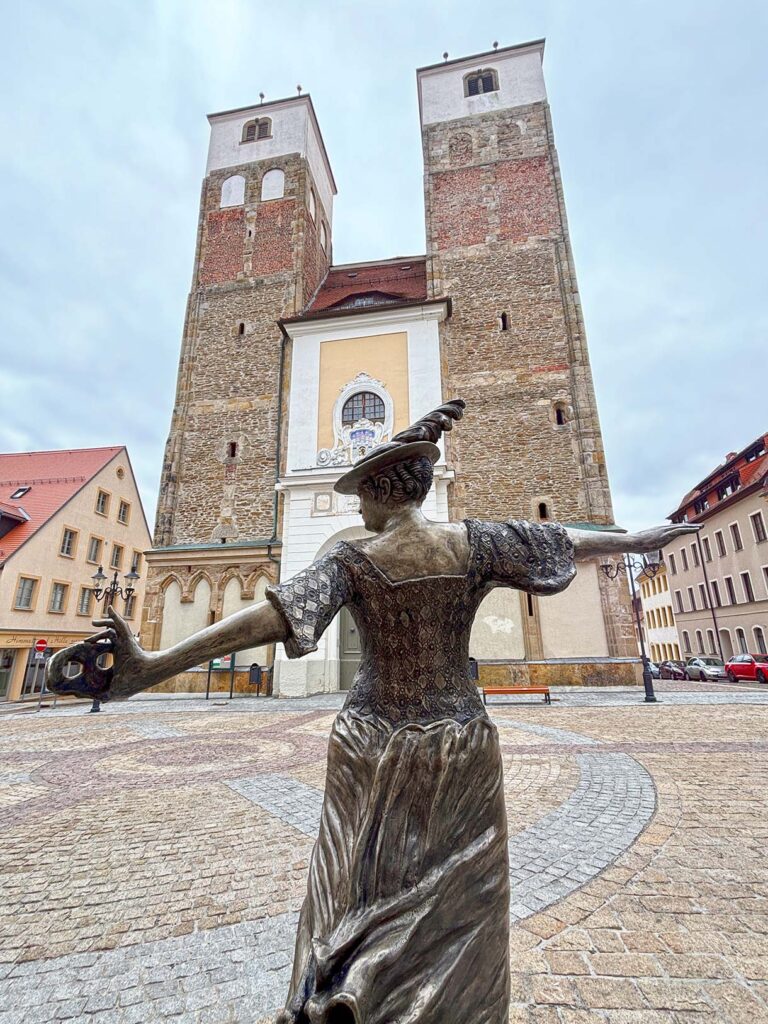
My favorite spot on the Silver Trail, and my favorite of the eleven sculptures that line is, is at Nikolaikirche (Saint Nicholas Church).
This is the second-oldest church in the city, constructed shortly after the cathedral. Like the Freiberg Cathedral, Nikolaikirche was destroyed by fire in 1484. Little of its original Romanesque style is still visible, with most of the current architecture representing Gothic and Baroque design influences. Under the GDR there were plans to demolish the church, and its baptismal font was even moved to the Frauenkirche in Dresden for safekeeping, but political changes happened just in time to save the building.
All that being said, Nikolaikirche no longer holds religious services. As the statue in front of the church (“The Actress”) suggests, Nikolaikirche has been repurposed into one of the most unique concert and conference venues in Saxony.
Fun fact: The square in front of Nikolaikirche is called Buttermarkt, which literally translates to “butter market”. I love thinking that at some point in time the demand for butter in Freiberg was so high that they needed an entire square devoted to it!
#10 – Silver Mine Tours
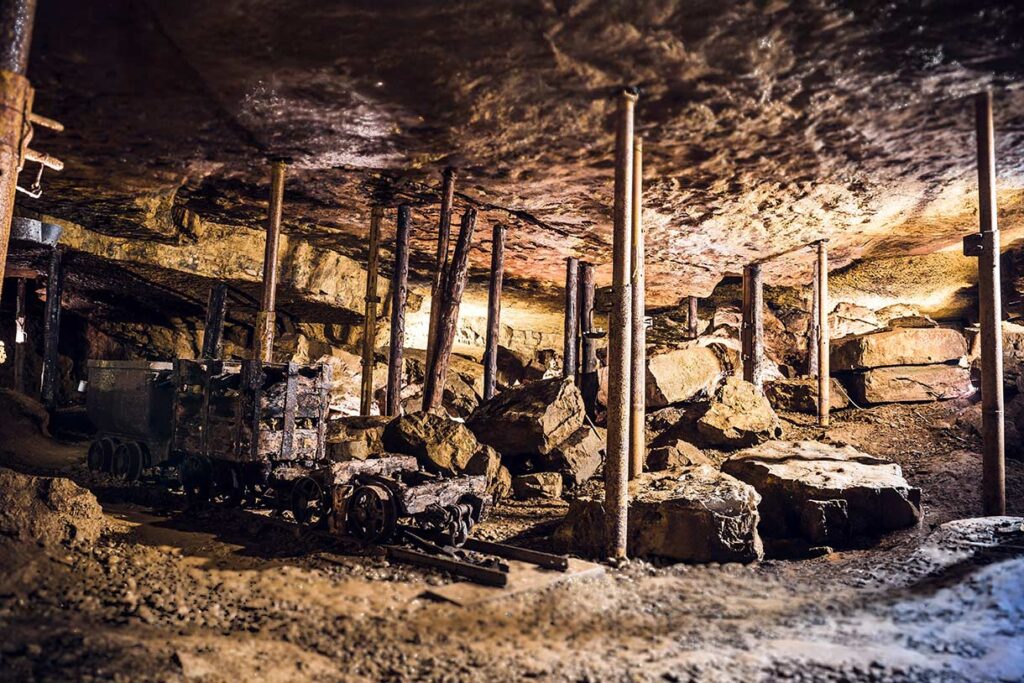
If you come to Freiberg by car, you may be able to include a visit to the city’s silver mine as part of your trip. Located about two kilometers outside the city center, the Freiberg Silver Mine typically offers public tours on one or two days each week, bookable in advance on their website (German only, but you can use Google Translate).
On a tour of the Freiberg Silver Mine you’ll descend about 150 meters below ground, into the tunnels of a working silver mine. Once you’re underground you’ll walk about 500 meters through the mining tunnels, hearing the clink-clank of the nearby miners hard at work. Check the website linked above for full details, including who cannot participate for safety reasons and how to organize a tour in English or Spanish.
I have a complete guide to visiting Terra Mineralia in Freiberg. In that article you’ll also find my Freiberg hotel and restaurant recommendations.
If you’re planning a trip to Saxony, you might also like these quirky nearby travel experiences:
🗺️ 10 Things to Do in Chemnitz, Saxony
🚂 How to Ride the Historic Steam Train from Zittau to Oybin Castle
💫 12 Things to Do in Zittau, Saxony, Germany
🎥 The 15+ Best Things to Do in Görlitz
🎨 The Secret Art Passage in Dresden
🏰 Delitzsch, Germany: A Cute Day Trip from Leipzig
🥂 A Guide to Visiting The Chemnitz Wine Festival
📍 How to Visit Schloss Glauchau Castle in Saxony
Planning a trip to Germany? Pin this post for later!
 |
 |