

Dresden, Germany is home to two unique forms of public transportation: a suspension railway (sometimes called the Dresden cable car) and a historic funicular train. Riding one or the other (or both!) is a fun, off-the-beaten-path activity to add to your Dresden itinerary. Both offer an escape from the crowded historic city center, beautiful views of the Elbe River, and an experience that’s hard to find anywhere else in Germany.
In this guide I will focus on the Dresden suspension railway (also known as the cable car or monorail) because that is the one I rode. However, I will also share some information about Dresden’s funicular, which is nearby and similar in many ways.

What is the Dresden suspension railway?

The Dresden suspension railway is a unique type of public transportation. Opened in 1901, it has been taking travelers from the riverfront in Loschwitz up to the castles and villas in the surrounding hills for the past 125 years.
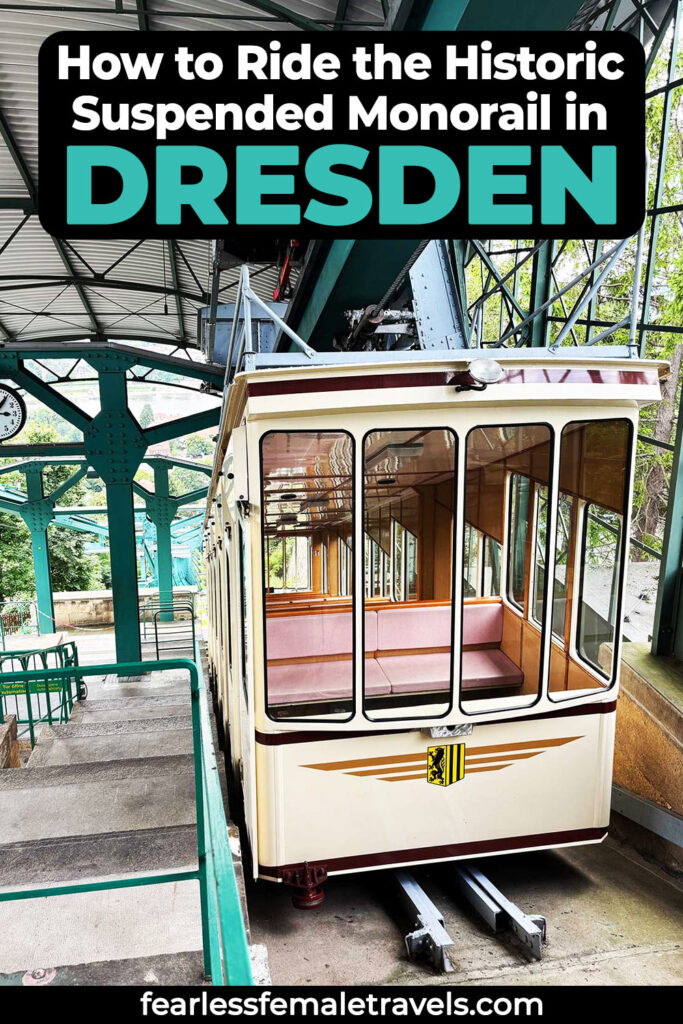
The suspension railway in Dresden is a type of monorail, in that the train moves along a single track. However, unlike most monorails, where the train rides on the track, here in Dresden the train hangs underneath, suspended from the single railing.
This is a fairly short railway, with only 274 meters between the upper and lower stations, and a total elevation change of 84 meters. This sets the overall steepness at about 30%, which (in my opinion) is an excellent reason to choose the suspension railway over your own two feet if you are going to go up into the hills around Loschwitz.
According to Wikipedia, there are only eight suspension railways confirmed to be in operation today. The Dresden suspension railway is the second-oldest, predated by its 13-kilometer counterpart in Wuppertal just five months earlier. Today, DVB (the Dresden public transportation agency) operates both the suspension railway and the nearby funicular.
Where is the Dresden suspension railway?
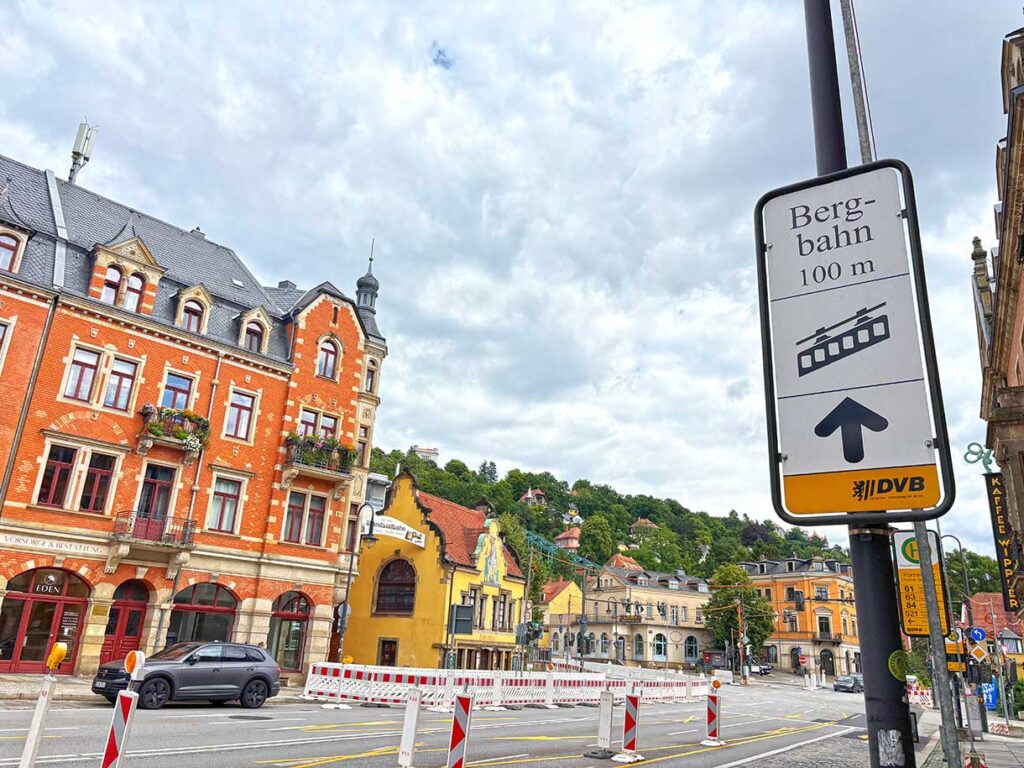
Dresden’s suspension railway is located is Loschwitz, a ritzy district to the east of both the Neustadt and Altstadt neighborhoods. Lotschwitz is known for the villas, mansions and castles that line its hills, and for being home to both the suspension railway and the funicular.
The photo above shows the main road along the riverfront in Loschwitz. On the left, you can see the entrance to the Dresden funicular (it’s between the orange and yellow buildings, with the white sign overhead). On the right, a sign directs you to continue walking 100 meters straight ahead to reach the suspension railway station.
How to Get to the Dresden Suspension Railway Station
While you can reach the suspended railway station by car, parking is extremely limited. Instead, I recommend taking public transportation from the historic center. Google Maps can help you plan your route, which will likely involve taking Tram #4 or #11, and then changing to bus #61 or #63. The trip should take about 35-40 minutes in each direction.
If you’re coming from Neustadt, Tram #6 travels directly from the Dresden-Neustadt train station to Loschwitz in about 25 minutes. You’ll need to get off at the Schillerplatz stop, which is a two-minute walk from Loschwitz across the river.
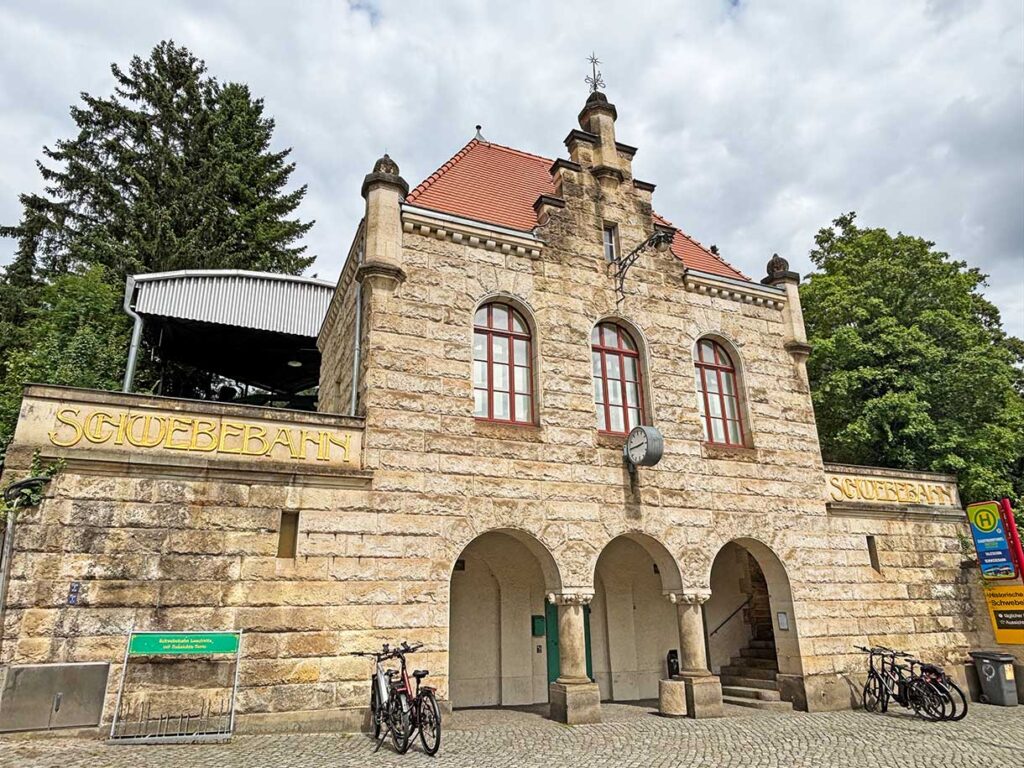
The entrance to the suspension railway is shown above. It is accessed via Pillnitzer Landstraße, just after the intersection with Grundstraße and Veilchenweg. Ascend the stairs from street level and you’ll be inside the open-air station.
Dresden Suspension Railway Tickets
Most visitors will need to purchase a ticket for the suspended railway. Tickets are sold from the automated DVB machine at the station. At publication time, the ticket prices are as follows:
- One way ticket – €5
- Return ticket – €7
There are discounts for families and children under 15, but not for seniors.
If you have a weekly or monthly transit pass for Dresden, it includes use of the suspended railway. Day passes are not valid. (Of course I had a day pass…)
Unless you’re a local resident with a special type of annual pass, DeutschlandTickets are not valid on the Dresden suspension railway.
Riding the Dresden Suspension Railway
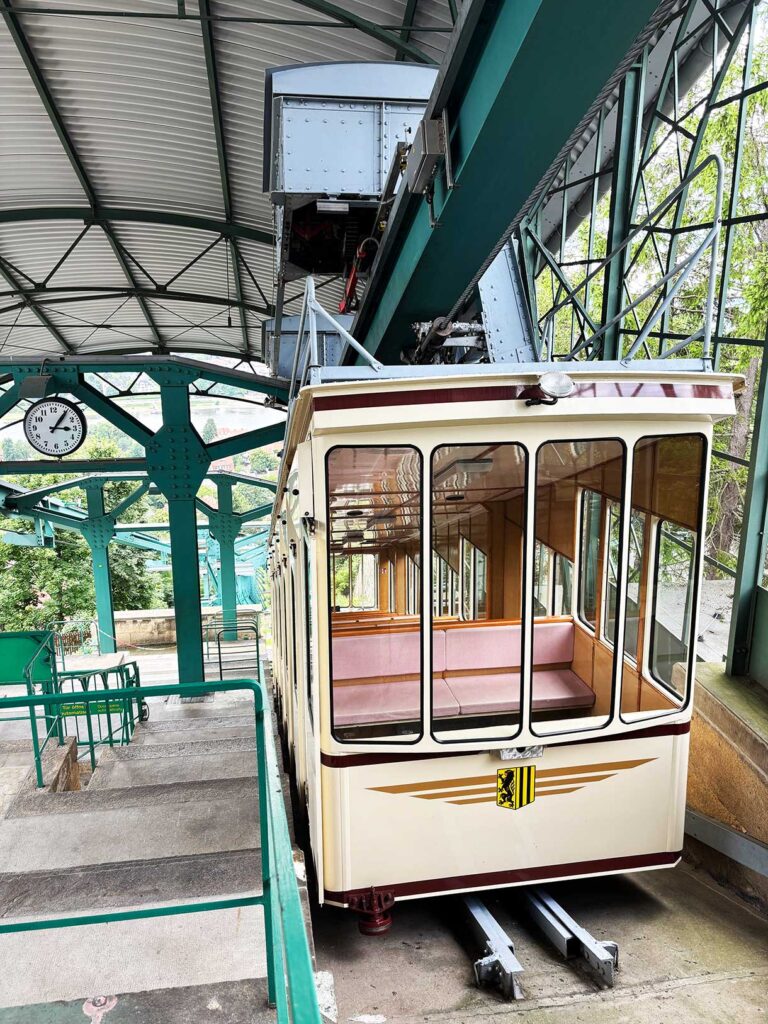
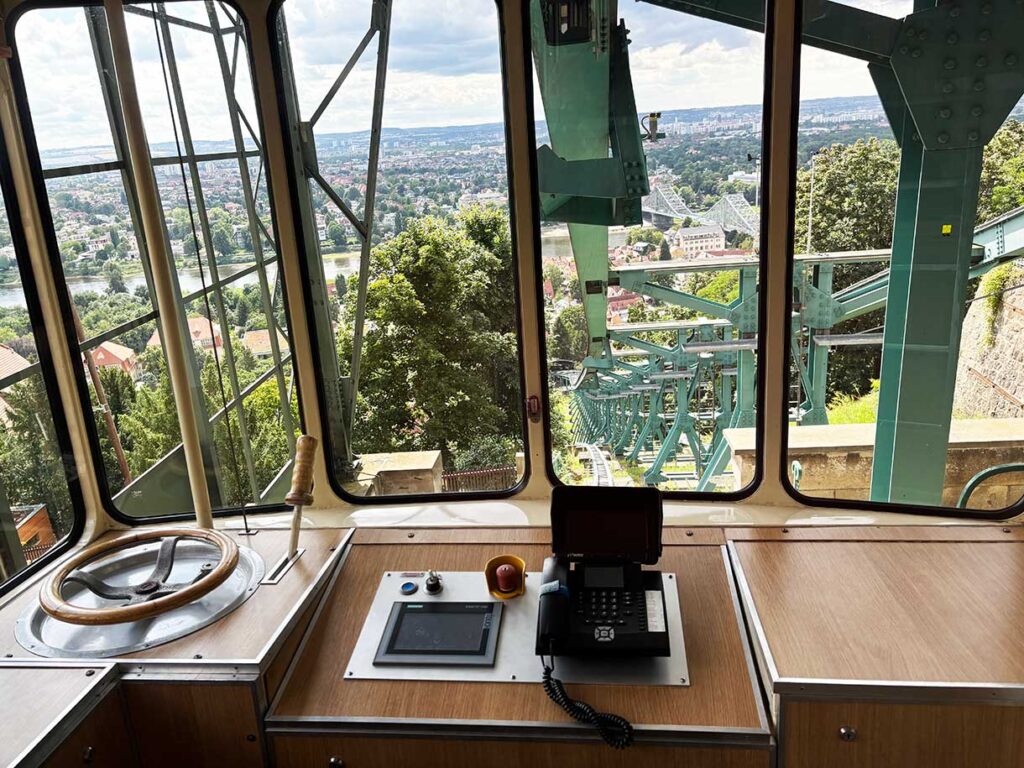
At the time of my visit to Dresden the suspension railway was running every fifteen minutes, and you were able to board the cars about five minutes before the scheduled departure time.
If possible, try to choose a seat at the front or back of the train (on the way up) and at the front of the train (on the way down) for the best views. The historic cars have bench seating, with space for three (comfortably) or four (squeezed) on each bench.
There is not an operator inside the train; instead it is staffed at the top and bottom stations. When it’s time to depart the doors to the train will close, and it will begin to move up or down the hill. According to my phone, the train was moving at speeds of between 5 km/h and 10 km/h during the journey… slow and steady.
The journey takes about five minutes and is generally quite slow and smooth. Your actual car is rarely very high off the ground, though the tracks do cross one road and one pedestrian pathway en route. If you have a fear of heights you probably won’t be too uncomfortable as you can always see the ground just a few meters below the train.
Note that both the suspension railway and the funicular have two annual closures for maintenance, typically in the late autumn and early spring. Check the DVB website to confirm opening dates and times if your visit falls in February, March or November.
What’s at the top of the Dresden suspension railway?
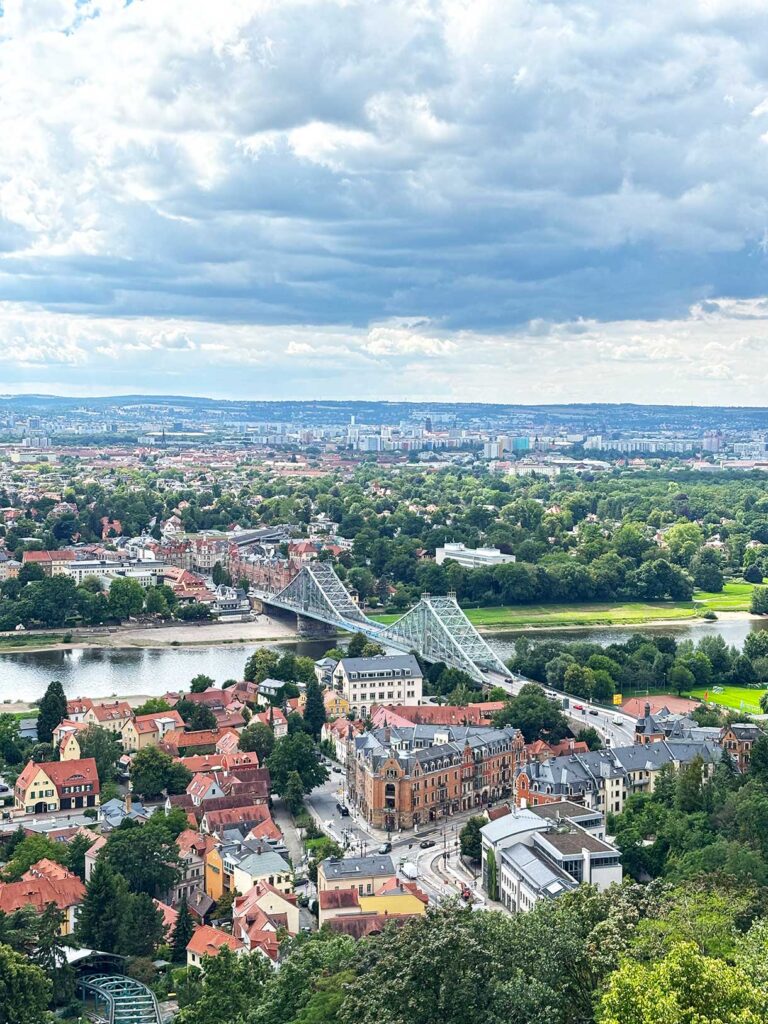
At the top of the suspension railway in Dresden there is a panoramic viewing platform. Located about ten meters higher than the station itself, it is accessible via outdoor stairs, or by a small, glass-walled elevator.
On the observation deck there is information about the different city monuments that are visible from the platform, as well as a little bit of information about the operation of the suspension railway.
I believe that you can also join an inexpensive tour of the mechanical operating room, if you’re extremely interested in historic suspension railways and how they work. Reach out to DVB by email or by phone at +49 351 8572410 for more information. I would be surprised if tours are available in languages other than German but you never know.
Dresden Suspension Railway Café
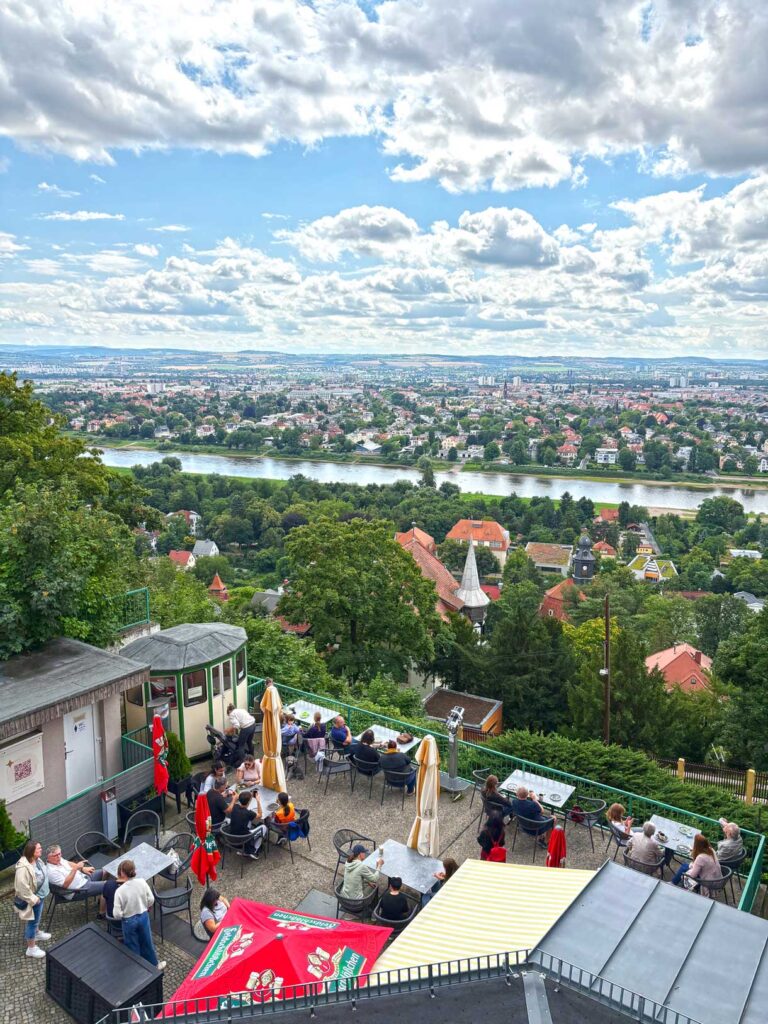
Of note, there is a café at the top of the Dresden cable car, called the SchwebeCafé. It has open-air seating with a panoramic view of the Elbe River Valley.
On the menu you’ll find drinks including beer, soda and coffee, as well as some very simple snacks and meals like pizza, sausages and the local cheesecake, Eierschecke. Prices are reasonable considering the location, but tables can fill quickly (especially around sunset on a clear evening).
All About The Dresden Funicular

Just a block away from Dresden’s suspension railway you’ll also find the city’s historic funicular station. This historic railway is slightly older than the suspension railway, having opened in 1895. At that time it was powered by steam, but today it is electric. As with all funiculars, this train works by having the weight of the descending train pull the ascending train up the hill.
The Dresden funicular track is nearly double the length of the suspension railway, measuring 547 meters in length and covering a total elevation gain of 94 meters. It is slightly larger than the suspension railway, with seating for 60 passengers in each car.
The five-minute journey on the Dresden funicular begins in a covered tunnel, but the tracks quickly open and offer views of the surrounding villas and the Elbe River. I always like to imagine what it must be like to live in one of the houses along the tracks, with the historic train passing by your backyard every day for the past hundred years.
Ticket prices and conditions are the same for the funicular as for the suspended railway (noted above). If you have a return ticket you are allowed to go up via one mode of transportation and down via the other, which is a nice way to experience both the suspension railway and the funicular.
What’s Nearby in Loschwitz
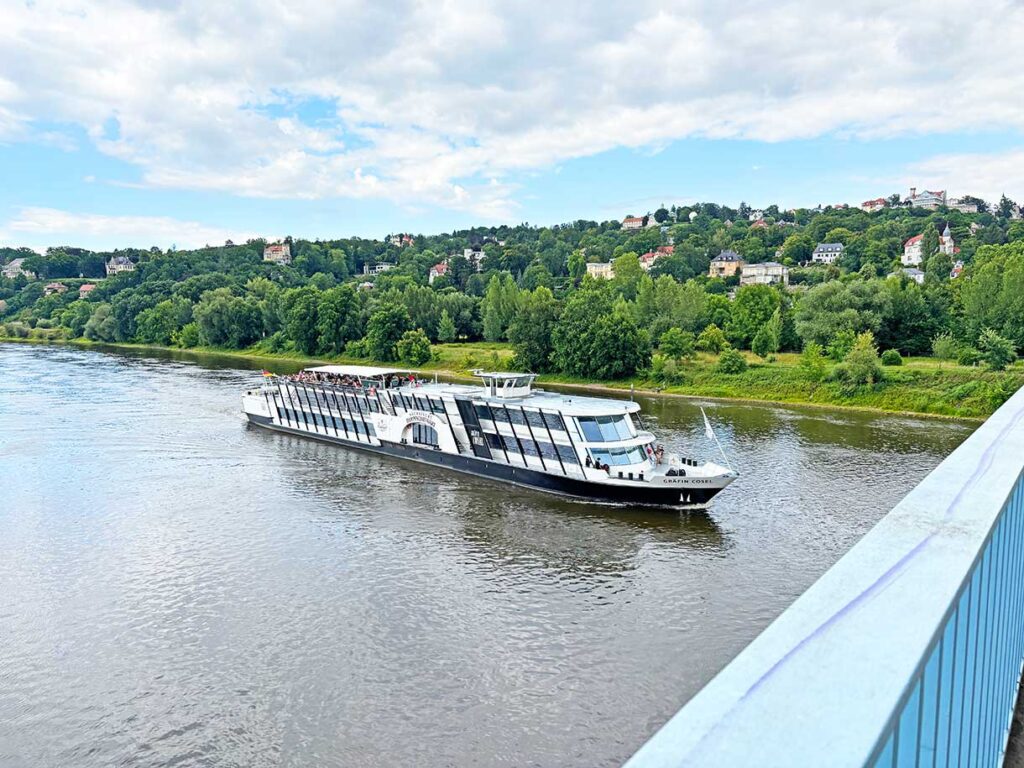
Loschwitz is a very cute neighbourhood that historically has been home to Dresden’s wealthiest and most prominent residents. Today, there’s a small commercial district with shops, restaurants and cafes along the waterfront, and then an entire villa district with historic mansions in the forested hills that rise from the riverbanks.
A few sights in Loschwitz that you might want to check out include:
- Schloss Eckberg – A merchant commissioned this Neo-Gothic, English-style manor in the 1850s. It was renovated in the 1990s and reopened to the public as a hotel, restaurant and event center. If you’ve always dreamed of staying in a hilltop castle you can reserve a room – they’re surprisingly affordable! Just be sure to book a castle room, not an annex room, if you want the full experience.
- Schloss Albrechtsberg – Baroness von Stockhausen bought the land here (from a Scottish lord) on behalf of Prince Albrecht of Prussia, with the goal of building a truly Prussian palace. The courtyard is typically open daily from 10:00 to 18:00, but access to the castle interior is limited to those who have booked a private or public tour. At publication time no public tours are scheduled, but private tours can be arranged on the castle website.
- Lingnerschloss – Less palatial than the previous castles, Lingnerschloss was previously owned by the founder of the Deutsch Hygeine Museum. The castle isn’t typically open for visitors (though it can be booked for special events). Instead, visitors come to stroll the open castle grounds and dine at the popular terrace restaurant.
- The Blue Wonder – The real landmark of the Loschwitz district is the Loschwitz Bridge, known as “The Blue Wonder”. Spanning 280 meters across the Elbe River, it was a miracle of modern construction technology when it was built the 1980s. While it initially opened as a toll bridge, it has been free to cross by car or by foot for the past 100 years.
- Loschwitzer Kirche – George Bähr was the architect of Dresden’s Frauenkirche, and this was the first church that he designed in the early 1700s.
- Luisenhof Restaurant – If Bruhl’s Terrace is the “balcony of Europe”, then Luisenhof is the balcony of Dresden. Opened in 1895 atop the hill in the Weißer Hirsch (“White Deer”) neighborhood, this is a popular restaurant for both traditional German and contemporary fusion cuisine. Vegetarian options are available.
Sightseeing boats depart from Bruhl’s Terrace in the city center and sail along the river to Loschwitz, offering some of the best views of the neighborhood.
Planning a trip to Saxony? These are a few of my Saxony travel guides that might also interest you:
🗺️ How to Spend Two Days in Dresden, Germany
🎞️ 15+ Fun Things to Do in Görlitz, Saxony
🚂 How to Ride the Narrow-Gauge Railway from Zittau to Oybin
🎨 Kunsthofpassage: Dresden’s Secret Art Passage
⭐ Neustadt vs. Altstadt in Dresden: Which is Better?
💎 Terra Mineralia: Europe’s Best Gemstone Museum
🪨 10 Things to Do in Freiberg, Saxony
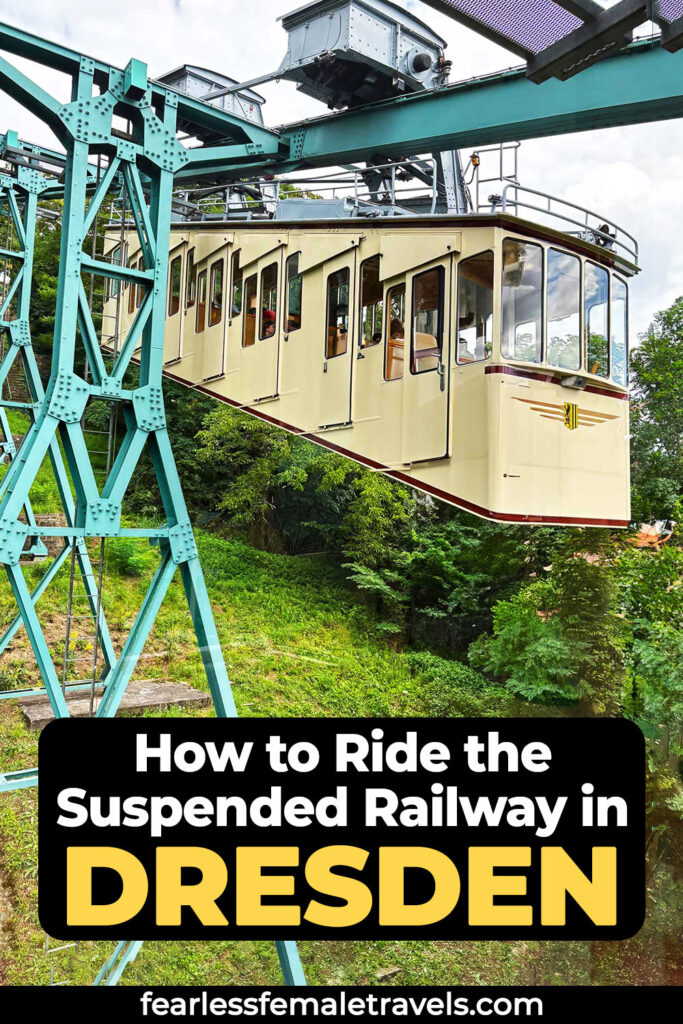
Planning a trip to Germany? Pin this post for later!
 |
 |