

When you’re in the trip-planning stages, it can feel impossible to narrow down what to see in Paris, France. As the world’s second most-visited city, Paris has literally thousands of tourist attractions and things to do during your visit. So what is actually worth your time and money in Paris?
I’ve been to Paris several times, and over the course of these trips (the most recent being a few months ago) I’ve narrowed down my favorite things to see and do in Paris. My own travel style is a bit eclectic (whose isn’t?) and I like to travel slowly enough that I can see a city’s main tourist attractions while also exploring more off-the-beaten-path locations.
Below, I’m listing FIFTY of my favorite things to see in Paris, along with my personal quick tips for making the most of your time at each one. Consider this post your Paris trip inspiration, or even your Paris trip planning starting point.

What to See in Paris: Museums
There are more than one hundred museums in Paris, so unless you’re moving to France you’ll probably never have the chance to visit them all. Which museums in Paris are worth visiting? Start with these twelve Paris museums, which are among the city’s most popular attractions (for a good reason!).
1. The Louvre

The Louvre is the world’s most-visited museum, welcoming almost three million visitors every year.
The Louvre hosts many famous works. Obviously, The Mona Lisa is the biggest draw here, and guests line up hours early to rush inside when the doors open and make a mad dash for da Vinci’s famous painting. Liberty Leading the People is an iconic representation of the French Revolution, while the Venus de Milo has captured viewers’ imaginations for almost two thousand years.
The Louvre is included in the Paris Museum Pass. I have a complete guide to getting the most value from a Paris Museum Pass. Click over to read it and see why I recommend saving The Louvre for your second day of sightseeing in Paris.
2. Musée d’Orsay

Many visitors to Paris remark that they enjoyed visiting Musée d’Orsay more than The Louvre. If you love Impressionist and post-Impressionist art, then you’ll definitely want to visit the Musée d’Orsay during your trip to Paris.
Located in a renovated train station, Musée d’Orsay showcases about 3,000 works at any given time. Some of the most famous paintings here include Van Gogh’s self-portrait and his Starry Night Over the Rhone (painted in Arles), Manet’s Olympia and Renoir’s Bal du moulin de la Galette.
Television host Rick Steves has a free app with audio guides to both Musée d’Orsay and The Louvre. I highly recommend following his recommended route through both museums.
Like many other attractions on this list, you should reserve an entry time at the Musée d’Orsay. Find out when reservations open in my new guide here.
3. Centre Pompidou

Note: The Pompidou Center closed in March 2025 for a period of approximately five years. 🥲
Centre Pompidou is France’s most important museum of both modern and contemporary art. At the time of its construction, in the 1970s, the building’s design sent shockwaves worldwide. By placing the electrical, water and ventilation systems outside the building, along with a “caterpillar”-shaped escalator, the museum’s architects challenged French architectural norms.
Inside the museum features several floors of rotating exhibits and permanent galleries. Among the museum’s “VIP” pieces are works by Matisse, Chagall, Mondrian and Miro.
Centre Pompidou also has beautiful outdoor terraces with stunning views over Paris. The rooftop Restaurant Georges also offers unparalleled views of the city, and is the perfect option for a special evening out in Paris.
4. Musée de l’Orangerie

Musée de l’Orangerie is home to eight of Claude Monet’s Waterlilies murals, and the museum itself was designed to accommodate these large Impressionist works.
You only need about 30-45 minutes to see Monet’s famous paintings, and another hour or so if you want to see the rest of the modest Impressionist collection. The museum is just across the Tuileries Gardens from the Louvre, so it’s easy to pop by after you’re done with the larger museum (do reserve your entrance time in advance though!).
5. Musée National Picasso-Paris

While you will find smaller Picasso museums in a number of other locations, the Musée National Picasso-Paris is considered to be the world’s best collection of works by Pablo Picasso.
There are almost 300 paintings here, even more sculptures, and almost two thousand additional sketches and drawings.
The Picasso Museum in Paris is housed inside the Hôtel Salé, one of the grandest Parisian houses built during the 1600s. Once you’re done viewing Picasso’s works, head to the private gardens behind the building for a peaceful escape from the crowds.
6. Rodin Museum

Like the Picasso Museum, the Rodin Museum is also located in a stunning heritage building in Paris. Rodin himself chose the Hôtel Biron as the home for the collection of sculptures and other artworks that he donated to the French state.
At the Rodin Museum in Paris you will find a rotating collection of 6,000 sculptures, 8,000 drawings and 8,000 other works of art. A collection of that size can’t fit into the Hôtel Biron, so it’s split between this city-center location and a second site at the Villa des Brillants in the Parisian suburb of Meudon.
7. Montmartre Museum
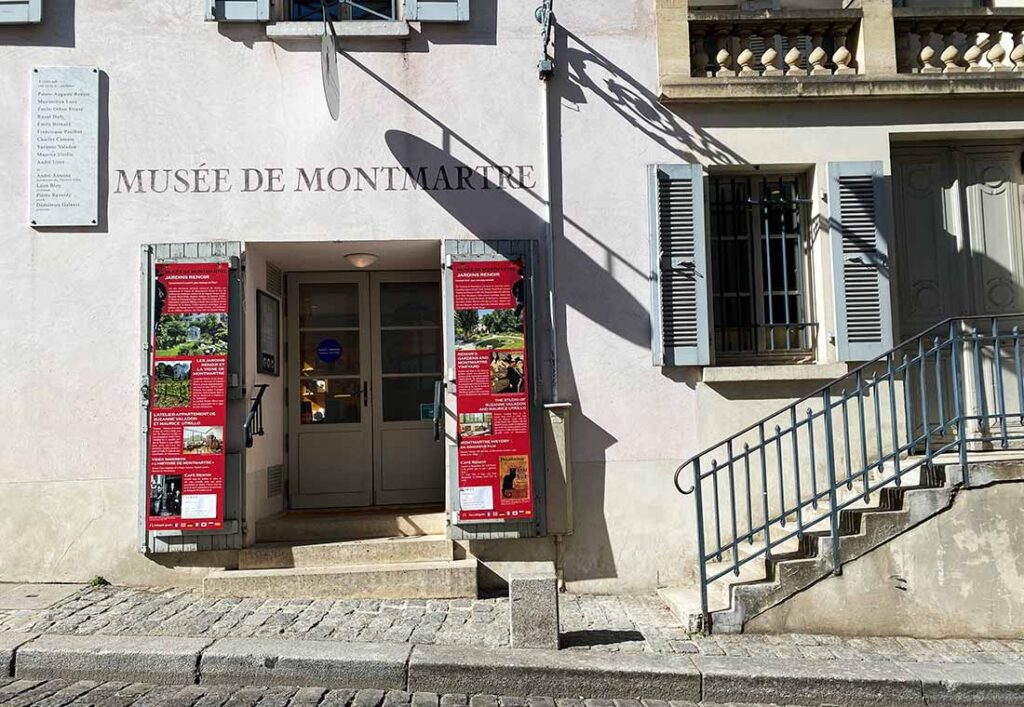
If you were inspired by movies like Moulin Rouge and Midnight in Paris, the Montmartre Museum will further capture your imagination.
Inside the museum you can visit the artist Suzanne Valadon’s former studio, and see a collection of drawings, paintings, photos and artifacts that tell the evolving story of life on Paris’ famous hill.
This is also a fantastic place to stop for lunch in Montmartre. Behind the museum, Café Renoir serves up light lunchtime fare in a garden environment inspired by the works of Auguste Renoir, a former resident of the museum building.
💶 Wondering how much all this sightseeing costs? Check out my new article about budgeting for a trip to Paris. 💶
8. Museum of the Art and History of Judaism
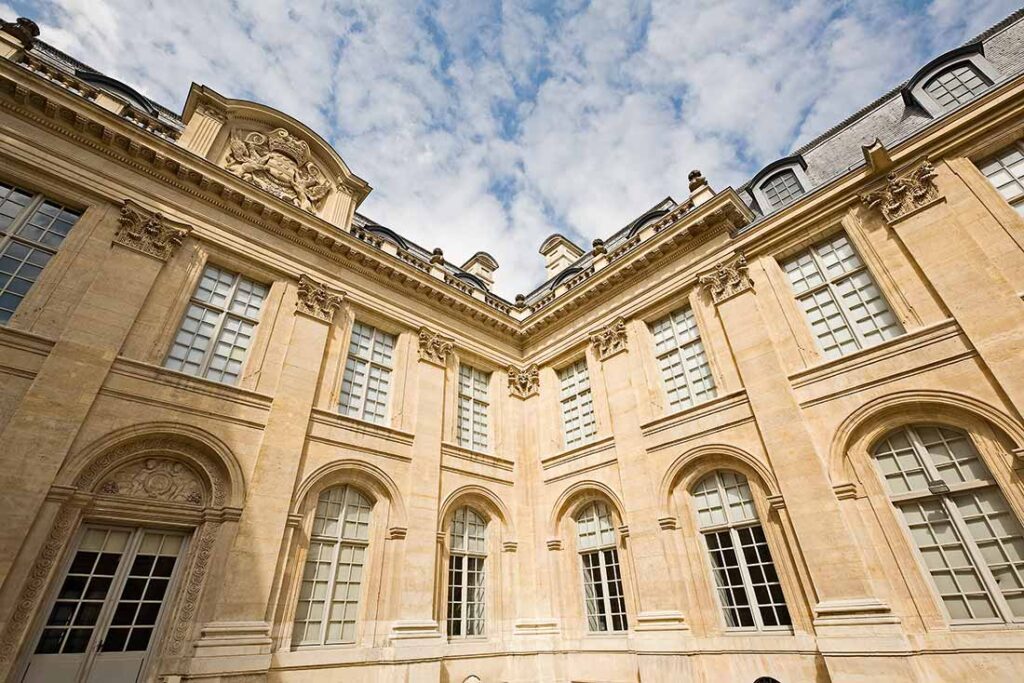
© Paris Tourist Office – Photographer: Marc Bertrand
The Museum of the Art and History of Judaism is located in Le Marais, which was historically Paris’ Jewish Quarter. In 1948, Paris’ first Jewish Art Museum was created by Holocaust survivors. In 1998 it evolved into the current Museum of the Art and History of Judaism in its new location inside Hôtel de Saint-Aignan, a building with a long history of housing Jewish artists and craftsmen.
The museum’s goals are to share the history of Judaism in France (which dates back 2,000 years) and to share the arts and culture of Jewish people with a worldwide audience. Collections include works ranging from ancient to contemporary eras, and spanning mediums including photography, painting, sculpture and religious artifacts.
9. Museum of Natural History
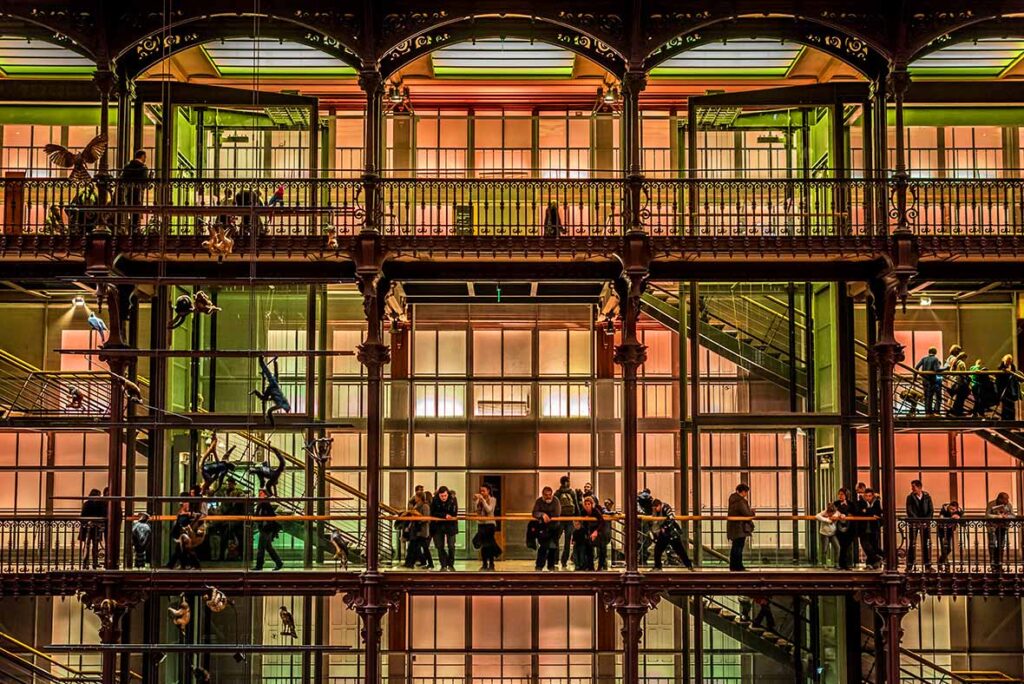
One of the best museums in Paris to visit with kids, the National Museum of Natural History in Paris is literally jam-packed with astounding exhibits.
A clear highlight is the Grand Gallery of Evolution, a huge gallery with more than 7,000 taxidermied animals, skeletons and preserved aquatic life. There are also collections of rocks and minerals, galleries dedicated to paleontology and botany, and a beautiful outdoor plant garden that is free to visit.
10. Cluny Museum

The Cluny Museum is also known as the National Museum of the Middle Ages. Here, in this building that used to be a Roman bathhouse, you’ll find one of the best collections of medieval art and antiquities.
At any given time, about 10% of the museum’s 23,000-piece collection is on display. The most famous piece is the tapestry series of The Lady and the Unicorn, which evoke each of the five senses and a mysterious “sixth sense”. Other highlights include stained-glass panels from Sainte Chapelle church (see below), gold and enamel works from Limoges, and a golden rose that was given by the Pope to the Count of Neuchâtel in 1330.
11. Musée des Arts et Metiers
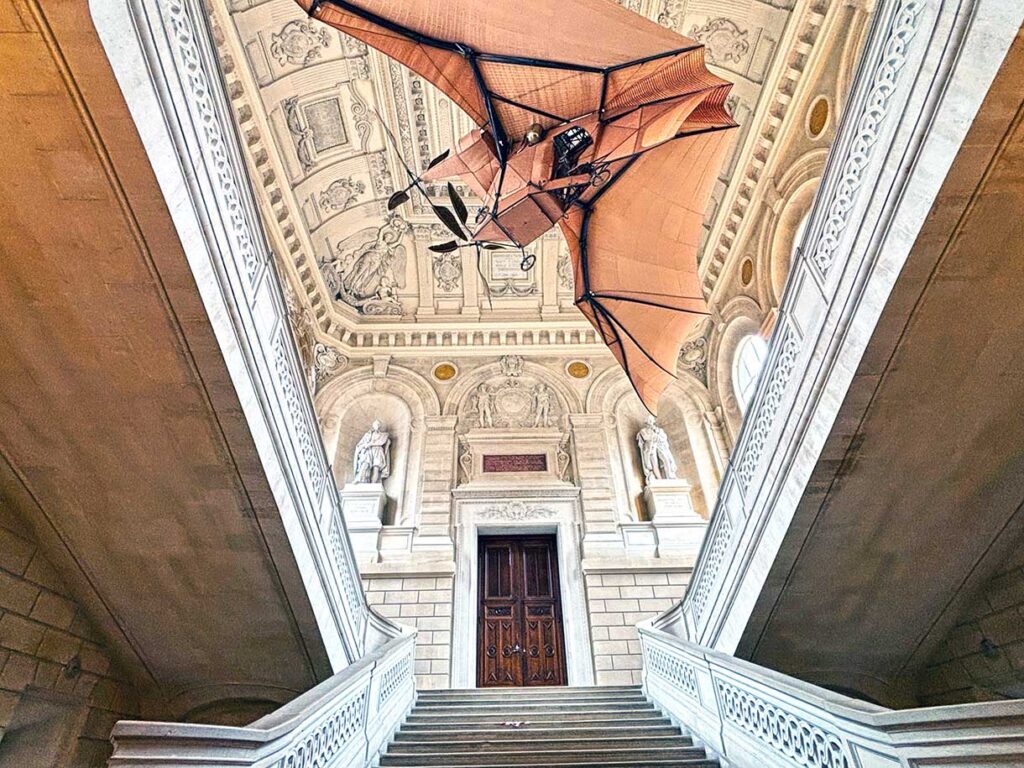
Paris’ Musée des Arts et Metiers, or Museum of Arts and Crafts, celebrates the history of science and innovation in France.
The collections here are organized around seven themes: scientific instruments, materials, energy, mechanics, transportation, construction and communication. You’ll find the original Foucault pendulum here, which was designed by the physicist to explain the Earth’s rotation. Early models of airplanes and automobiles evoke simpler days, while the world’s first mechanical calculator will make you very glad you weren’t a math student during the Renaissance.
12. Musée de la Vie Romantique

© Paris Tourist Office – Photographer: Amelie Laurin
On the southern edge of Montmartre, Le Musée de la Vie Romantique (Museum of the Romantic Life) is an underrated Paris gem. In the 1800s, French Romantic artists flocked to this private home to converse over cocktails while listening to live musical performances.
Today, the main floor of the museum is dedicated to French writer George Sand. Sand was born Amantine Lucile Aurore Dupin de Francueil, but used a male pen name to publish her many works. This didn’t bother Chopin, and the two had a steamy eight-year love affair.
Upstairs, there is a rotating collection of temporary exhibits. It’s usually free to visit the main floor, and a paid ticket is only required to visit the temporary galleries (and/or if the temporary exhibits spill over onto the ground floor or into the garden).
Some people say that the Rose Bakery, in the museum’s garden, is one of the sweetest spots to stop for lunch or a beverage in Montmartre.
What to See in Paris: Landmarks
These quintessential Paris landmarks are some of the city’s top things to see, whether you choose to buy an admission ticket or simply admire them from afar. Actually, some of these Paris landmarks are totally free to visit, so they’re perfect for budget travelers in Paris.
13. Eiffel Tower

Possibly the world’s most recognizable landmark, the Eiffel Tower is a must-see on every trip to Paris.
If you want to ascend the tower, book your tickets well in advance. If you’re visiting Paris in high season, you might want to consider a guided, skip-the-line ticket to make the most of your time here. I recommend taking the elevator to the top, where there are two floors of panoramic viewing decks (one indoor, one open-air) and amazing views of Paris.
If you’re in good shape (and wearing comfortable shoes) you can save almost 50% of the ticket cost by purchasing a ticket with second-floor access via the stairs. The second floor is about halfway up the tower, and it’s the ideal spot to watch the hourly light show that illuminates the Eiffel Tower every evening.
⭐ Can’t decide the best time of day to visit the Eiffel Tower? Read my guide! ⭐
Of course, you don’t have to ascend the Eiffel Tower! I did go up on my first visit to Paris, but on my return trips I just admired it from street level. There are great, free views of the Eiffel Tower from Sacre Coeur Basilica in Montmartre, from the Champs-de-Mar in front of the tower, and from the pedestrian walkway on the Bir-Hakeim Bridge.
14. Arc de Triomphe

For more than 100 years, Paris’ Arc de Triomphe was the tallest monumental arch in the world. Today, a few other arches stand taller, but none stand as famously.
Access to the panoramic viewing platform atop the Arc de Triomphe is included in the Paris Museum Pass. If you don’t have a Paris Museum Pass, you’ll want to buy your tickets in advance to avoid a long, crowded underground queue at the ticket booth.
From the top of the Arc de Triomphe you’ll have amazing views of the Champs-Élysées (see below), the Eiffel Tower, and Palais Garnier (see below), all the way to Montmartre!
15. Champs-Élysées

The grandest of Europe’s grand avenues, the words “Champs-Élysées” are synonymous with luxury and grandeur. I recommend starting atop the Arc de Triomphe, and then walking down the Champs-Élysées all the way to Place de la Concorde.
As you walk along the Champs-Élysées you’ll see a number of Paris’ most beautiful buildings, including the Grand Palais and the Petit Palais. This is also where you’ll find the flagship stores for many luxury brands, including Christian Dior, Guerlain and Louis Vuitton.
16. Catacombs
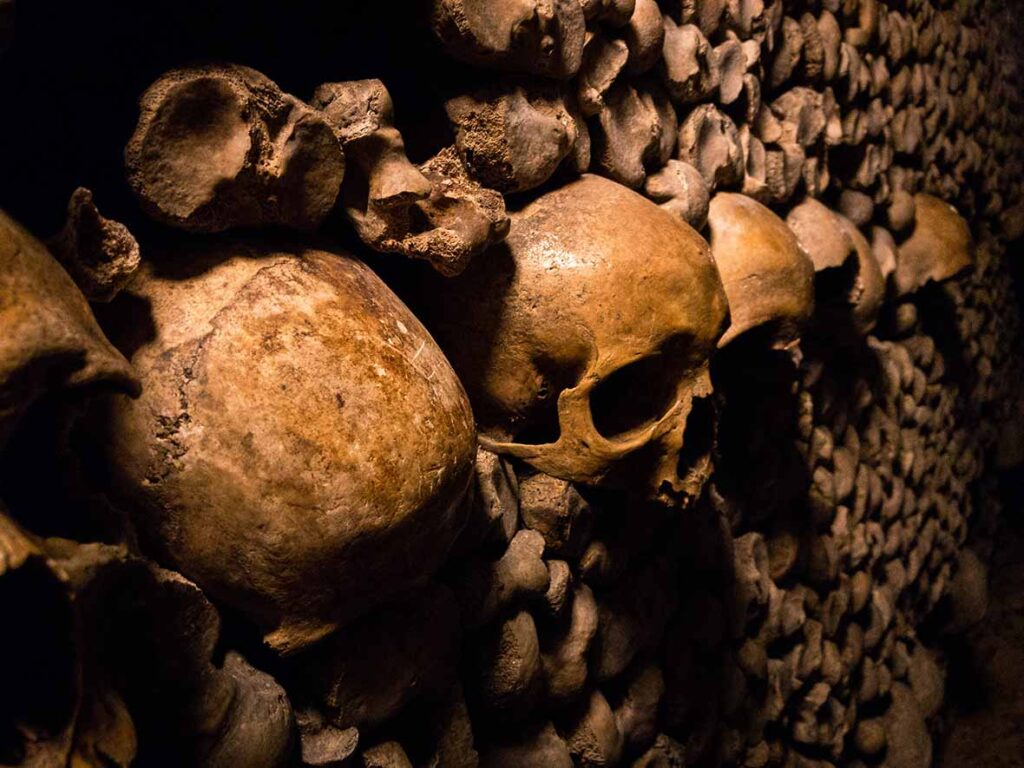
In the late 1700s, Paris’ cemeteries were overflowing. The solution? The city exhumed millions of bodies and moved them into these former quarry tunnels, located about twenty meters underground.
There are actually more than 300 kilometers of tunnels lined with human remains, but the pathway that is open to tourists is only about 1.5 kilometers. For your own safety, do not even think about venturing out of the approved areas.
The catacombs are one of the most popular things to do in Paris, so it’s advisable to book your tickets well in advance. They sometimes sell discounted last-minute tickets (available one day in advance if they’re not sold out) but these get snapped up quickly and they rarely have more than one ticket available at any given time slot.
17. Vendôme Column in Place Vendôme
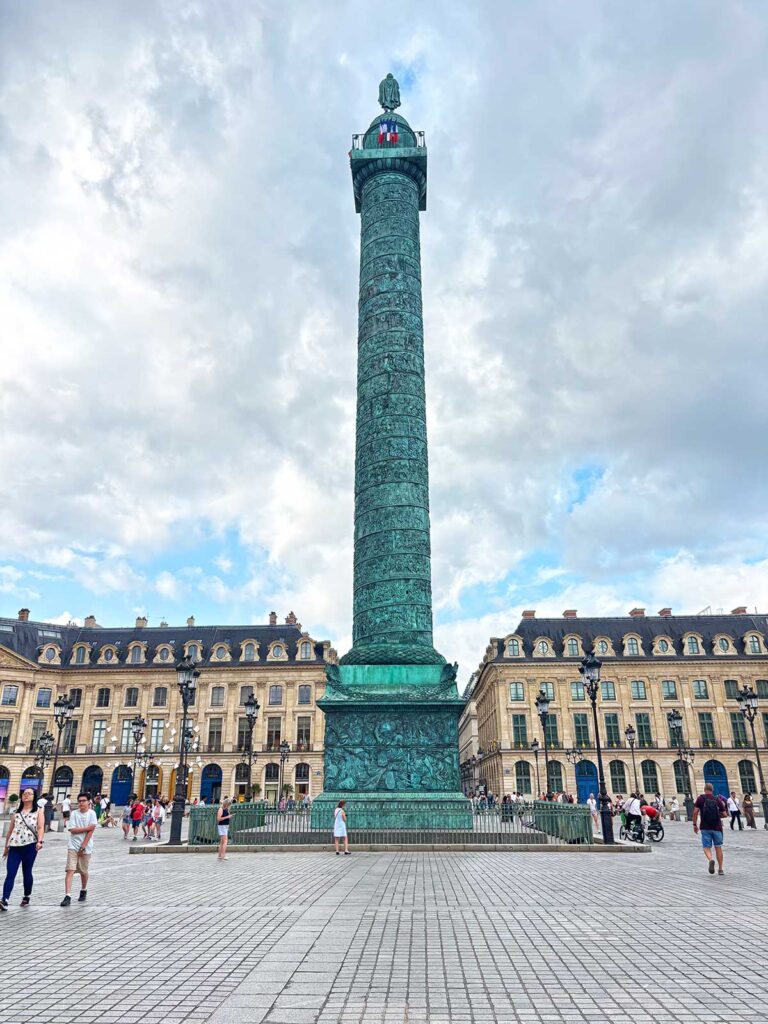
Place Vendôme is located in the heart of Paris, midway between the Tuileries Gardens and Palais Garnier opera house. At the heart of the plaza is the Vendôme Column, one of Paris’ most famous landmarks.
Napoleon ordered the construction of the Vendôme Column in 1806, and it was erected about four years later. The column is wrapped in more than 400 bronze panels, each sculpted with scenes from France’s victory at the 1805 Battle of Austerlitz. Atop the column? Napoleon himself.
Place Vendôme is lined with hôtels particuliers, or grand townhouses once owned by France’s richest families. This is where you can find the Hotel Ritz Paris, one of the most luxurious hotels in the world (Coco Chanel checked in for a short visit and ended up staying for 34 years!).
18. Place du Trocadero
Just across the river from the Eiffel Tower, Place du Trocadero offers some of the best views of the Eiffel Tower. Don’t be surprised if you see a marriage proposal (or two!) at this Instagrammable Paris landmark.
The Palais de Chaillot’s pretty terrace (shown above) is the perfect frame for all your shots of the Eiffel Tower. But don’t stop there! Inside the building there are a number of museums worth visiting, including the National Navy Museum, the Museum of Mankind, and the City of Architecture and Heritage.
19. Memorial to the Martyrs of the Deportation
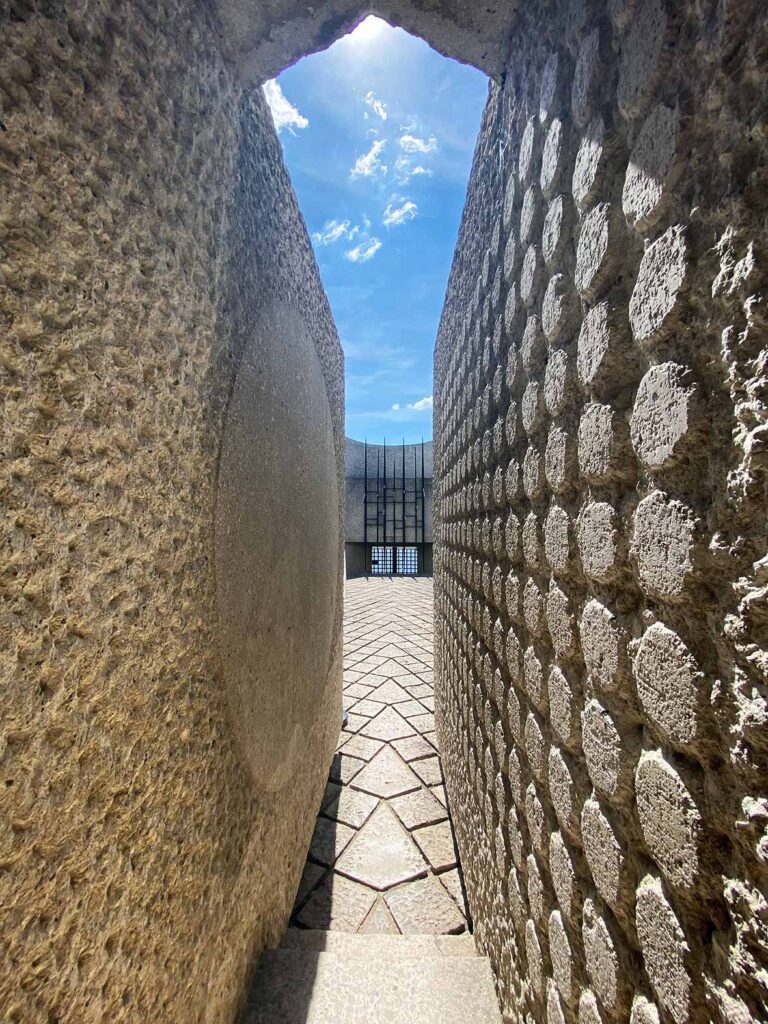
Every day, thousands of tourists walk right past this Paris landmark without realizing they’re passing by one of the city’s most thought-provoking landmarks.
Hidden behind Notre Dame Cathedral, the Memorial to the Martyrs of the Deportation is a memorial to the 200,000 people who were deported from France to Nazi concentration camps during World War 2.
Admission to this memorial is free. Inside, you descend one of two narrow staircases to a waterfront rotunda. Here, there are two small chapels containing soil and human remains from concentration camps. In another dark chamber, a crystal-lined tunnel is illuminated by a single light at the end of a long tunnel.
It’s a somber, sobering place of reflection that I would encourage you to visit if you’re in the vicinity.
20. Grande Arche de la Defense
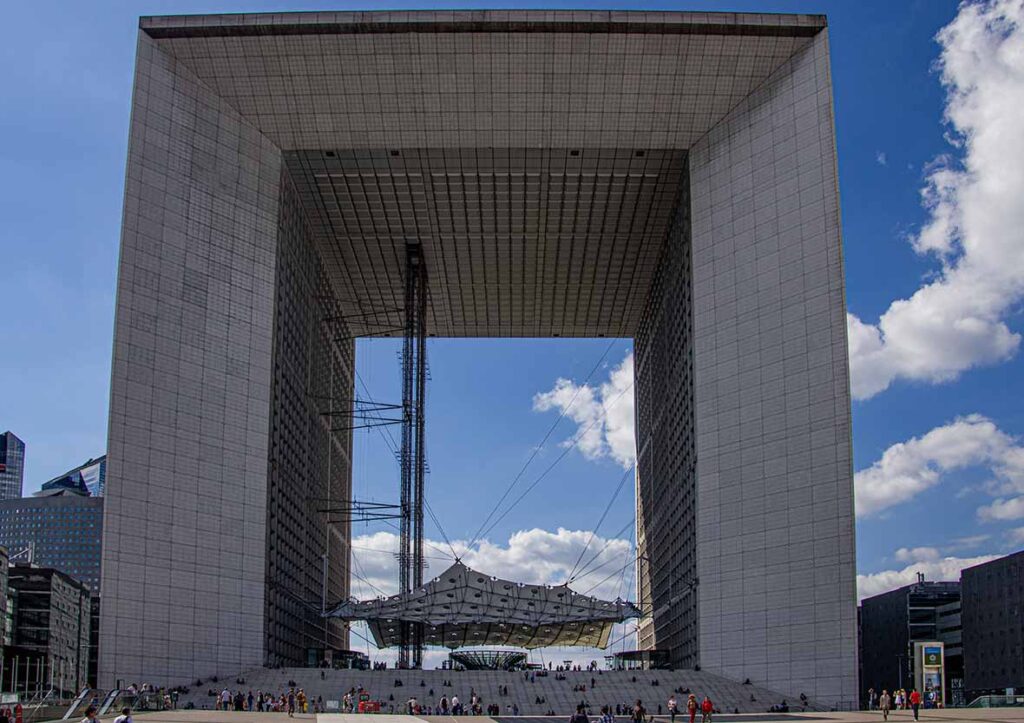
La Defense is Paris’ business district. Located about three kilometers west of Paris’ city center, La Defense is famous for its breathtaking Grande Arche de la Défense (and also for being where Alfie from Emily in Paris lives).
Designed to be a modern interpretation of the Arc de Triomphe, the Grande Arche de la Défense is 110 meters of concrete and glass. Beneath the tower, “Le Nuage” (The Cloud) is suspended over the open space.
At publication time, a €15 ticket gives visitors access to the rooftop terrace atop the arch, which includes a 100-meter footbridge with panoramic city views.
21. Moulin Rouge
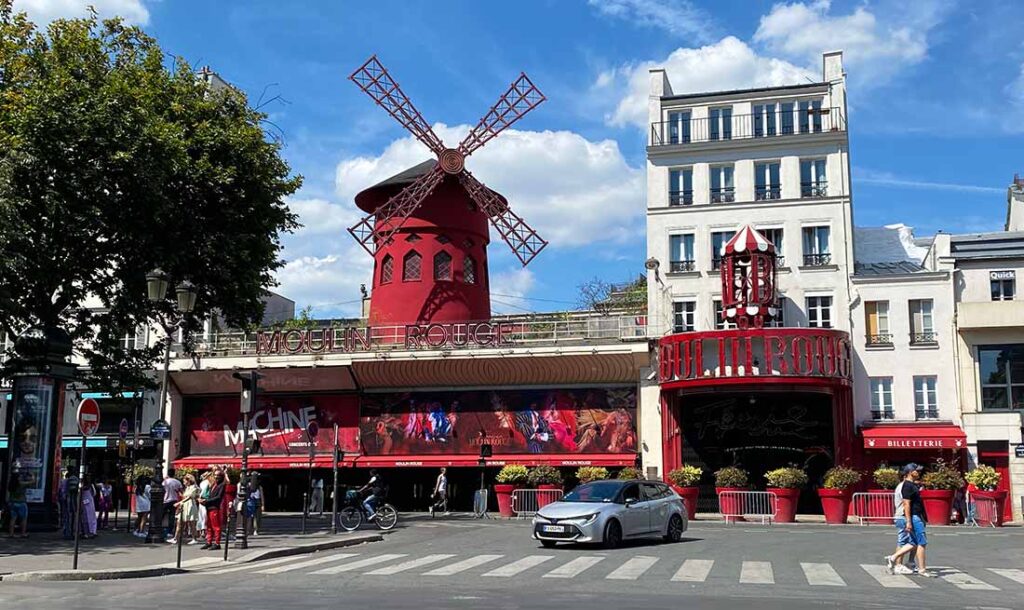
You’ve heard the song, you’ve seen the movie, and now that you’re in Paris you can see the famous cabaret for yourself!
Situated on the busiest street in Montmartre, the Moulin Rouge opened in 1889 and is believed to be the birthplace of the can-can. In its heyday, the Moulin Rouge welcomed performers including Edith Piaf and Josephine Baker.
Today, the Moulin Rouge building is home to both the original cabaret and a modern nightclub (“Machine”). You can pass by for a quick photo (like I did), or you can purchase tickets to see the cabaret show. Depending on the day of the week, options include matinee and evening shows, with or without an included meal.
22. Conciergie

A stark monolith, La Conciergie was born a royal palace, but converted to an infamous prison that held countless revolutionaries during France’s Reign of Terror.
The main draw here is the former cell of Marie Antoinette, who was imprisoned here in the months leading up to her beheading by guillotine. Shortly after her death, the cell where she stayed was converted to a small chapel, and today it is preserved in that state.
23. Palais Garnier
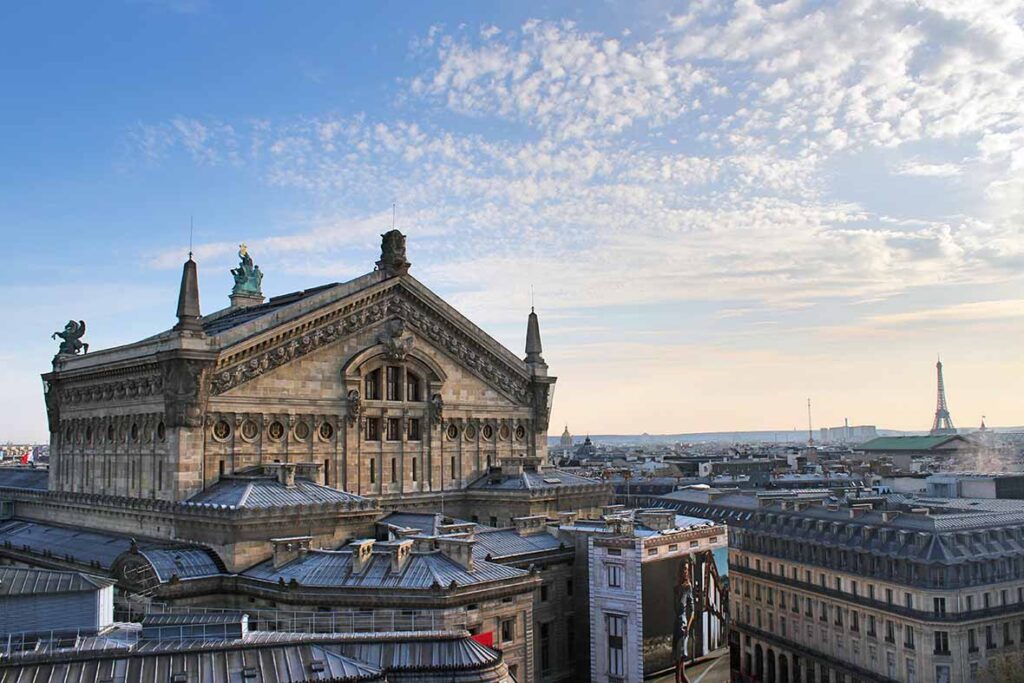
France’s national opera is based in the stunning Palais Garnier, a 19th-century opera house in the 9th Arondissement. You can visit to take in a performance, or simply to revel in its amazing architecture.
There are both guided tours (email the opera house to coordinate) and independent tours of the Palais Garnier. These are available almost every day, from 10:00 am to 5:00 pm. A highlight of any architectural tour is a glimpse of the auditorium’s ceiling, which was painted by Marc Chagall with scenes from several different operas.
In the evening, entrance is restricted to visitors who hold a valid ticket to one of the opera or ballet performances that take place nightly. Although there is no specific dress code, the website does note that “proper attire” is required.
24. Le Mur des Je T’aime (Wall of Love)
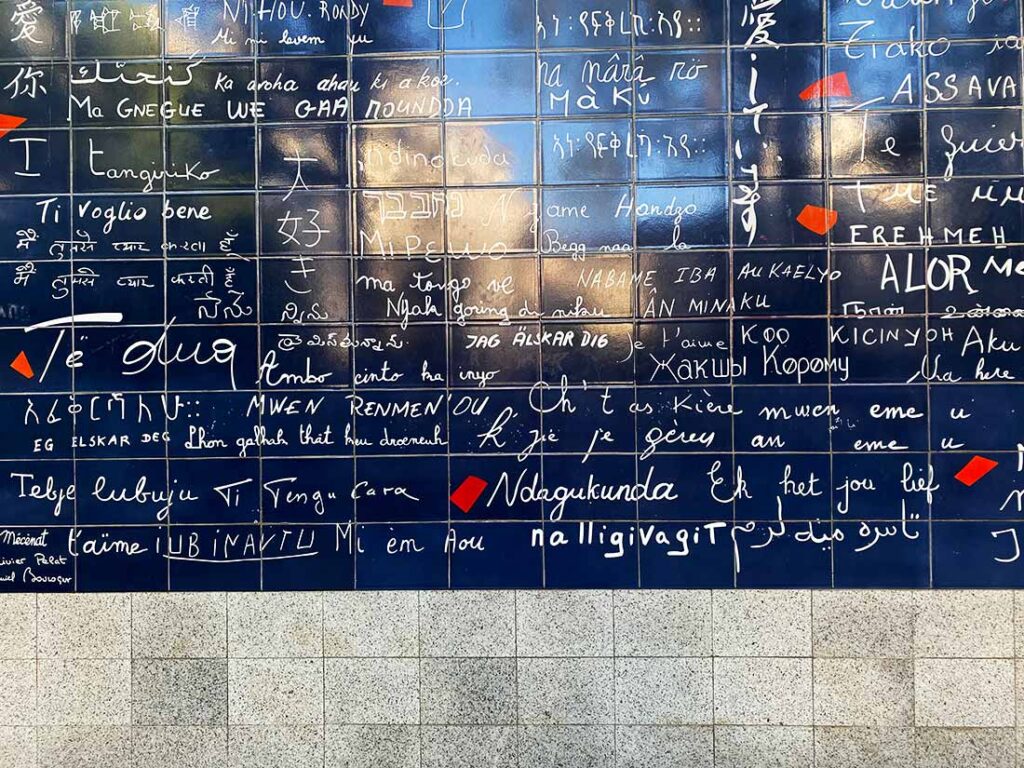
Up the hill from the Moulin Rouge, in a more quiet part of Montmartre, the Wall of Love is a semi-secret Paris landmark.
Tucked away in a little park in Square Jean Rictus, the Wall of Love is made from 612 blue tiles that cover 416 square feet. The wall features the phrase “I Love You” more than 300 times, in 250 different languages. The artists behind the wall collected the translations the old-fashioned way: by asking friends, family and even diplomats to translate “I Love You” into their language.
In the off-season, Paris parks close quite early (sometimes as early as 5:30 pm). Try to visit this Montmartre landmark early in the day to make sure it’s open.
What to See in Paris: Churches
Paris has some of the world’s most famous churches. You don’t have to be religious to visit the churches in Paris. You also don’t have to be rich, as entrance to many of Paris’ churches is totally free. Just be mindful of following basic church etiquette: dressing appropriately, avoiding flash photography, staying quiet and avoiding designated prayer areas unless you’re actually planning to pray.
25. Notre Dame

Of course, Notre Dame is one of the most important churches in Paris and a must-visit on your trip to the city.
The cathedral’s exterior is famous for two things: the large flying buttresses that support its heavy walls, and the many gargoyle figurines that some believe are intended to scare off evil spirits.
Inside the church, highlights include the beautiful stained glass windows, the treasury filled with valuable relics (including the Holy Crown of Thorns) and the views of Paris from the two-level bell towers.
26. Sainte-Chapelle

Next door to the Conciergie (one of the best landmarks in Paris, noted above) you will find Sainte-Chapelle, a Gothic chapel famous for its spectacular stained-glass windows. Both attractions are included in the Paris Museum Pass, so you can breeze through them both before continuing to some of the more famous museums nearby.
It is recommended that you visit Sainte-Chapelle on a sunny day to get the full effect of the medieval stained glass windows on the upper floor. There are fifteen stained-glass windows, each made from thousands of tiny pieces of glass, picturing important scenes from the Bible.
27. Sacré Coeur

With Notre Dame out of commission, Sacré Couer (“Sacred Heart”) is now Paris’ most-visited church. It was built in the 1870s, making it one of the newest churches in Paris.
Keep a hand over your purse as you enter Sacré Couer. The crowded steps and plaza in front of the church are popular with pickpockets and other scammers.
Entrance to the basilica is totally free. Inside, take note of the mosaic above the apse (it’s one of the biggest in the world) and consider visiting on Sunday when the giant organ is played at Sunday mass.
An optional €6 ticket gives you access to the Dome, which is reached by 300 spiral stairs. From the top, you have amazing views of Paris (wave to the people at Pompidou Center who are looking your way!).
28. Saint-Sulpice
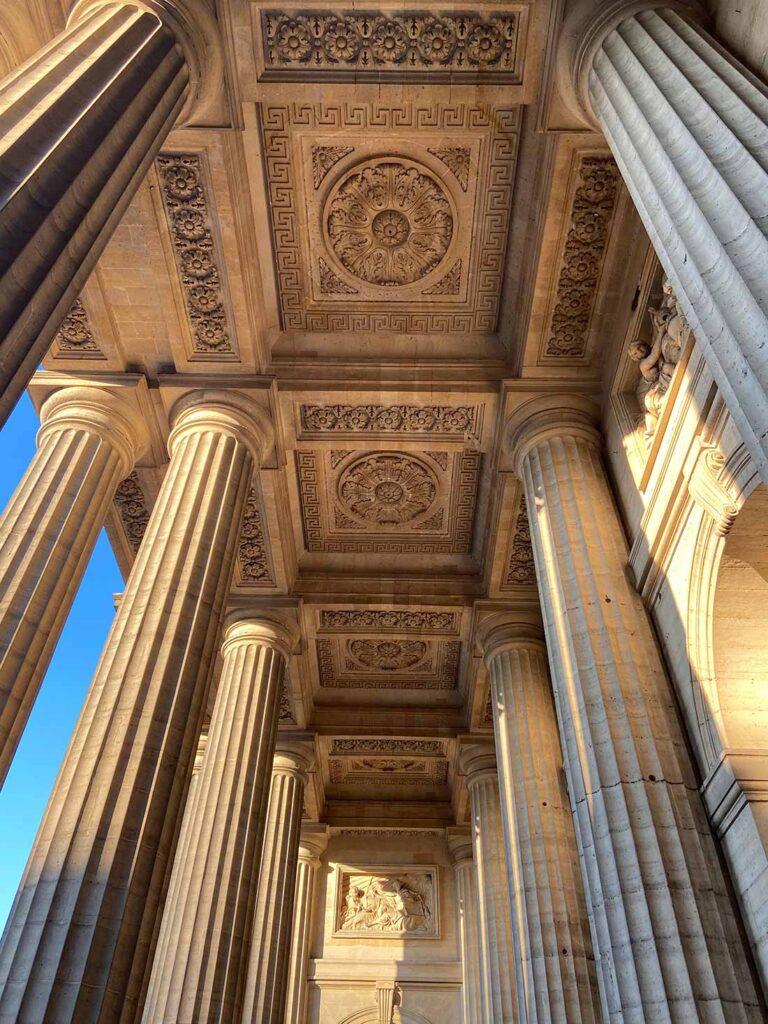
Inside Saint-Sulpice, a unique gnomon, or sundial, helped 18th-century priests keep track of the equinoxes (and therefore the date when Easter should fall). There are also three murals by Delacroix inside the first chapel on your right as you enter the church.
If you have a funny feeling of déjà vu during your visit, it might be because you saw Saint-Sulpice in the movie adaptation of Dan Brown’s “The Da Vinci Code”.
29. Saint-Eustache

Saint-Eustache is so grand that you might think you’ve stumbled across a cathedral or a basilica. However, Saint-Eustache is just a really, really, really big church.
Built over a hundred years, starting in 1532, Saint-Eustache today represents a range of artistic and architectural styles (Gothic, Renaissance and Classical). Inside, the works of art on display range from a painting by Rubens to a bronze triptych by contemporary artist Keith Haring.
The acoustics in Saint-Eustache are especially good, making it a popular concert venue for famous composers such as Mozart. If you’d like to take in a concert at Saint-Eustache, check their website for a list of upcoming performances.
30. Madeleine Church

Are you in Paris, or are you in Ancient Greece? You might not be sure the first time you see La Madeleine, a striking church just four blocks behind Place de la Concorde.
Inspired by the Maison Carrée in Nimes, in the South of France, La Madeleine is surrounded by fifty-two Corinthian columns. Its entrance is guarded by heavy bronze doors, and inside the layout of the interior evokes memories of Roman baths. Be on the lookout for the painting in the half-dome, picturing scenes from the history of Christianity in France, and also for the Neo-Byzantine mosaic depicting Jesus with various French saints.
Beneath La Madeleine there is something very unique: a members-only, non-profit restaurant where a modest annual subscription gives patrons access to affordable, healthy, traditional French meals. If you’re staying nearby for more than a week or two, you might want to consider subscribing!
What to See in Paris: Iconic Neighborhoods
You don’t want to over-plan your time in Paris, because one of the greatest pleasures of any trip to Paris is simply strolling through the city’s streets and taking in the the charming nuances of each district. These are some of the Paris neighborhoods that I recommend you explore by foot.
31. Montmartre

Wear comfortable walking shoes on the day you visit Montmartre, as you’re going to be walking up, up, up and down, down, down some slippery cobblestone hills.
I have a complete guide to spending a day in Montmartre. Of course it hits the highlights like the Moulin Rouge and the Montmartre Museum, but it will also help you find some off-the-beaten-path spots including Paris’ only urban vineyard, a street unexpectedly filled with English-style row houses, Paris’ secret cemetery and more delicious cafes and restaurants than you can count.
If you have limited time or mobility, Montmartre is one neighborhood in Paris where you might want to take a guided walking tour. Working with a professional guide means you won’t have to backtrack up and down the same hills because you accidentally missed a highlight. A few Montmartre walking tours to consider:
- Sacre Coeur Basilica & Montmartre Guided Tour 🤩
- Hidden Gems of Montmartre with a Local (Pastry Included!) 🥐
- 2.5-Hour Belle Epoque Walking Tour 🎺
32. Latin Quarter
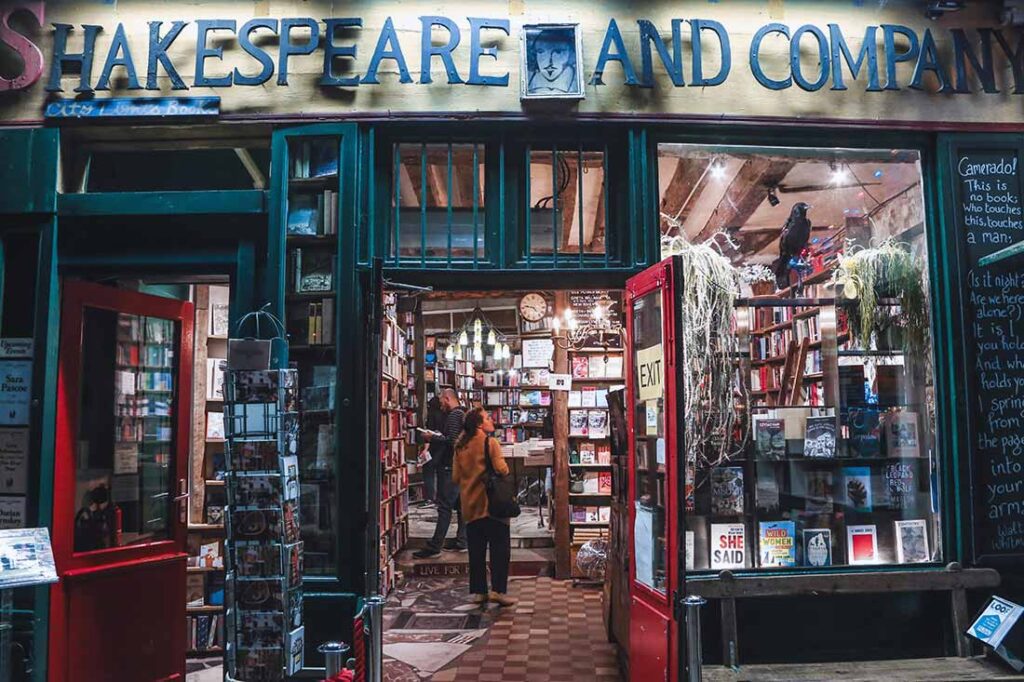
When I told people I was planning another trip to Paris, one of the first things people replied was, “Oh, I’ve always dreamed of visiting Shakespeare and Company.” I considered adding this famous bookstore to the post as a stand-alone landmark, but ultimately decided to group it in with the many different things to see and do in the Latin Quarter district. So yes, this is where you’ll find the world’s most famous bookstore. In the high season, prepare to queue just to get inside!
If you don’t want to stand in line to enter a bookstore, the Latin Quarter has lots of other things to explore by foot. This area is home to the Church of Saint-Séverin, the Cluny Museum (see above), the Sorbonne, the Pantheon and the Ancient Roman ruins at the Arènes de Lutèce.
🛎️ If you’re looking for a comfortable, affordable hotel in the Latin Quarter, check out my review of Hotel Korner Sorbonne.
On my next trip to Paris I want to visit the Grand Mosque of Paris, and take in a traditional steam session and body scrub at their hammam (open to women only). If you’re traveling with a man, or just not into getting naked in front of strangers, the mosque also has a beautiful tea room serving mint tea with sweet or savory snacks.
33. Le Marais

“Marais” is French for “swamp”, but there’s absolutely nothing icky about this beautiful neighborhood in Paris. For years, this district attracted royals and nobility, and the architecture that remains today is evidence of their wealth and prestige.
Many of the museums I recommended above are concentrated in Le Marais, including the Picasso Museum, Centre Pompidou and the Museum of the Art and History of Judaism. As you walk between the museums you’ll inevitably be tempted to do some window shopping, as this is one of the best areas in Paris for shopping at any price point.
Place des Vosges (shown above) is the oldest planned square in Paris. The gardens here are perfect for a picnic (or a play date if you’re traveling with children). Both Victor Hugo and Colette once lived in the apartments lining the park.
For lunch, I recommend stopping at the Marché des Enfants Rouges. This is Paris’ oldest food market, and there are dozens of street food-style stalls serving everything from vegan dishes to traditional French cuisine to dishes from lands that the French colonized, such as Vietnam and Morocco.
34. Canal Saint-Martin
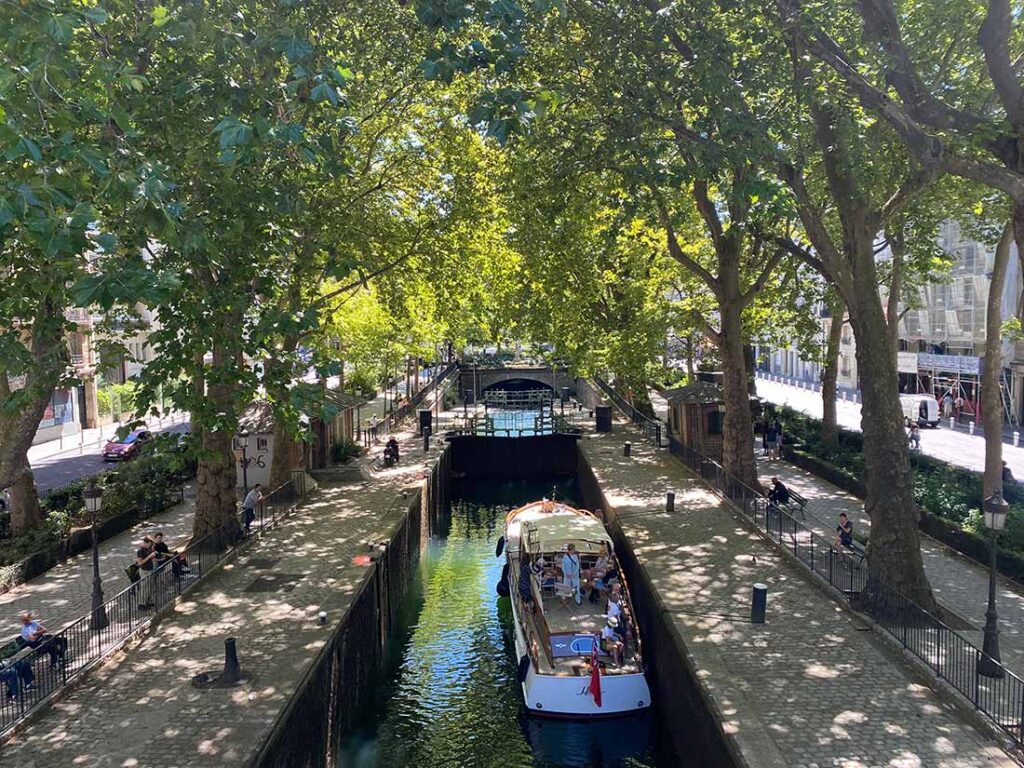
On my most recent trip to Paris, I spent my last morning in the city walking along the Canal Saint-Martin, which is both a beautiful urban waterway and an increasingly trendy neighborhood in Paris.
The canal is almost five kilometers long, though about two kilometers of that are underground. The parts that are visible from street level include a series of locks (shown above), iron footbridges undoubtedly inspired by those in Venice, tree-lined sidewalks with benches under shady chestnut trees and, in the summer, a man-made beach and swimming area in the adjacent Bassin de la Villette (admission is free!).
There are boat tours that will whisk you from the Seine underground to the canal, and up or down the series of locks. If you’re on foot, the streets around the canal are full of pretty parks, budget-friendly restaurants, cozy cafes, independent boutiques and, by night, some of Paris’ hottest bars.
35. Saint-Germain-de-Pres
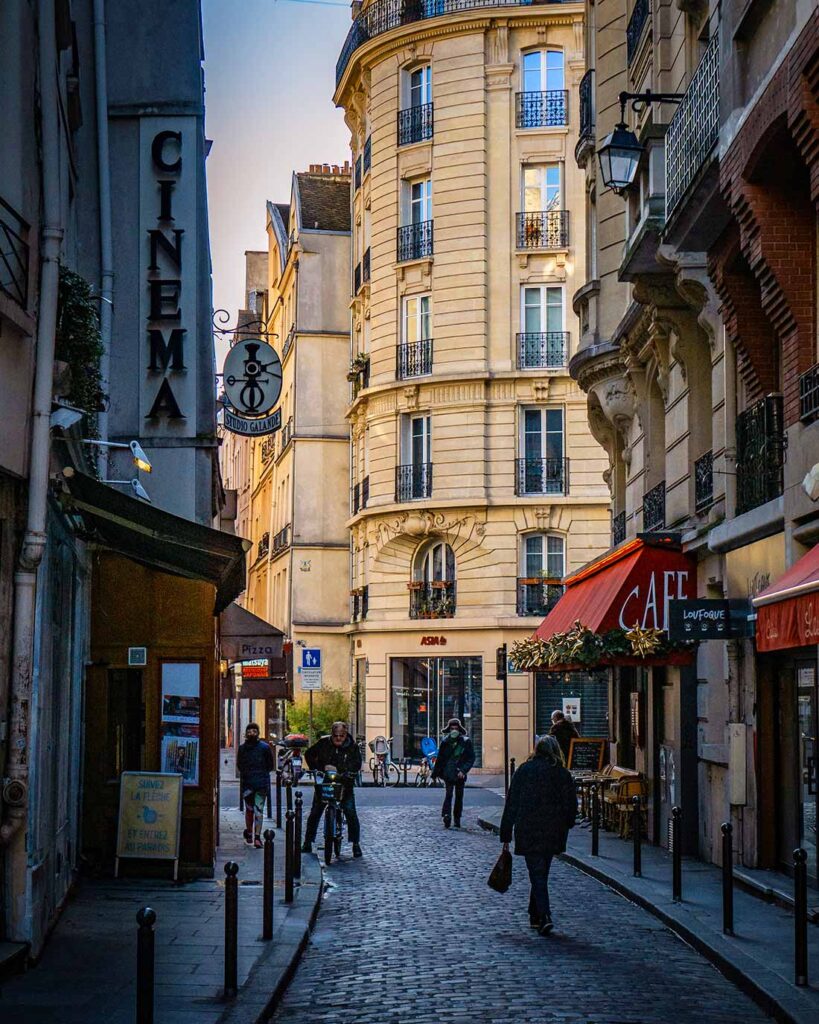
Much like Montmartre, Saint-Germain-des-Prés has a rich artistic and creative history. This is where Sartre and Beauvoir pondered Existentialism in the 1950s, and it’s where the city’s liveliest post-war jazz clubs opened their doors in the decade prior.
The cafes along Boulevard Saint-Germain are big draws, and you’ve probably already seen both Café de Flore and Les Deux Magots in countless Instagram photos.
The Pont des Arts is one of the prettiest bridges across the Seine. It used to be a place where couples left love locks, but as the weight of the locks increased to 45 tonnes the practice had to be prohibited.
At the southern end of Saint-Germain-des-Prés, bordering the Latin Quarter, you’ll find the Luxembourg Gardens. It’s free to stroll through the 25-hectare gardens, which feature both traditional French and English gardening styles. The area around the Luxembourg Gardens is one of the best areas to stay in Paris – click through to see all my hotel recommendations.
36. Île de la Cité
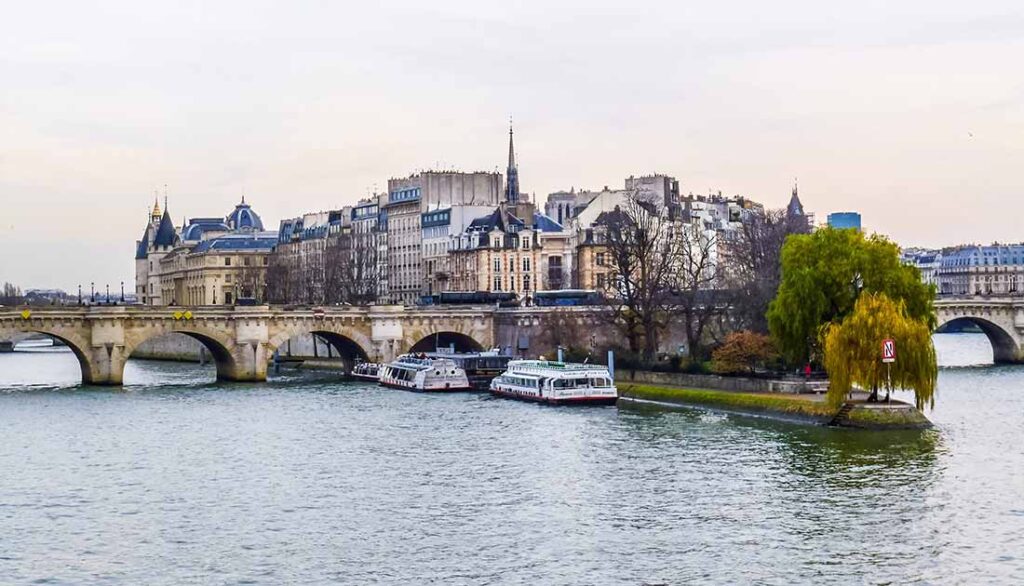
Quite a few of the things to see in Paris that I’ve noted above are located on Île de la Cité, including Notre Dame, Sainte-Chapelle and the Conciergie. Don’t rush off the island once you’ve seen those sights, though! It’s definitely worth spending at least an hour exploring this island in the Seine.
This island was the oldest settlement in what is now Paris. You can get a sense of the original settlements by visiting the Archeological Crypts located underground, in front of Notre Dame.
At the other end of the island, Place Dauphine is one of Paris’ prettiest squares. In fact, you might recognize it from the episode of Sex and the City where Carrie took a wintertime stroll with Aleksandr Petrovsky. From here, you can cross Pont Neuf and be at The Louvre within minutes.
Things to See in Paris: Tours
When you’re tired of planning what to see in Paris, you can relinquish control to an expert Paris tour guide. Whether you like wine, pastries or simply guided sightseeing, Paris will have a tour for you.
37. Wine Tasting
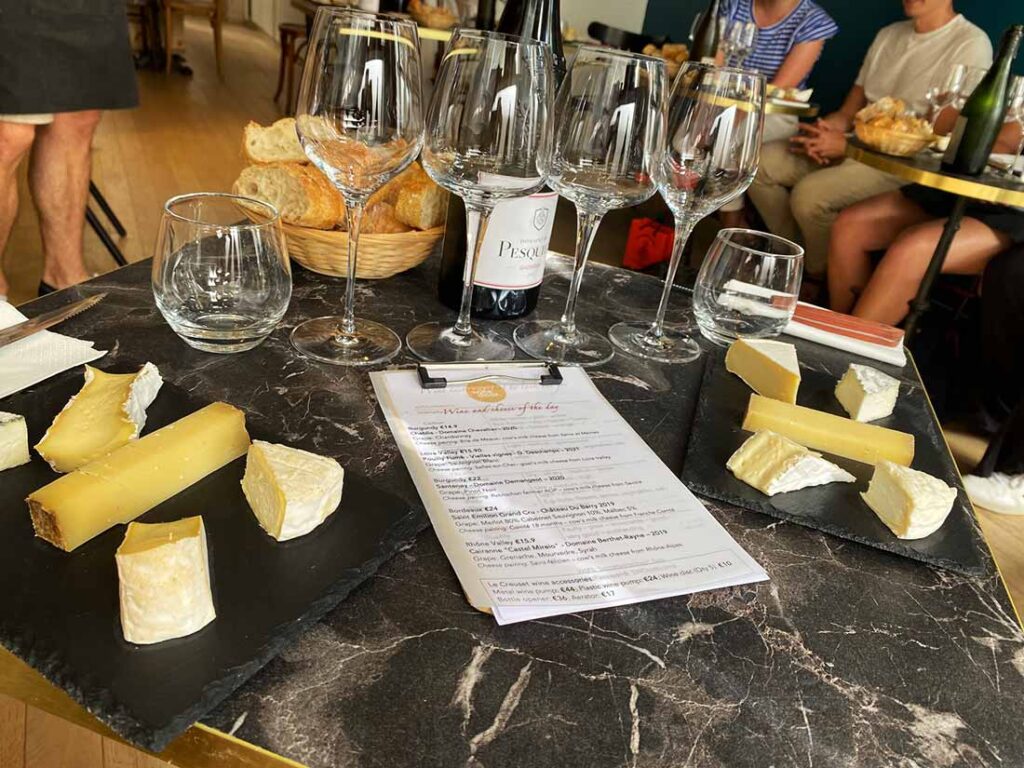
The French love their wine, and Paris is the perfect place to learn a little bit more about the art and science of vin. If that wine happens to come with cheese? All the better.
I’ve done wine and cheese tastings at two places in Paris: Secret Wine Door and O Chateau. In some ways the experience is quite similar (especially with regards to the number of wines and cheeses you’ll try), but in other ways they’re very different. To read about each tasting experience and to figure out which one is best for your Paris trip, you can read my full review.
38. Food Tour
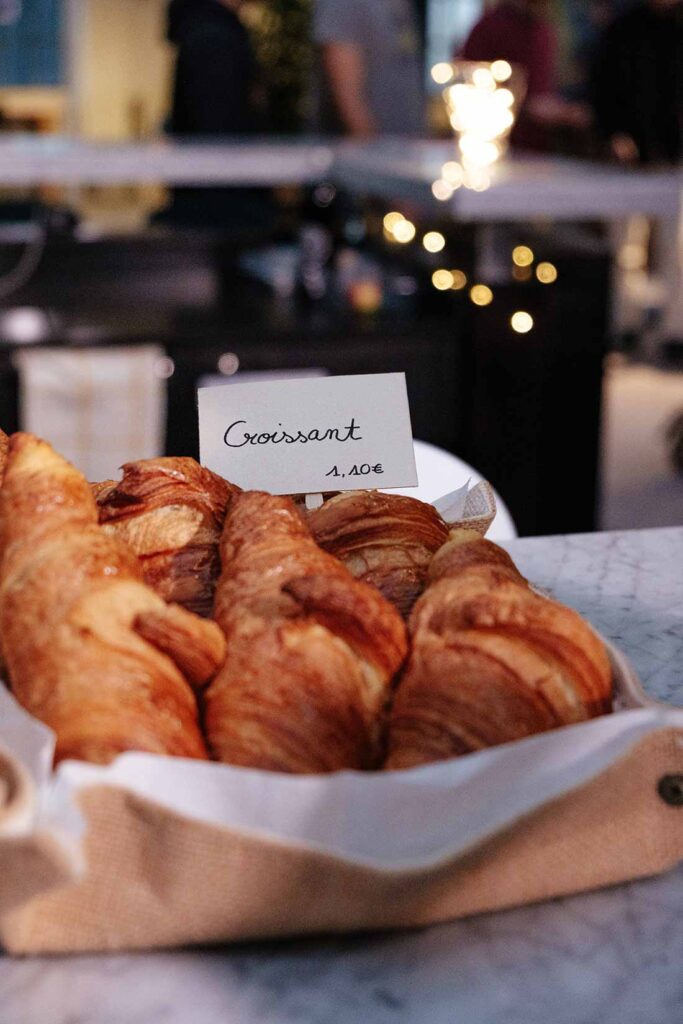
In my article about finding healthy food in Paris, I recommend taking a Paris food tour. On your own, you might be tempted to buy one of everything from every boulangerie and patisserie that you encounter, but on a guided food tour you’ll be able to try bite-sized samples of quintessential Parisian foods without over-indulging.
I am partial to the original Flavors of Paris tour, which was created by a Canadian expat who couldn’t resist the pull of the City of Lights. Expect to sample local delicacies such as macarons, cheese, baguettes, croissants, chocolates, preserves and olive oils.
Other tours that look amazing (but that I can’t personally recommend) include this tasting tour of Le Marais, this Montmartre bistro tour, and this indulgent chocolate and patisserie walking tour. Make sure to let me know if you try one of these (and what your favorite bite was!).
39. River Cruise
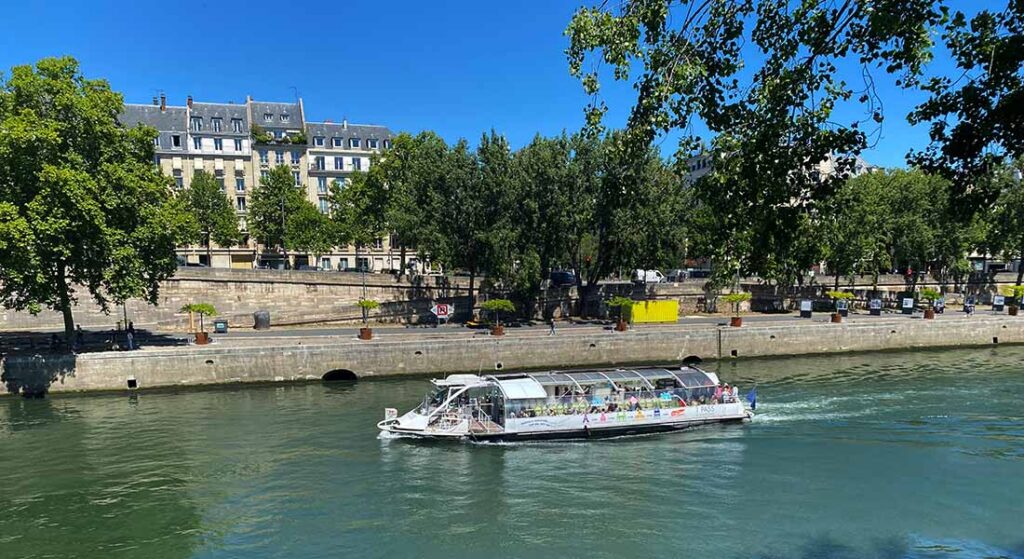
Many different companies offer river cruises along the Seine, and you’re sure to find something at every price point and level of luxury. One of the most popular Paris river cruises is run by Bateaux Parisiens, with multilingual audio commentary and an optional smartphone app with even more information.
In my opinion, a sunset or evening cruise along the Seine is one of the most special experiences you can have while you’re in Paris. Les Bateaux Mouches have hour-long sailings every thirty minutes from the late afternoon into the evening. They also have two nightly dinner cruises (and yes, the menu has a vegetarian option).
If you’re not taking one of the food tours I recommend above, consider the “Crepe and Canal” tour offered by Vedettes du Pont Neuf. Instead of sailing the Seine, you’ll travel down Canal Saint-Martin (see above) while sampling crepes with different spreads and jams.
40. Free Walking Tour
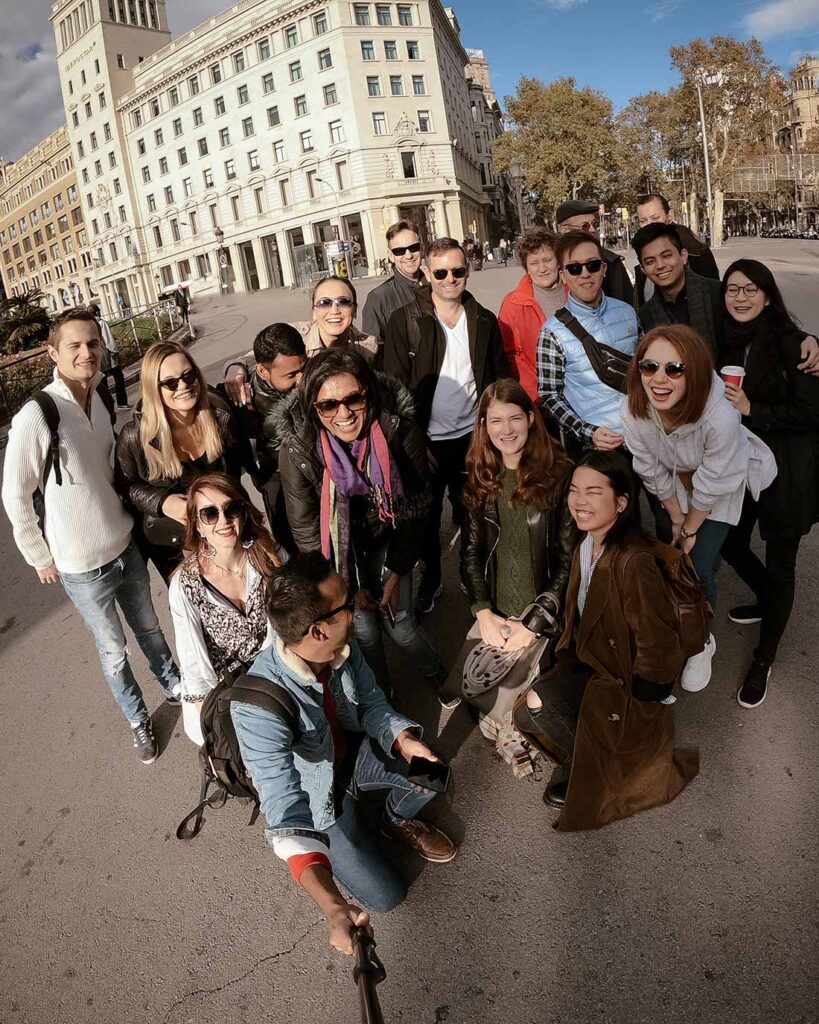
I love taking free walking tours when I travel. I find they’re a great way to meet new people and to get local insight into the city where I’m visiting.
A lot of free walking tour companies didn’t survive the tourism slowdown in 2020 and 2021, but there is one reliable free walking tour in Paris that is available in English, French and Spanish: Sandeman’s Free Paris Tour.
On their three-hour free walking tour you can expect to walk along the Seine, see the Louvre (from outside), visit Notre Dame and learn a bit about the history of Paris as you meander through the Tuileries Gardens.
As with all free walking tours, make sure to leave an appropriate tip for your guide. I recommend at least €10 per person in your group.
41. Hop-on, Hop-off Bus
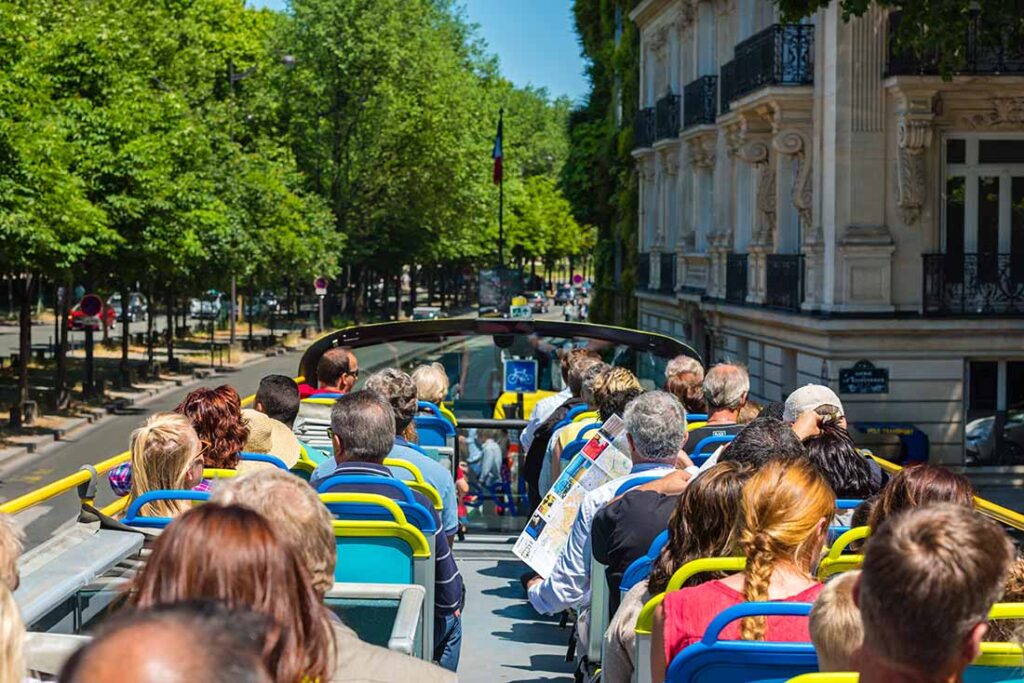
Fortunately unfortunately Paris has an amazing metro system. This makes it tempting to quickly hop around the city on the subway, but spending too much time underground means that you miss seeing the beauty of the city from street level.
The solution is easy – grab a ticket for one of the hop-on, hop-off buses in Paris. Several companies operate similar services, but the most reliable seems to be BigBus Paris. Their route does something of a figure-eight, looping around Île de la Cité towards the Louvre, driving down the Champs-Élysées to the Arc de Triomphe, doubling back towards the Hotel des Invalides and finally heading back to the Eiffel Tower. Along the way, you can hop on and hop off as often as you’d like, with buses operating about every ten to fifteen minutes at publication time.
What to See in Paris: Day Trips from Paris
Okay, I’ll admit these aren’t the best things to see in Paris, but they are the best things to see near Paris. Paris is perfectly located for countless day trips, but in my opinion, these are the Paris day trips that you absolutely shouldn’t miss. (Yes, that does mean you should add five days to your Paris itinerary so that you can see them all!)
42. Versailles
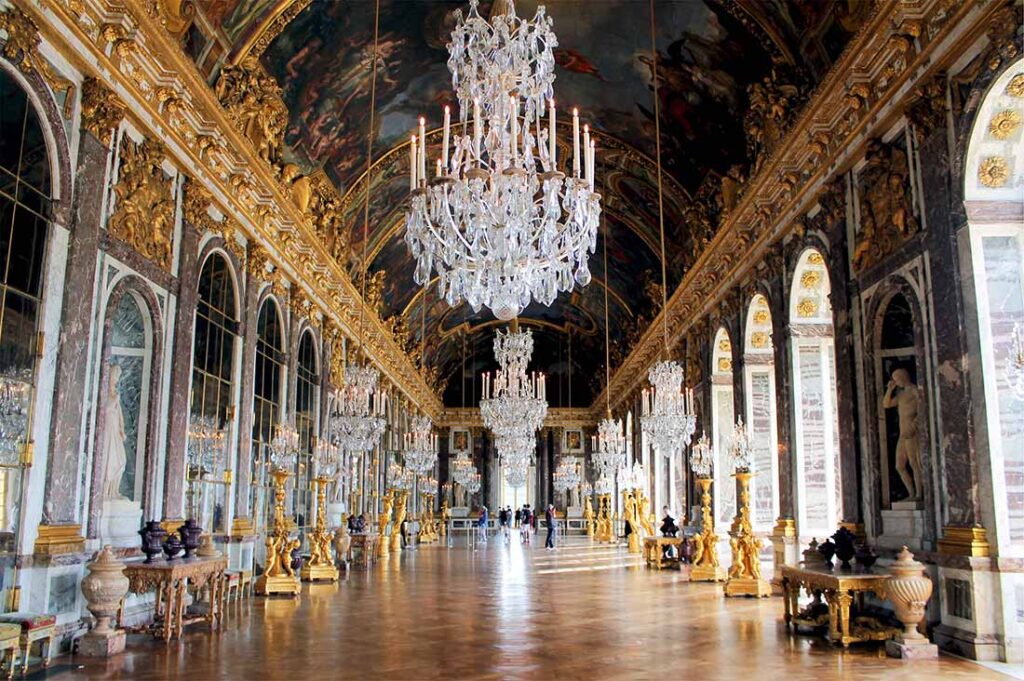
If you’re wondering whether or not to include a day trip to Versailles in your Paris itinerary, consider this your message from above: do it!
There’s a reason this palace and its opulent gardens are one of Europe’s most popular tourist attractions and one of the best things to see in Paris. Nothing compares to the pure, unadulterated luxury of the Sun King’s former palace.
Versailles is included in the Paris Museum Pass, and if you’ve bought the four- or -six day pass this is one of the best ways to get the maximum value from your ticket. The gardens themselves are actually free (unless there’s a special event going on) but your ticket or pass will give you access to the elegant interior of the chateau.
Even with a pass, you must book your entry time online in advance to ensure entry. By mid-morning, the queue to buy tickets is always already full of unprepared travelers – don’t be one of them! Consider joining one of the guided tours to get more insight into exactly how much all that gold cost!
43. Disneyland Paris
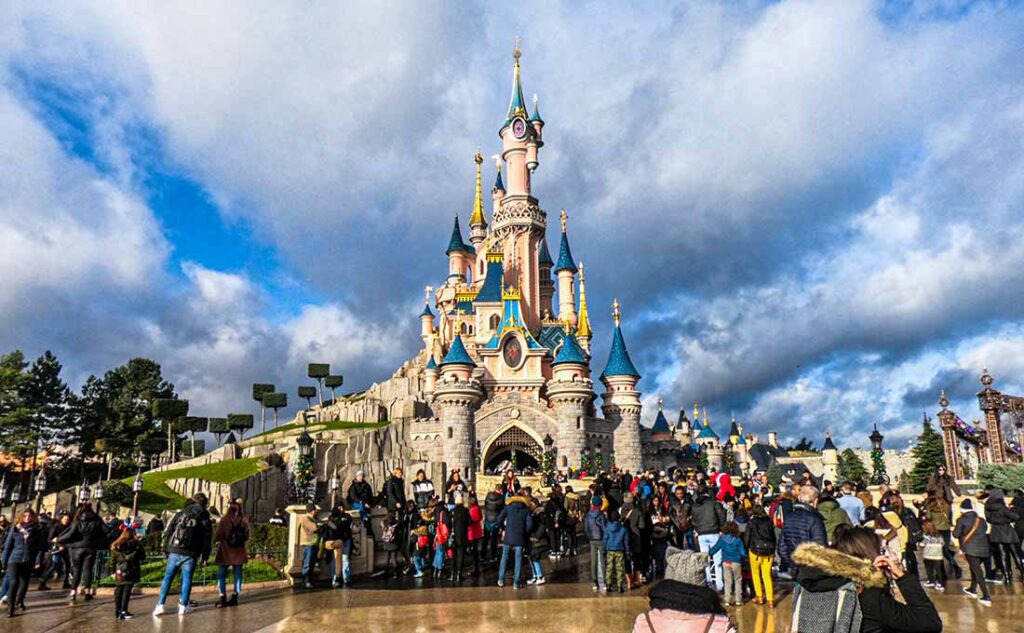
If you’re in Paris with kids, Disneyland Paris is one of the best things to see and do. If you plan in advance, you can purchase a ticket for a high-speed TGV train that will whisk you from CDG airport to the Disneyland station in only nine minutes (from the city center, you can piece together a route on two high-speed trains, or just take a normal train in about 50 minutes).
Formerly known as EuroDisney, Disneyland Paris is home to two theme parks: Disneyland Park and Walt Disney Studios Park. The former features the rides you may know from the original parks in the USA, like Pirates of the Caribbean and the Phantom Manor, while the latter is built around their French film studio, showcases the art of Disney film-making, and also houses some popular rides like Ratatouille: The Adventure.
You can visit both parks in one day, but you may wish to invest in a FastPass to skip the lines (especially if you’re visiting during European school vacations). Buy your tickets online in advance to skip the lines, and download the park’s official app to keep an eye on wait times for each ride.
44. Giverny
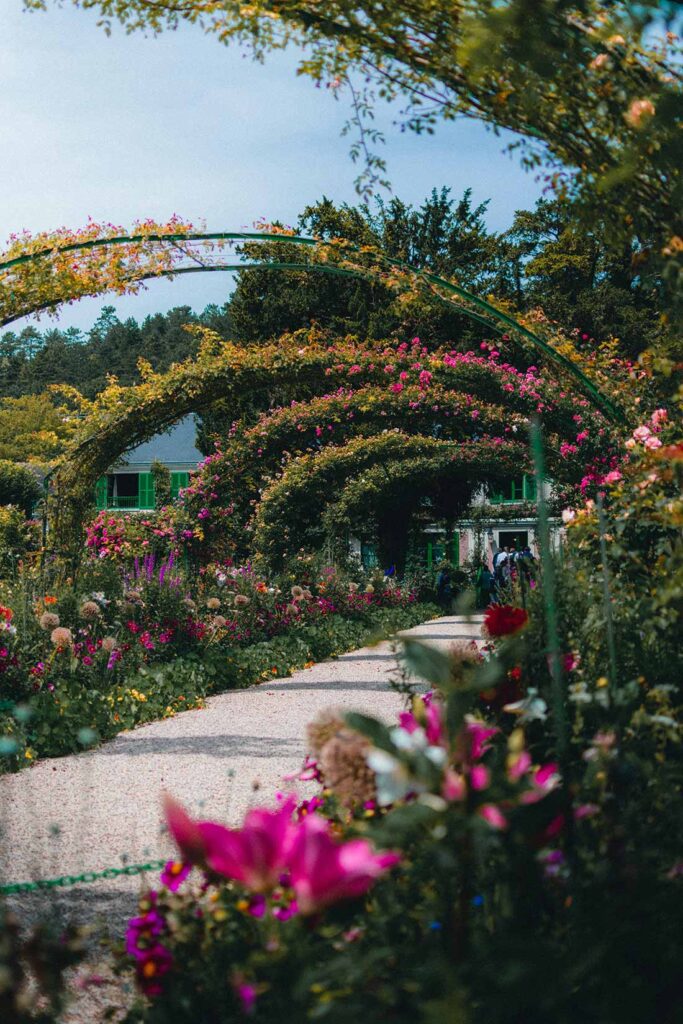
After you visit the Musée de l’Orangerie, you may be inspired to learn more about Claude Monet and the inspiration for his Impressionist paintings of waterlilies. Or, you might just want to escape the crowds of Paris. In either case, you’ll love taking a day trip from Paris to Giverny, the beautiful village where Monet spent the last forty years of his life.
The main draw in Giverny is Monet’s former house and gardens, now a well-preserved museum. The gardens here change with the seasons, but are most stunning between May and September. You can also visit Giverny’s Impressionism Museum, which operates in partnership with the Musée d’Orsay to showcase the movement of Impressionism (including its origins, motivations and legacy).
Giverny doesn’t have a train station. From the nearest train station, Vernon, you can hire a taxi, take a seasonal shuttle bus (check schedules in advance!) or rent a bicycle to make the five-kilometer trip. If navigating those connections seems crazy (I hear you!), look into a guided tour of Giverny from Paris.
45. Fontainebleau
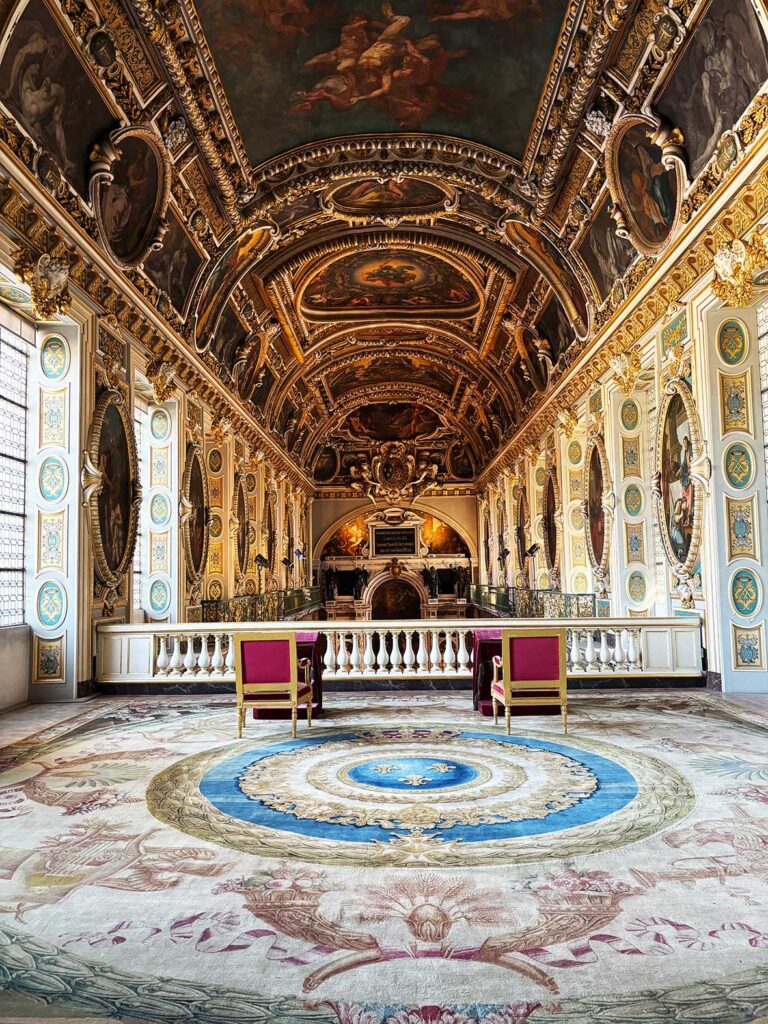
So you want to visit a majestic palace on a day trip from Paris, but you don’t want to fight the crowds at Versailles? Consider taking a day trip to Fontainebleau, a pretty little town with a very large chateau.
Don’t worry about whether or not it will compare to Versailles – Fontainebleau has 1,500 rooms that were decorated by Marie Antoinette using the most expensive decorations of her era. On a self-guided tour you’ll see the former monarchs’ first-floor apartments, which are described as “sumptuous”, “sensuous” and “sophisticated”. Signing up for a guided tour will give you even more access to the rest of the palace.
Fontainebleau is easy to reach by train, and I have a new guide with step-by-step instructions to get you from Paris to the castle gate.
46. Loire Valley Chateaux
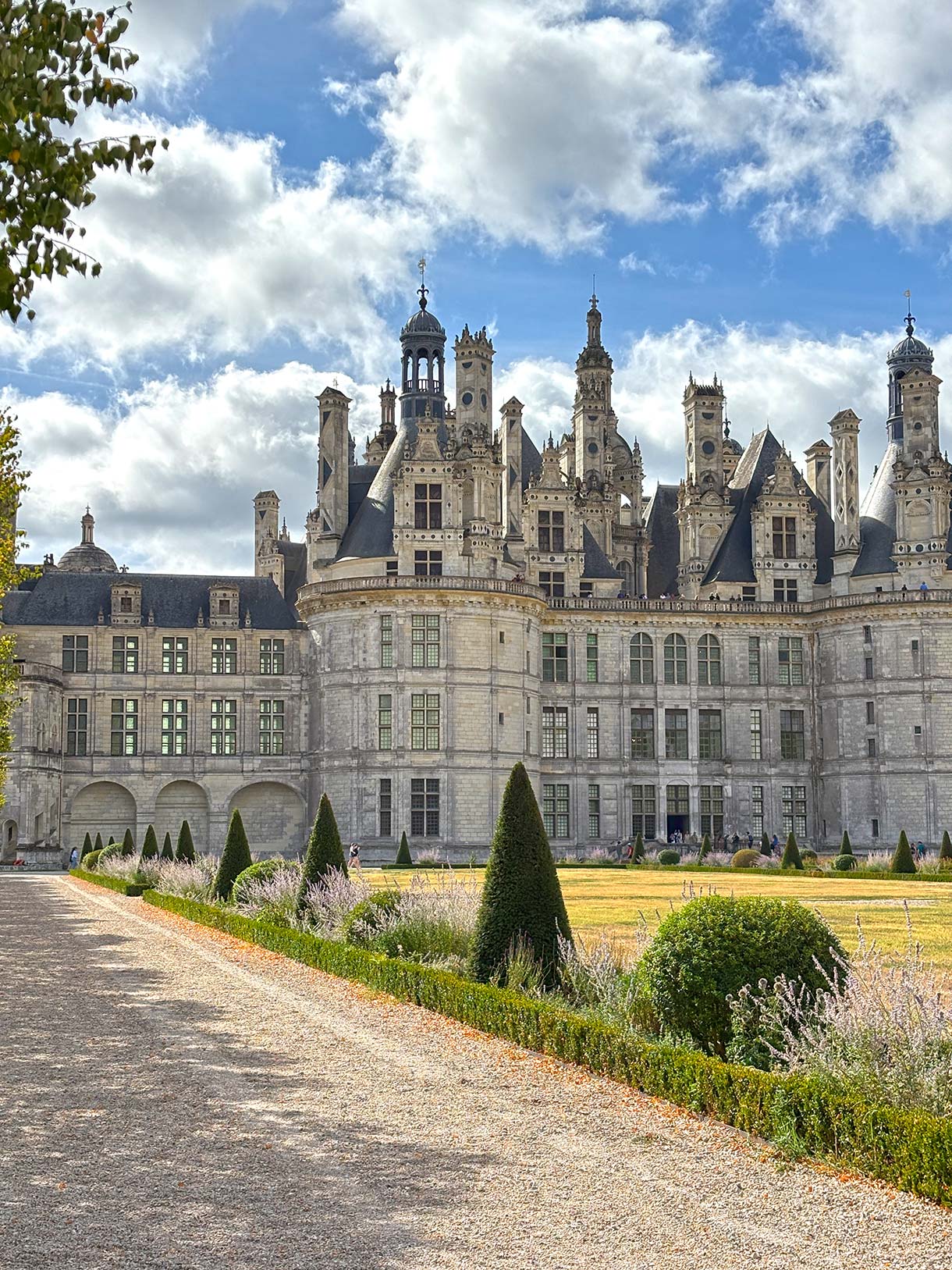
The Loire Valley in France has more than 300 chateaux, and more than 100 of those beautiful castles are open to the public. The easiest way to visit them from Paris to is to take a Loire Valley day trip by bus.
The tour that I recommend is thirteen hours, making for a long day but giving you ample time to explore two famous Renaissance castles and one charming medieval town. It also includes a wine tasting in a sixteenth-century wine cellar. In my opinion, this is the best way to get out to the castles without worrying about renting a car, or being limited by train schedules (which are extremely infrequent and inconvenient in the area).
What to See in Paris: A Few Extra Things to Do in Paris
If that wasn’t enough for you, I have a handful of extra things to see and do in Paris that I couldn’t really categorize into any of the sections above. These are activities that brought me joy on my own trips to Paris, and that I think will make a memorable impression on you too.
47. Shopping – Grandes Magasins
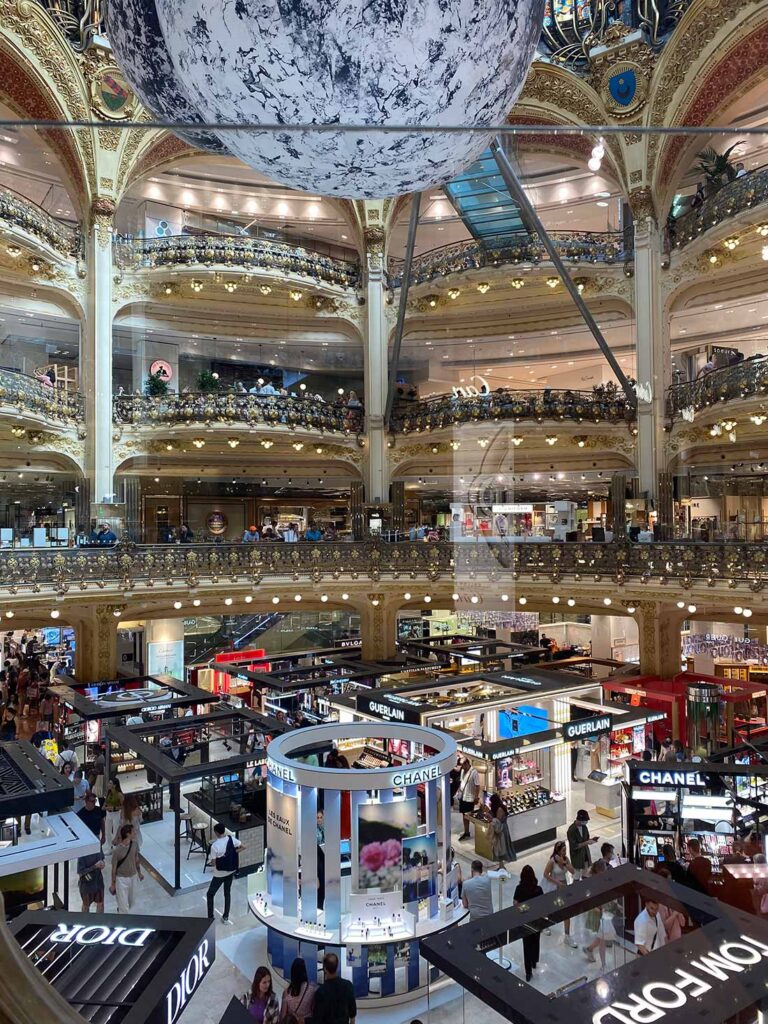
“Grands magasins” is just the French translation of department store, but department stores in Paris truly are grand. These are luxurious flagship stores that exist as much to entice your imagination as they do to make sales. A few that you should consider visiting include:
- Galeries Lafayette Paris Haussmann – My personal favorite Paris department store has an amazing selection of perfumes and staff who don’t mind letting you sniff scents that cost more than my monthly mortgage payment. The rooftop terrace here is open to the public with free admission and there’s a new, free GlassWalk under the dome!
- Bon Marché Rive Gauche – This was the world’s first department store, and today it is owned by LVMH. It’s especially fun to visit at Christmas, when the window displays and decorations are so magical that they are celebrated around the world. This is also one of the best places to shop for niche perfumes.
- La Samaritaine Pont Neuf – If you only have half an hour in your Paris itinerary, you can still squeeze in a quick visit to La Samaritaine, which is located right behind The Louvre at the north end of Pont Neuf. It was closed for seven years for renovations, and only reopened to the public in 2021, so go take a peek at the luxurious new design!
48. Metro Stations
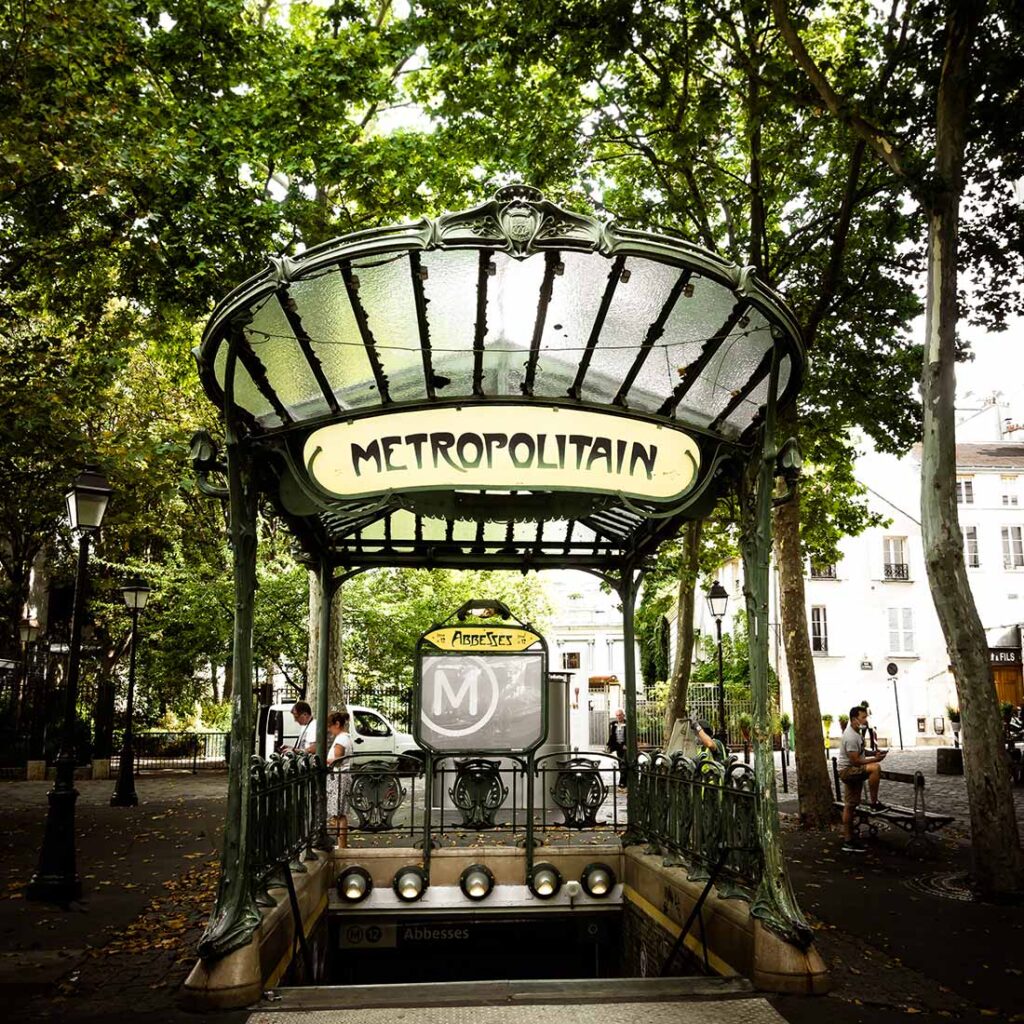
Paris is famous for the beautiful Art Nouveau entrances to many of its metro stations. These were designed by Hector Guimard in the early 1900s, and the ones that remain standing today are now protected heritage monuments.
Some of the most beautiful entrances can be found in Montmartre, including the entrance to Abbesses (shown above) and Lamarck–Caulaincourt (featured in the movie Amelie). At the Porte Dauphine station you can also see one of the pretty butterfly-inspired glass roofs over a metro entrance; only three of these remain today.
Some of the Paris metro stations also have beautiful interiors. The Arts Et Metiers station has a futuristic design (reflecting the focus of the collection of the nearby museum with the same name) and at the Bastille station, the platforms on Line 1 and Line 5 are painted with scenes from French history. If you’re staying in Montmartre, like I was on my last trip, you’ll probably find yourself changing trains at Concorde every day. The tiles on the wall? Those spell out the entire Declaration of the Rights of Man.
49. Instagrammable Cafes

There are a lot of cafes in Paris, and there are also a lot of Instagrammable cafes where the design is just as much a draw as the coffee. Stopping by one of these Instagram-famous cafes for a few selfies or a tabletop flat-lay is a fun thing to do in Paris – and don’t worry, locals do it too!
When you visit any of these cafes, you’ll probably have to wait in a queue and you can expect the prices to be high. Still, for a special event or a one-off splurge, a trip to one of these famous Paris cafes may be worth it. Here are some options:
- La Maison Rose – This Montmartre coffee shop and restaurant has been in operation for more than 100 years, and they haven’t done any renovations in that time. Visiting La Maison Rose is like stepping back in time.
- Angelina – Famous for their indulgent hot chocolate, Angelina’s beautiful Belle Epoque interior was popular with Coco Chanel, who preferred Table 45.
- Au Vieux Paris d’Arcole – Even though this is on the busy Île de la Cité, this cute little cafe never gets too busy. Locals love the facade, which features climbing purple wisteria in the summer and all-in Christmas decorations in the winter.
50. Sit in a Paris Park and Do Absolutely Nothing

I saved the best for last. One of the best things to do in Paris is to ditch your itinerary, throw out your schedule, forget your plans and just relax in the moment.
The best places to do this are in Paris’ many city parks, including Place des Vosges (shown above), the Luxembourg Gardens, or the Tuileries Garden in front of The Louvre. A short metro ride away, parks like Parc Monceau and Parc des Buttes-Chaumont are beautiful parks that are mostly popular with locals, giving you a little break from the tourist track.
Paris has almost 500 parks and gardens, most of which are totally free to enter. Many parks have good seating on benches and chairs that can often be moved to accommodation your group size, the angle of the sun, or your people-watching preferences. Just be aware of the opening and closing hours, as most parks close overnight and the hours depend on the season.
Have you been to Paris? Do you have any favorite things to see and do in Paris that I forgot to include? Is there anything you’re looking forward to on your next trip? Let me know in the comments!
I have a few other articles that will help with your Paris trip planning:
The Best Areas to Stay in Paris
The Best Things to Do in Paris at Night
How to Learn French Before Your Trip to France
All My Articles About Traveling in France
Planning a trip to Paris? Pin this post for later!
 |
 |