
Grocery shopping in Italy can feel confusing at first, but once you get the hang of it you’ll realize that browsing in an Italian supermarket can be one of the most enjoyable activities on any Italy trip. From sampling unique food products to understanding different shopping etiquette, buying groceries in Italy is always an adventure!
I’m an experienced Italy traveler, avid home cook and frequent grocery store visitor. In this guide I’m going to talk about some of the unique products you’ll find in Italian supermarkets, some of the ways that supermarkets in Italy are different from those in North America and the UK, and how to have the easiest, most convenient, most fun shopping trip to any Italian grocery store.

My Experience Grocery Shopping in Italy
Grocery shopping in Italy is something that I have a lot of experience doing! I lived in Turin, Italy for about two years, and in that time I had several Italian roommates. I learned how to shop like a local, and I also had the chance to observe how my Italian roommates shopped.
Since moving away from Italy, I have returned on numerous trips. Because I’m usually staying for a month or longer, I typically rent an apartment (or several apartments) so that I cook some of my own meals, using the ingredients and techniques that I learned to love when I was living in Italy. When I’m at home in Canada I even use a reusable shopping bag adorned with a picture of the Mole Antonelliana!
My most recent trip to Italy was in July 2024, and during this time I rented several different apartments and shopped for groceries all the way from Piedmont to Puglia. I hope the ten tips below will help you feel as comfortable and confident as me when you’re venturing into Italian grocery stores on your next trip!
🍝 If you’d prefer to listen to this article as a podcast, it is now live on YouTube! 🍝

#1 – The Different Types of Grocery Stores in Italy

Roughly speaking, there are four different types of grocery stores in Italy:
- Small supermarkets – You’ll find small supermarkets dotted around most neighborhoods, within walking distance of people’s homes. This is where locals would stop to grab a few things on their way home from work. The most common chains include Carrefour Express, Conad and Crai, but many are also operated either regionally or independently. If your nearest supermarkets don’t have what you’re looking for, you might need to venture further afield to a…
- Large supermarkets – These will often have “ipermercato” in their name, which translates to “hypermarket”. These large supermarkets are usually located outside the historic center and have large parking lots to accommodate people arriving by vehicle for large shops. They have bigger selections and larger quantities.
- Specialty stores – For many Italians it would be sacrilegious to buy bread at the supermarket when there is a beautiful bakery on the same block. The same goes for fruits and vegetables, dairy products and meats, which are still sold at specialized stores.
- Stores selling prepared food to take away – When Italians are too tired to cook after work they don’t go to McDonalds. Instead, they stop at one of the many stores that sells freshly-made food to take away. These shops will often have fresh pasta (to cook at home), salads, grilled or roasted vegetables and meat dishes.
#2 – Be Prepared for Smaller Packages

Back home in Canada, I buy a lot of my basics at Costco. Sure, 12 rolls of paper towels takes up a lot of space, but the bulk-buying discounts are worth sacrificing my spare closet! In Italy, however, people in live in closer quarters with less storage space, so products in the grocery store are often sold in much smaller quantities.
As you can see in the photo above, paper towels are often sold in packages of just three or four small rolls; you’ll find the same for toilet paper. Foods are often smaller too – I’m always on the lookout for a big tub of yogurt but often find that I’m stuck with single-serving containers. And forget about a four-liter jug of milk!
The main advantage of buying groceries in smaller quantities is that you use things up while they’re still fresh, and you’re not left with wasted food that you couldn’t finish before its expiry date. The biggest disadvantage is that it requires more trips to the grocery store, especially if you’re shopping for a family and need multiples of everything.
#3 – Bring Your Own Bag (and Then Bring It Home!)
Like many other countries, Italy limited (or even banned) single-use plastics a long time ago. Grocery stores don’t provide plastic bags – instead they sell reusable bags, compostable bags and/or paper bags… and some stores don’t have any extra bags at all.
You’ll want to bring your own reusable shopping bag when you’re grocery shopping in Italy. I always carry a packable bag like these ones in case I need to pop into any supermarkets while I’m out and about, but for dedicated grocery shopping trips I use one or two large, folding reusable bags.
⭐ One of my top travel tips is to look for cute reusable bags at local supermarkets while you’re abroad. They make awesome souvenirs since they’re lightweight and fold down to almost nothing. Then, when you’re back home and shopping at your boring old regular supermarket, you can look down at your Italian grocery bag and reminisce about your trip! ⭐
#4 – The Bottled Water Selection is Crazy

I’ve only dipped my toes into TikTok, but my most-viewed video over there has 150,000 views, more than 2000 likes and 200 comments. What is it about? Bottled water in Italy!
Bottled water in Italy is a controversial topic. Some people drink exclusively bottled water and wouldn’t think to drink the tap water in their (two-hundred-year-old) homes. Other people live and die by the tap water and argue that bottled water is wasteful and unnecessary. Others still believe bottled water has magical powers and can do everything from help you lose weight to guarantee your path to heaven (okay, I made the last one up).
Clearly, there is a huge market for bottled water in Italy and grocery stores there have a huge selection of both still and sparking bottled water. There are a few tricks for buying bottled water at the supermarket in Italy:
- In most stores it’s frowned upon to open up a sealed package of bottles
- However, if a package is already opened, you can take one or two bottles from it
- Some stores can tape a handle onto the top of a sealed package to make it easier for you to carry home
- The taste of bottled water varies widely, from fresh alpine stream to earthy underground spring. If you find a water that tastes good to you, make note so that you can buy it again later.
- Remember to recycle your empty plastic bottles – there are likely bins in the street, but if you can’t find them you can ask any local for directions
#5 – Fruits and Vegetables Are Often Packaged in Plastic and Styrofoam


This is the #1 thing that drives me crazy about grocery shopping in Italy! Look at those beautiful bananas, already encased in nature’s grocery bag (aka their banana peel). Italian supermarkets go crazy with the packaging, putting bananas on a styrofoam or plastic tray and then further wrapping them in more plastic! What a waste!
It’s not just bananas that you’ll find encased in layers of packaging. Tomatoes often come in packages of three or four, shrink-wrapped so that you can only see one side of then, and even sturdy produce like peppers, apples and oranges are all sealed up.
If this bothers you (like it bothers me) then I’d recommend buying your produce from a street market or greengrocer, where you should be able to pick the pieces you want (or the workers will show you each piece before bagging them).
#6 – Weigh Your Own Produce

I remember the first time I went grocery shopping in Italy and I brought a basket full of loose fruits and vegetables to the cash register, carefully placing them on the conveyor belt as though each one was as delicate as a piece of Murano glass… only to have the cashier shout at me, wave her arms, roll her eyes and basically act like I’d just defaced the Mona Lisa. I had committed the cardinal sin of Italian grocery shopping: I had not weighed and stickered my own produce.
If your fruits and vegetables don’t have a price on them, there’s a 90% change you need to weigh them yourself on one of the scales in the produce section. Unlike US and Canadian supermarkets, Italian cashiers don’t weigh produce at the point of sale. Instead, shoppers weigh their fresh foods and the scale prints out a price sticker that you affix to the foods.
The scale should look something like the one shown above. Scroll through the pictures to find your items (or check for a code on their price tag on the shelf), put the items on the scale, hit the “Enter” button and wait for the price sticker to emerge. Most stores expect you to put the products into a plastic bag first, and then use the sticker to seal the bag closed, but if you’re like me and hate using even more plastic then you might be able to get away with putting the sticker right on the food item (especially for something simple like some bananas).
#7 – More Products to Pick Up
If I have a kitchen in my Italian apartment rental, there are a few basic food products that I pick up upon arrival:
- Fresh pasta! My favorites are filled pastas like ravioli and tortellini that are stuffed with vegetarian ingredients such as pumpkin, mushrooms, spinach and/or cheese.
- Butter, which I lightly brown and use as a pasta sauce.
- Frozen minestrone soup mix. This is a quick and easy veggie-packed meal on a cold night, or when you don’t feel like making a salad. To make it even more flavorful stir in a teaspoon of basil pesto.
- Jam and soft cheese, to spread on fresh bread for breakfast.
- I also buy yogurt for breakfast, especially if I can find pistachio or almond flavors.
- Mulino Bianco Macine cookies. These are my favorite cookies on the planet. They’re an Italian interpretation of shortbread, made from real cream, and perfect for dipping in your coffee or tea.
#8 – Italian Supermarkets Are Perfect for Souvenir Shopping!
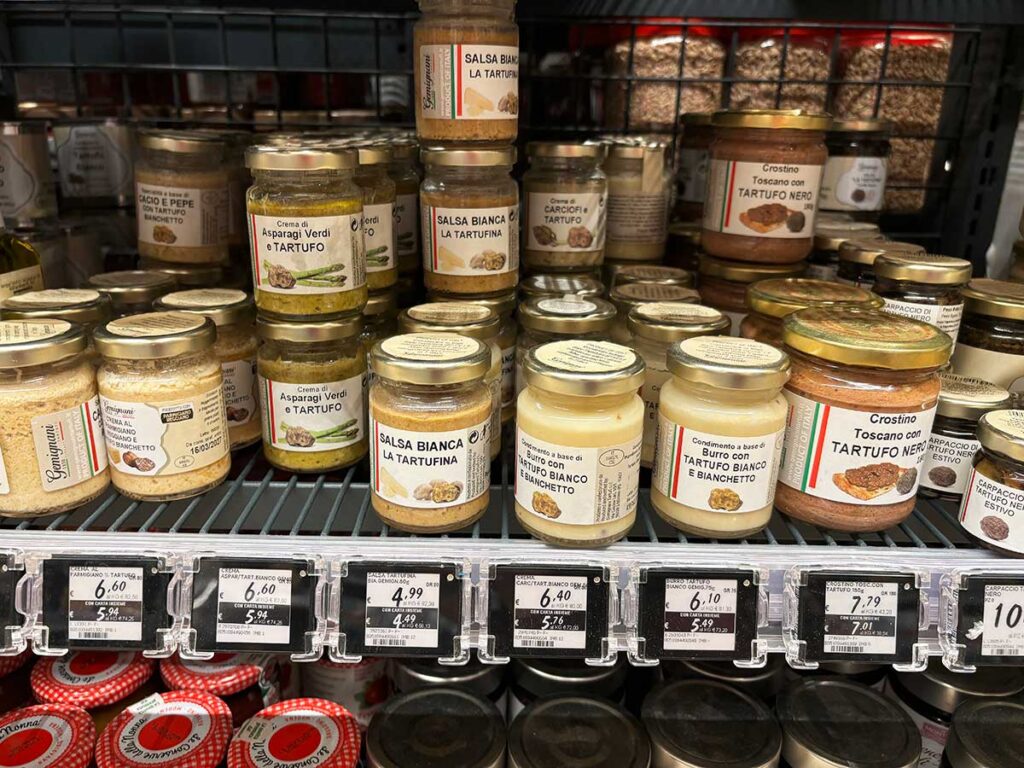
Look, I love gourmet supermarkets in Italy like Eataly, but when it comes to shopping for souvenirs I prefer to head to a normal grocery store.
Most grocery stores in Italy will have an excellent selection of shelf-stable products that you can easily transport back home as souvenirs and gifts. I always start in the condiment aisle, where you can find things like truffle cream, pesto sauce, jarred olives and other little touches that will enhance the flavor of many different dishes.
Dried pasta also makes a great souvenir, but there’s no point bringing home the same Barilla pasta that you can buy at home. Look for pasta made in the typical local shape (for example, orecchiette in Puglia or trofie in Liguria) or with fun local ingredients blended into the dough.
Other things I often bring home from regular Italian supermarkets include bars of chocolate, almond and pistachio liqueurs, and even saffron (I think it’s cheaper because it’s a common ingredient in risotto milanese).
Before transporting any food products outside of Italy, be sure to check the customs regulation of the country where you’re heading!
#9 – Italian Supermarkets Have Epic Liquor Selections!
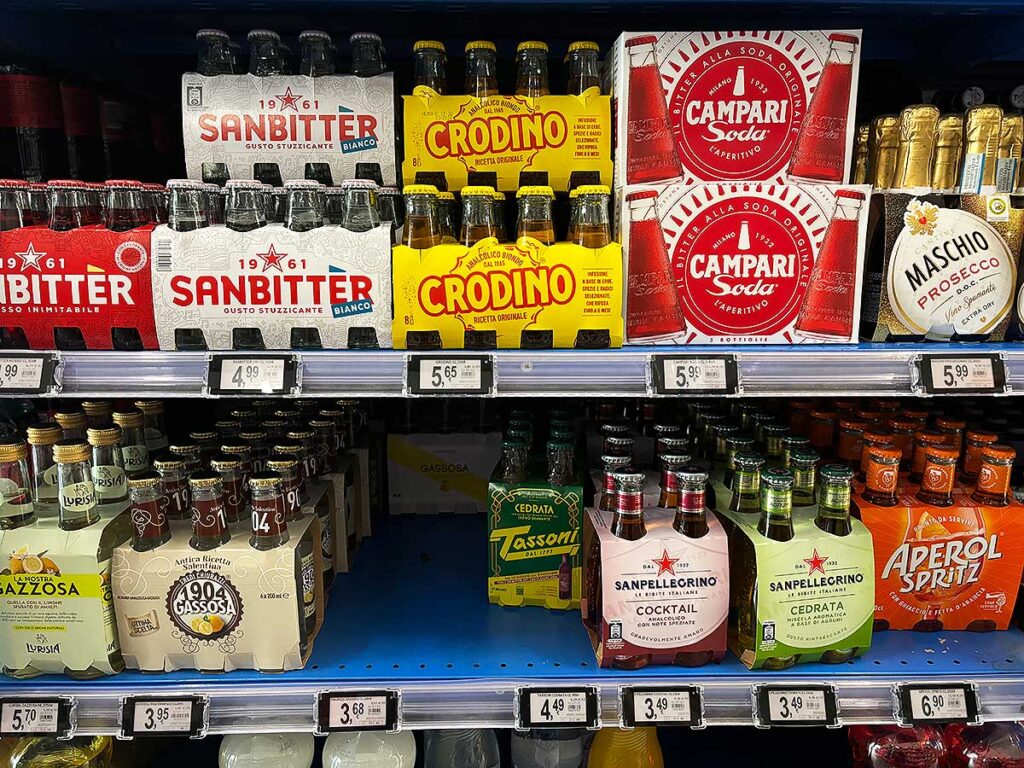
Can’t justify spending €10 on another Aperol Spritz? Head to the nearest grocery store, where you should be able to find an exciting variety of pre-mixed spritzes along with other apertifs and cocktails, ready to be chilled and served. Some already contain alcohol, like the three-pack of Aperol Spritz for €6.90 that is shown above. Others, like the adjacent San Pellegrino cocktails, are “analcolico”, or without alcohol, and can be enjoyed alone or with your own alcohol mixed in.
Italian supermarkets also have great wine selections, typically with a focus on very local wines, along with beer and spirits. The legal drinking age in Italy is 18, so as long as you’ve graduated from high school you should be able to cut down costs on drinking by visiting a local grocery store.
#10 – Use the Self-Checkout Like a Pro

So you’ve found all the pasta, cheese, chocolate and wine that you need? It’s time to check out, either at a cash register or at the self-check-out.
If you choose to take your groceries to the cashier your experience will probably be similar to in your home country. The cashier will probably ask you if you have a loyalty card and/or if you need a bag. They won’t put your purchases in the bag, though, so keep the line moving by bagging as your items get scanned. You can pay with credit cards or cash, though the store might not be willing or able to accept a large bill…
… which brings me to the automated check-out! These are one of the best places to get change for large bills in Italy, so I always try to use them after the ATM (or bankomat in Italian) gives me a €50 bill. If you’re lucky the screen will have a flag icon that allows you to change the language, but even if it doesn’t the process doesn’t vary much from the rest of the world.
You’ll need to scan each product (make sure it shows up on the screen so the store doesn’t call the carabinieri!) and move it to the opposite side of the machine. If you want to pay with cash then you’ll slide bills into the narrow slot and drop any coins into the curved hole. Your change will come out below, and the receipt will likely come from somewhere near the card reader. Hold onto your receipt because you may need to scan it to open the exit gate on your way out of the supermarket.
Planning a trip to Italy? Pin this post for later!
 |
 |