
Once known as “The Shame of Italy”, today Matera has rightfully earned its renewed reputation as one of the most beautiful – and interesting – cities in Italy. Continuously occupied since the Paleolithic era, Matera is richly steeped in history that you see around every corner and feel with each footstep. Matera is simultaneously raw and elegant, hopeful and sad, and it was easily in the Top 3 cities I visited on my last trip to South Italy.
Technically speaking Matera isn’t in Puglia – it’s actually in the neighboring region of Basilicata. However, its proximity to Bari, Polignano a Mare and Monopoli make it an ideal side trip from northern Puglia. On my recent trip to the region I spent three nights in Matera. While some people do choose to visit Matera as a day trip I was glad that I had the opportunity to see the city by day and by night, and to have enough time to really take in some of the attractions that aren’t on every visitor’s radar.
Below, I’m going to highlight fourteen of my favorite things to do in Matera – not everything made the cut, but these activities are definitely worth your time!

Take Walking Tour of the Sassi
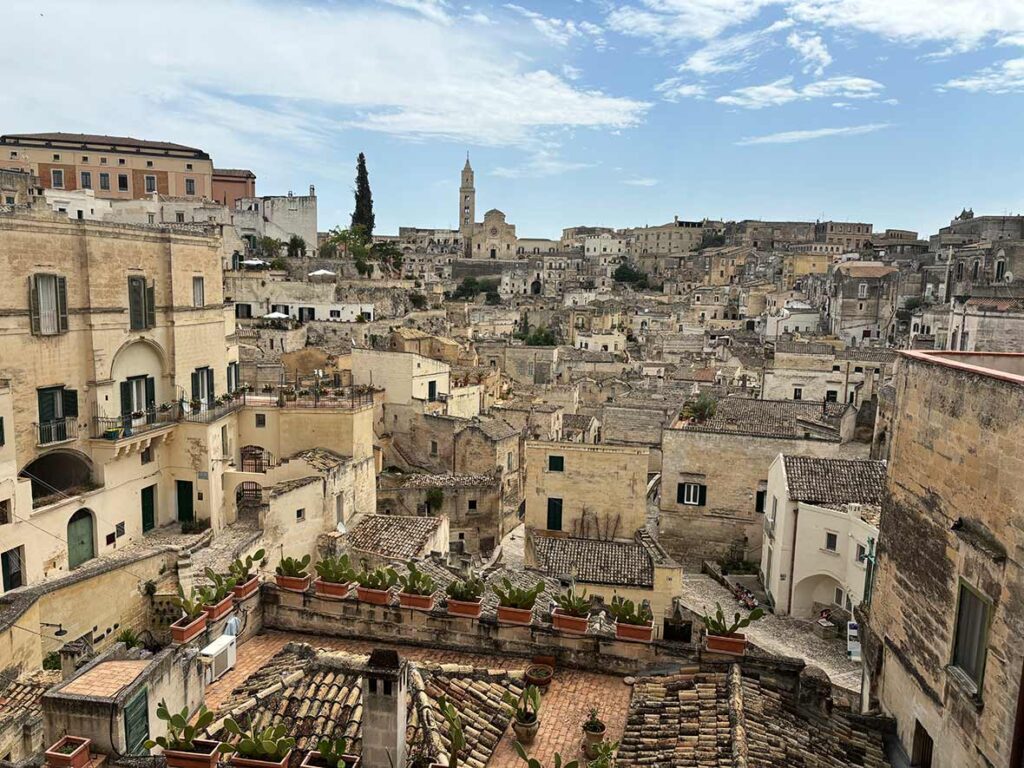
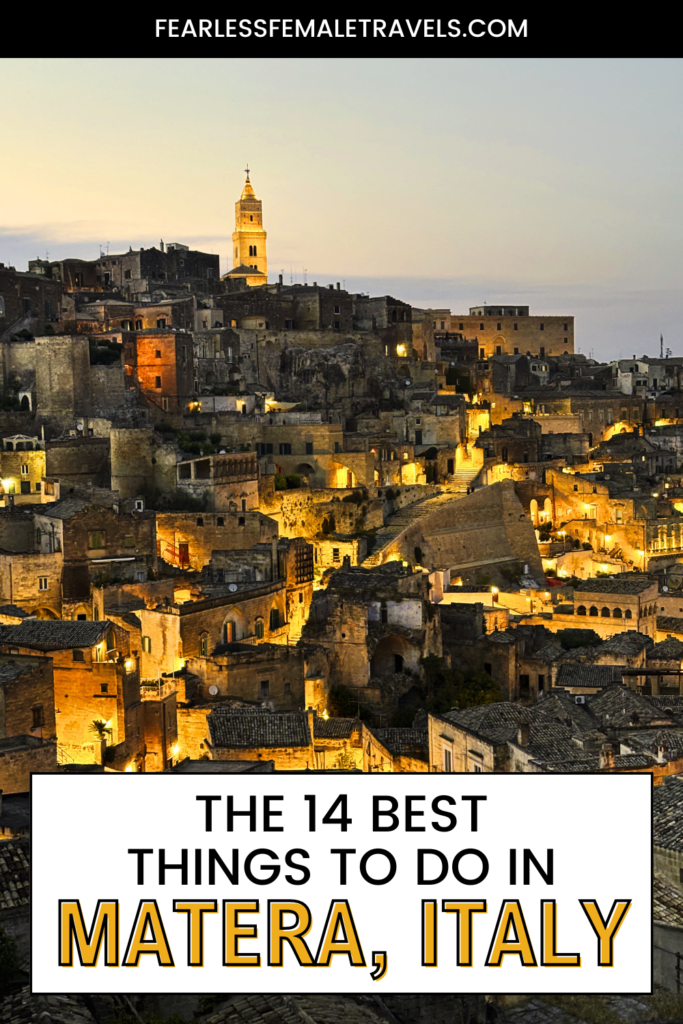
I started my first full day in Matera with a guided walking tour of the sassi, or cave, district. As you can see from the photo, the historical center of the city is built on a steep hill and organized around a labyrinth of stairs and alleys. Starting your visit with a guided tour helps you understand what you’re seeing in the cave zone, and it also ensures you follow a logical route without too much backtracking uphill.
The tour that I took started in the modern city center (at the top of the hill). We then walked to one of the panoramic lookout points (see below) before descending into the sassi. Along the way we learned about the history of the city, the construction and uses of the caves, how people lived as part of cave communities and how the sassi went from being homes to being abandoned to becoming tourist attractions.
Our tour also included entrance to a cave house museum (I also visited one independently) and the ruins of a cave church. Overall, the guided walking tour took just under three hours and equipped me with the information that I needed to understand what I would see for the rest of my visit.
Pick up the Cave Church Pass
This was actually a mistake I made on my own trip to Matera. I thought to myself, “How many cave churches will I actually want to go inside? I’m sure one will be enough.” Of course, I quickly realized that I actually wanted to go inside all of them, but by then I’d missed out on the value that I could have got if I’d paid for the city’s all-inclusive church and museum pass.
For €25 (in Summer 2024) you could purchase a single ticket that includes entry to three cave churches, one cave house museum (see below), one underground water cistern (see below) and a few other attractions. This is a good value and I regret not buying it at the first included site that I visited.
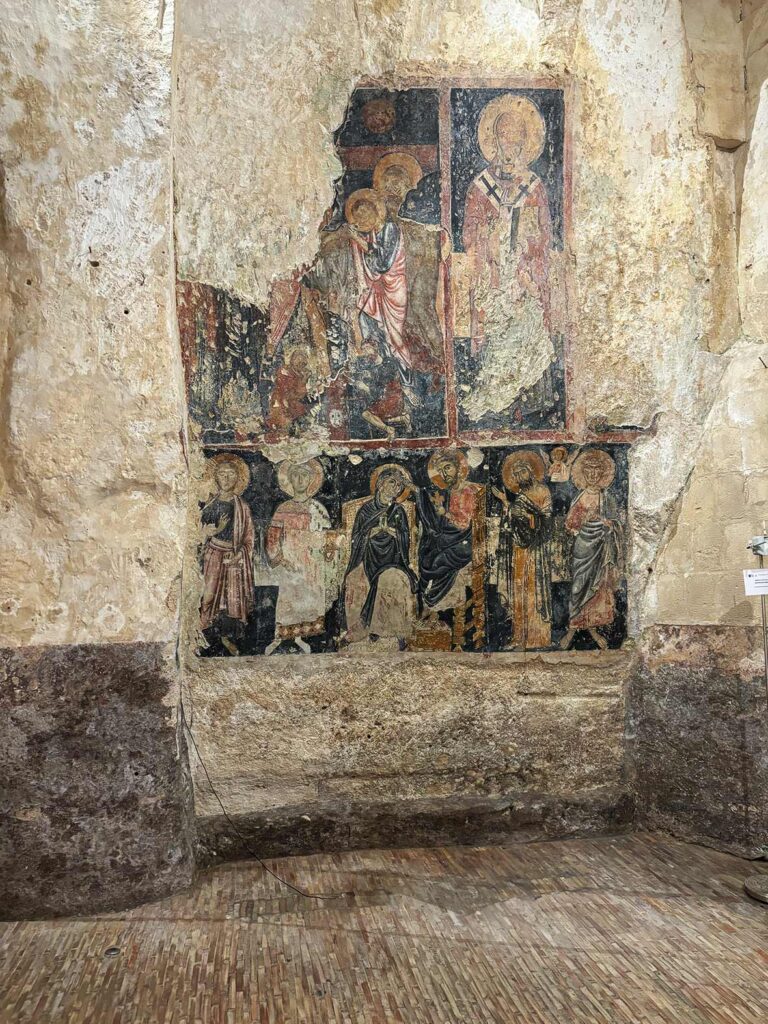
The first cave church I visited was Santa Lucia alle Malve, which is located at the bottom of the historical center, near the canyon. Dating back to the 700s, this Rupestrian church is notable for its well-preserved frescoes (top photo) from the early middle ages. This is a small church and you’ll only need five or ten minutes to see the interior.
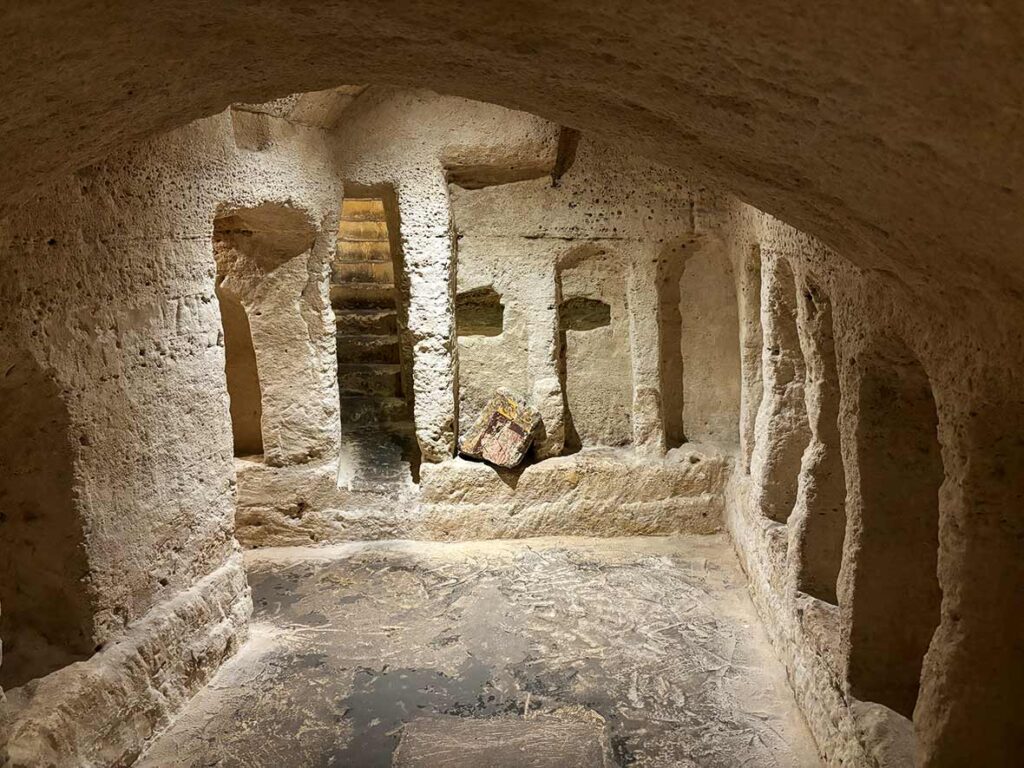
The cave church that I enjoyed the most was San Pietro Barisano. The largest cave church in Matera dates back to the 1100s and has two levels that are open to visitors. The ground floor features several intricate altars carved from stone. Beneath the altars you can descend into the subterranean sepulchre (bottom photo), where the corpses of priests who had passed away were (historically!) left to drain of all their liquids. It was definitely one of the creepiest places I’d ever visited!
Note: Photography is not permitted in the cave churches but I took photos anyways because I was annoyed with the ticketing and security staff listening to pop music on full volume inside the churches. I figured that discreetly taking a photo was approximately one million times less annoying than listening to Italian techno music on repeat in a sacred historical site.
Go Inside Chiesa San Pietro Cavoso
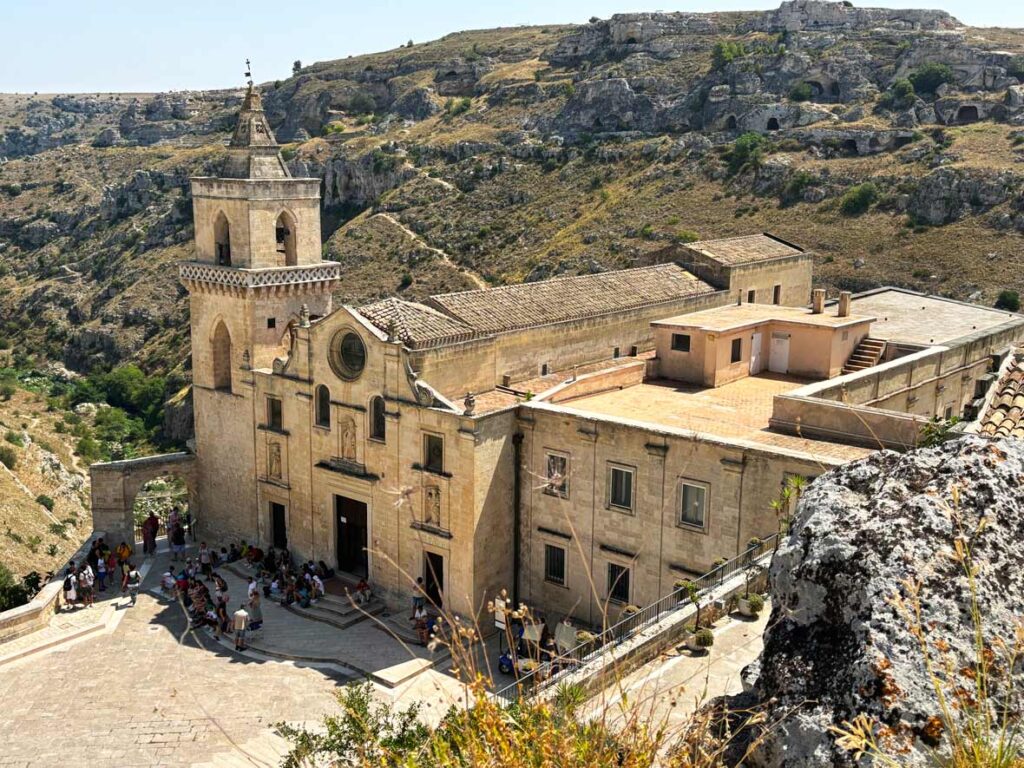
One of the most spectacular churches in Matera isn’t located in a cave, but rather at the bottom of the historic center, perched on the edge of the canyon. San Pietro Cavoso (not to be confused with San Pietro Barosano, above) is an unmissable landmark that can be seen from all around Matera.
This Baroque church was constructed in the fourteenth century, although much of the interior is more recent. To the left of the entrance is one of the best panoramic lookout points in the city (see below), and to the right you’ll find access to Santa Lucia alle Malve (see above). When I was in Matera in July 2024 the temperature was close to 40° Celsius every day, and simplistic interior of this church was both free to enter and welcome respite from the heat.
Enjoy the Panoramic Lookouts

Matera’s famous caves are situated downhill from the modern town center, allowing for a number of spectacular viewpoints of the stone houses and caves that tumble down the hill.
The first panoramic viewpoint in Matera that I stumbled across was Belvedere di Piazza Giovanni Pascoli, which is near the National Musem of Matera. From here, at the south of town, you can look north across the whole sassi area, all the way to the Cathedral tower.
Another easy-to-access panoramic viewpoint in Matera is Belvedere Luigi Guerricchio, also know as the “Three Arches”. This lookout point is more central, so it’s great for taking panoramic photos that span the sassi from north to south (or vice versa). The arches themselves are quite contemporary so they don’t create much of a photo-framing opportunity, unfortunately.
There are several other panoramic lookout points around the historic center of Matera; many are marked on maps while others are just happy coincidences where a break in the caves and stone happens to create a beautiful view.
Shop for Typical Products

My favorite souvenir to bring home from Italy is always food. The sassi districts of Matera are home to numerous gourmet regional food shops where you can find local foods to bring home with you (or to prepare in your vacation rental!). The shop that I visited the most was La Grotta della Petrarola, which featured two levels of local ingredits.
A few dishes that you might want to consider shopping for include:
- Crusco – A prodotto agroalimentare tradizionale that can only come from the region of Basilicata, these crispy, dried, sweet bell peppers add a delicious flavor and pleasing texture when they are added to pizza, pasta, soup, stew or meat as a garnish right before serving.
- Taralli – Somewhere between a cracker and a little breadstick, these Southern Italian snack foods come in both sweet and savory versions.
- Dried pasta – In South Italy, dried pasta is typically made without eggs and thus travels well. Stock up on local pasta shapes like orecchiette and cavatelli.
- Condiments – Jarred pasta sauces, along with both sweet and savory spreads, travel well (although they can be a bit heavy). Ask the shop staff which ones are made with hyper-local ingredients.
If you’re not a foodie, don’t worry! There’s another iconic Matera souvenir that you can bring home for yourself or your loved ones: the cuccù. Shaped like a rooster, these handmade ceramic whistles are rich in local lore. Some people believe they have magical powers, others believe they are good luck symbols, and yet others consider them symbols of love and fertility. You should be able to find a small cuccù for about €5, while larger and more ornate versions can run you closer to €100!
Go Underground in a Cistern

For centuries, residents of Matera relied on a complex system of underground cisterns to provide water for their homes, families, animals and businesses. These interconnected cisterns were surprisingly technologically advanced; although they were each dug by hand, they were designed and engineered in such a way to ensure no water would be wasted. As the cisterns towards the top of the hillside sassi filled to capacity, the excess water flowed through sloped channels to fill the cisterns further down the hill.
Today, several cisterns are open to the public. I visited the Palombaro Lungo, a cavernous underground well that opened to the public in the 1990s. When it was in use, Matera’s largest cistern could hold more than five million liters of water. With ceilings towering 18 meters tall and metal walkways suspended just inches above the water, a €3 admission ticket to the cistern is worthwhile simply to see the scale of the city’s former water system.
Taste Some Pane de Matera


Italy takes its food seriously, with three different labels to protect the origins, ingredients and preparation of traditional foods. One local Matera dish to earn the title of IGP, or “protected geographical indication” in English, is pane de Matera – Matera Bread.
It’s impossible to miss the pane de Matera, as loaves are places in the street for decoration and almost every restaurant serves a basket of it with your meal. It’s huge, it’s dark brown on the outside and it’s pale yellow on the inside. It’s made from durum wheat semolina flour and fermented with yeast derived from local fruits. And, historically, pane de Matera was baked in communal ovens, stamped with each family’s special seal so it could be easily identified when it was ready.
For those with the time and inclination, €3 gets you admission to the Museum of Bread near the top of the sassi. Inside the museum you can learn more about the history, ingredients and traditions of pane de Matera, with good signage in both Italian and English.
Go for a Hike in the Canyon
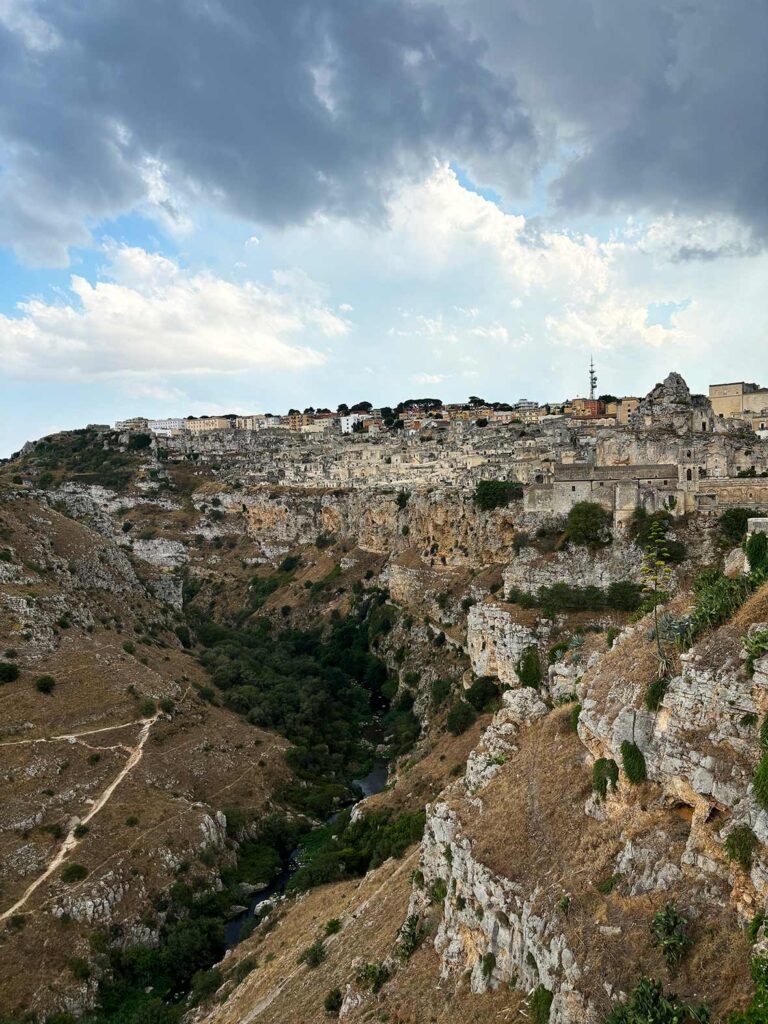
At the bottom of the sassi district you’ll find the Gravina River canyon, a deep crevice in the stone that separates the historic and modern city center from the most ancient cave dwellings on the opposite side. For traveler with good footwear and hiking experience, an adventure into the canyon could be a highlight of your visit to Matera.
To hike into the canyon you can find the trailhead on Google Maps here. If it looks closed check the date that the Google car drove past – Google Street View is showing me a photo from 2016 where the trail is closed, but I was there in 2024 and it was definitely open. It’s a clear, easy-to-follow path from the street down the canyon to the suspension bridge across the river, and then back up the hill on the opposite side to the once-inhabited caves and the panoramic viewpoint of the sassi.
The only thing you need to keep in mind that is what goes down must come up. There’s no protection from the elements on the trail, so avoid hiking in the heat of the day and/or if there is rain in the forecast (as the trails are prone to flash flooding). The walk takes about one hour each way, and then you’ll want to add on more time for exploring.
If you want to get the view from across the river without the hike, this tour by minibus ends with a sunset photo stop overlooking the canyon. It’s also accessible by car if you have a vehicle with you.
Understand a Typical Cave House
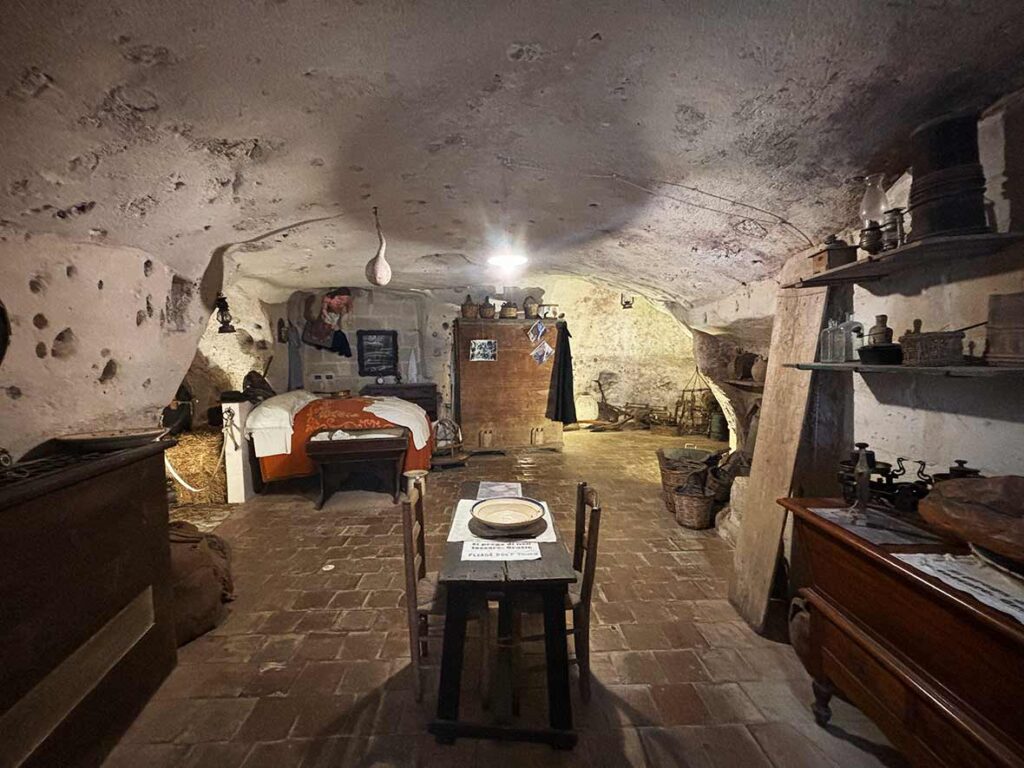
When we talk about people living in the caves in Matera, we’re not talking about the Middle Ages. People lived in traditional sassi cave houses in Matera well into the 1950s. It was only with the publication of a tell-all book designating the city as “The Shame of Italy”, followed by a visit from an appalled Italian prime minister, that the caves were abandoned in favor of newly-constructed apartments and houses at the top of the canyon.
Some Matera residents remained proud of the sassi district and the unique lifestyle that had been the hallmark of Matera’s community for centuries. So, when people were eventually allowed to return to the sassi, they converted their former family homes into house museums. There are several of these museums around the historic center, and through a combination of reconstructions, simulations, audio guides and written information visitors can come to understand what life in the caves was like.
I visited two cave house museums and both were similar, so I think you’ll be fine to just visit whichever one you happen to notice as you walk by. Inside, expect to learn how large families lived together in small spaces, often alongside animals like donkeys, pigs and chicken. You’ll learn how they stored and prepared food, how their sanitation systems worked (or didn’t work) and how community played an important role in sustaining this unique way of life.
Relax at a Cave Spa

Now this is probably one of the coolest and most unique things that I did in Matera! I love visiting spas when I travel, and on my second full day in Matera I had a thought – “I wonder if there are any spas in caves here?”
It turns out there were at least two underground cave spas in Matera, and one had availability for later that afternoon. Located inside the Locanda di San Martino hotel, the Ancient Termae Romanae features a sauna, steam room and dual-chamber swimming pool with a hidden whirlpool at the end. There were only a handful of other people there when I visited, so it was a very relaxing and tranquil environment.
Admission to the spa at Locanda di San Martino was €30 for 90 minutes, and included a bathrobe and mandatory swimming cap. You’ll probably also want to bring an extra towel to dry off, flip-flops and whatever extra personal care products you need to feel presentable when you get out of a pool, as the change rooms are small and minimally equipped.
Take a Tuktuk Tour

Matera can be a challening destination for anyone with mobility limitations, as the most interesting parts of the city are built on steep hills and access is via long, uneven stairways (usually without handrails), slippery cobblestones and craggy sidewalks.
A great alternative to exploring Matera by foot is exploring Matera on a guided tuk-tuk tour. You’ll hop on board a typical Italian Calessino, first taking in the sights of the new city center before descending into the ancient cave district. The driver will stop at the best panoramic photo lookouts, and share information about the landmarks you pass along the way. Of course, the best part is that you won’t have to trek back up to the top of the hill when you’re done – your driver will whisk you right back to where you started!
Wonder at Matera by Night

Seriously, the view from Matera’s panormic lookout points never gets old… and it only gets prettier as the sun sets. It’s definitely worth walking down into the sassi as dusk falls and the lights begin to turn on, as the city becomes truly magical. This is also a great time to stop for a glass of wine, an Aperol spritz, or a plate of local foods.
Once darkness has truly fallen, the sassi district quiets down. Locals tend to prefer to spend their evenings in the more modern streets along the top edge of the canyon, with people gathering in both Piazza Vittorio Veneto and along Via Ridola. Grab a gelato and join the locals for their evening stroll.
Eat in a Cave Restaurant
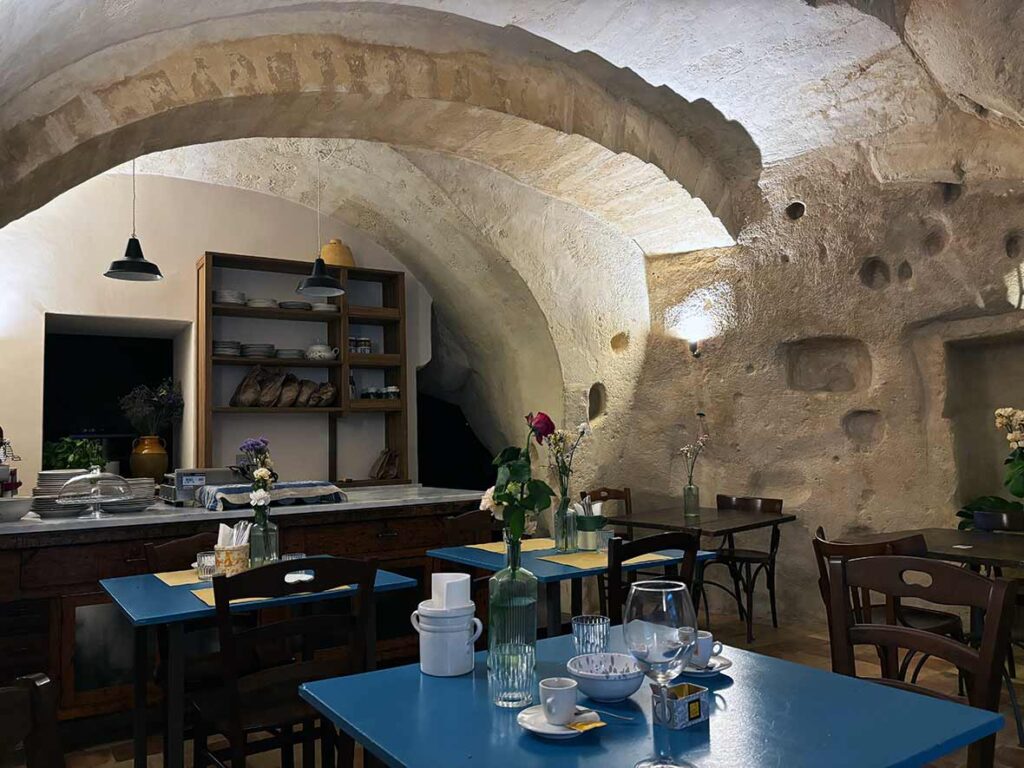
Speaking of Matera at night, one of the most iconic things to do in Matera is to enjoy a meal in one of the cave restaurants carved into the sassi. Options range from the Michelin-recommended Baccanti to the restaurant-cinema hybrid La Lopa. Whether your want to go upscale or homestyle, you should reserve your table in advance as the best cave restaurants fill up each evening.
Typical local dishes that you might want to try in Matera include:
- Cialledda – Matera’s version of panzanella, this bread salad features cubes of pane de Matera and fresh local vegetables.
- Fave e Cicorie – If you like hummus you have to try this dish from Matera, which is made from mashed fava beans topped with cooked chicory.
- Crapiata – Hailing from the sassi district, this stew made from assorted beans and grains is the perfect representation of cucina povera.
- Pignata – This dish can be prepared many ways, but it always involves some kind of stew cooked in a clay pot, often with a “lid” fashioned out of bread dough that cooks as the stew simmers.
I had one dinner in a cave restaurant that was recommended to me in a Facebook group – the restaurant was called Conzato. They are a small plates restaurant so unfortunately it was prohibitively expensive for me as a solo diner, but if you’re a couple, group or family you’ll love sharing their regional dishes made with the freshest local ingredients.
Stay in a Cave Hotel

Last but not least, let’s talk about how sleeping in Matera can become an iconic activity in itself! Although few locals live in caves today, many of the former cave houses have been renovated and reopened as unique cave hotels. Carved into the side of the hill these hotels now feature modern amenities in ancient surroundings.
During my stay in Matera I took note of all of the cave hotels that I would consider staying at on my next trip to the city, and I compiled them in my Matera hotel guide. The list includes luxury hotels, intimate guesthouses, apartment rentals inside caves and a few other properties you might want to consider as well.
Prefer to listen? The podcast version of this travel guide is now on YouTube!

For more information about getting to and from Matera without a car, check out my Matera transportation guide.and my list of the best cave hotels in Matera.
You’ll probably also like these other Puglia travel guides:
🗺️ One Week in Puglia: An Easy Itinerary by Train and Bus
🌷 Things to Do in Bitonto, Italy
🏖️ The Most Beautiful Beaches in Monopoli, Italy
💎 The Best Things to Do in Alberobello
🍷 My Favorite Things to Do in Locorotondo, Italy
💫 The Best Things to Do in Lecce, Italy
Planning a trip to Matera? Pin this post for later!
 |
 |